Tet celebrated abroad

Vietnamese living abroad are celebrating the Lunar New Year (Tet) celebration - the most important traditional festival of Vietnamese people.
Tet celebrated abroad ảnh 1Staff at Quyet "Pho" restaurant in Tokyo make "chung" cakes. (Photo: VNA)

Hanoi (VNA) – Vietnamese living abroad are celebrating the Lunar New Year (Tet) celebration- the most important traditional festival of Vietnamese people.

Dang Huy Quyet, owner of a restaurant selling “Pho” (noodle soup)- one of the traditional dishes of Vietnam – in Tokyo, and his employeesprepared 70 Tet gifts, including “Chung” cake and “Gio” (steamed pork paste) togive to Vietnamese students living in his neighbourhood.

Quyet said that having lived in Tokyo for 15 years, heunderstands the difficulties that Vietnamese expatriates usually face and theirhomesickness during traditional celebrations like Tet. He said he hopes to bring a feeling of Tet to them.

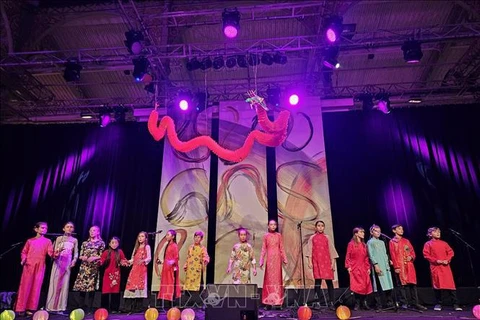
Meanwhile, an event to honour the beauty of theVietnamese language was held in Vientiane, Laos, on February 7.

Vietnamese musical and poetry works were introduced atthe event, helping the Vietnamese community in Laos and Thailand, as well as and Lao peoplewho can speak Vietnamese feel the beauty of the Vietnamese language, use it,and preserve it further.

Within the framework of the programme, participantsenjoyed songs and poems about President Ho Chi Minh, the country and people ofVietnam, and the Laos-Vietnam friendship.

Vietnamese students at the Pushkin State RussianLanguage Institute in Moscow have held an event to celebrate the Vietnamese Tetfestival.

During the event, they told international participants aboutTet in Vietnam with typical rituals, food, games, and wishes.

The event aimed to promote the image of Vietnam andits culture in Russia./.
VNA

See more

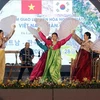
A performance at the Vietnam–Korea Festival 2026 in Da Nang city (Photo: VNA)

Vietnam–Korea Festival 2026 kicks off in Da Nang

Now in its fifth edition, the festival has cemented its place as Da Nang’s signature annual diplomatic event, spotlighting the distinct cultures of both nations, fostering friendship and driving cooperation with Korean localities and partners.

A performance at the opening ceremony of the 2026 Hanoi International Martial Arts Festival on August 7 (Photo: VNA)

Hanoi opens international martial arts festival

The event attracts about 2,000 martial artists of 66 delegations, including seven international delegations from six countries, namely Indonesia, Russia, France, Germany, Switzerland and Morocco.

The statue of Vietnam's King Ly Thai To ( (974 - 1028) in Bonghwa county (Photo: VNA)

RoK to develop K-Vietnam Valley project linked to Ly Dynasty heritage

With the designation in place, Bonghwa will carry out eight specialised projects worth a combined 347.6 billion KRW (245.1 million USD) from 2026 to 2030 – among them the K-Vietnam Valley itself, tourism development around Changpyeong Reservoir, rental smart farms, and a Baekdudaegan healing ‘pet village.’

The organising committee presents awards to outstanding martial artists at the festival. (Photo: VNA)

9th Int’l Festival of Vietnamese Traditional Martial Arts wraps up

The ninth International Festival of Vietnamese Traditional Martial Arts has fostered the martial spirit, strengthened national pride, promoted cultural exchanges and reinforced the aspiration to bring Vietnamese traditional martial arts to a wider international audience.

An appetising bowl of My Quang features a rich combination of ingredients. (Photo: VNA)

Da Nang to host festival honouring Quang Nam-style noodle soup

My Quang is not only a signature dish of the Quang region but also reflects the history, culture and daily life of communities in central Vietnam. With its diverse ingredients, preparation methods and distinctive flavours, the noodle soup has become one of Vietnam's best-known culinary specialities, helping strengthen Da Nang's position on the culinary tourism map.

Hanoi’s traditional silk weaving craft continues to be preserved and developed today. (Photo: VNA)

Van Phuc silk weaving village officially recognised as Hanoi tourist destination

With its millennia-old heritage and growing integration of preservation and innovation, Van Phuc silk weaving village is poised to become a distinctive cultural destination, helping promote Hanoi’s sustainable cultural tourism and bring the quintessence of Vietnamese silk weaving closer to domestic and international visitors.

Minister of Construction Tran Hong Minh speaks at the session (Photo: VNA)

Lawmakers mull over changes to architecture law

On architectural management, the draft Law amending and supplementing several articles of the Law on Architecture clarifies the concept of “national cultural identity in architecture”, tying design to the preservation and promotion of regional heritage. It pushes architecture that mirrors local identity and fits each locality’s natural, historical and social conditions, while setting criteria to identify, assess and protect architecturally valuable buildings as a distinct form of cultural heritage.