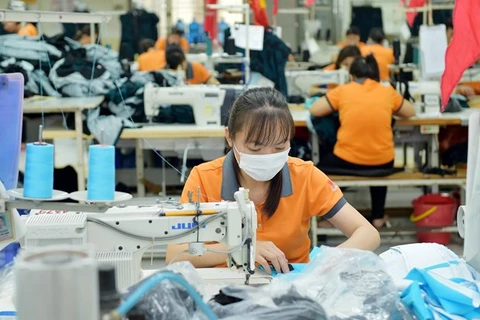
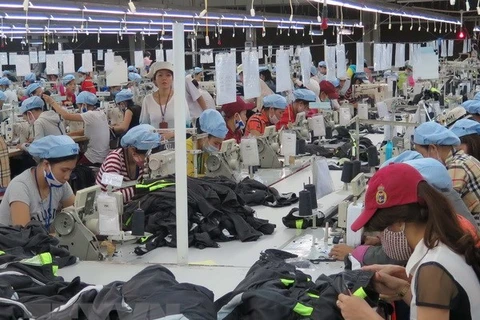
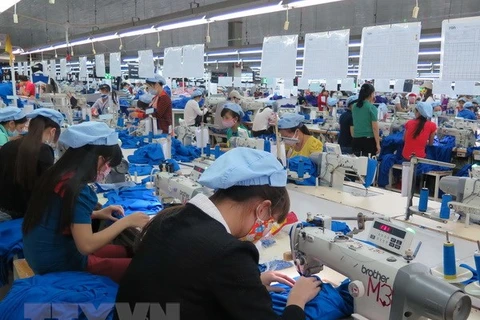
Workers of the Sai Dong Garment Company produce shirts for export to the US, the EU and Japan (Photo: VNA)
 Hanoi (VNS/VNA) - Textile and electronics have been the two export-oriented sectors mostly impacted by the COVID-19 pandemic, an official has said.
Nguyen Thi Xuan Thuy, deputy director of the industrial development centre under the Ministry of Industry and Trade, made the statement during the webinar themed 'Global Value Chains in the Time of COVID-19: The Experience of Ethiopia and Vietnam’, hosted last week by the World Bank Chief Economist Offices of the Africa and East Asia & Pacific Regions and the Finance, Competitiveness and Innovation Global Practice.
“Most Vietnamese textile and apparel companies are currently involved in the outsourcing practice, closely linked to consumer markets,” Thuy said.
“However, the sector is facing major difficulties and challenges related to branding. Textile businesses depend heavily on global value chains.
“Amid the COVID-19 crisis, most companies have had to lay off a large number of employees to cope with the pandemic. Only some large-scale companies can maintain their workforce,” she said.
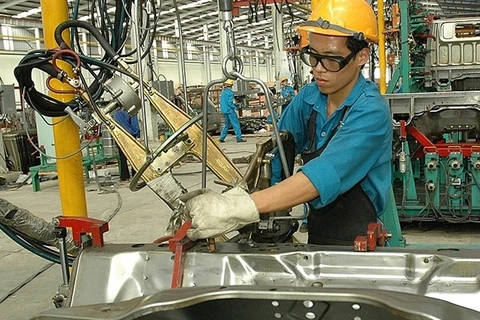
Meanwhile, most businesses in the electronics industry are multinational enterprises (MNEs) and are more resilient to the effects of COVID-19, Thuy said.
“Electronics is a very important industry in Vietnam. MNEs are seeking global suppliers to join the global value chain,” she said.
“For the textile sector, the value of apparel exports decreased by 2.3 billion USD in the first half of 2020. Meanwhile, the electronics sector achieved higher export value. In the global industrial manufacturing market, the growth of the textile industry decreased by 7 percent compared to the same period last year, while the electronics sector increased by nearly 3 percent.”
Vietnam’s Government was supporting the two sectors with trade facilitation measures as both are export-oriented sectors. It had allowed the opening of the border for goods trading and was willing to issue electronic certificates of origin for goods to make it easier for companies to export and import, she said.
Workers and businesses have also been supported by financial assistance packages.
For electronics, the Government has taken measures to promote linkages between MNEs and local suppliers.
These enterprises also focus more on capacity development, participating in the Government's programmes. From there, local businesses can improve their capacity to become global electronics suppliers, Thuy said.
The COVID-19 pandemic posed unprecedented challenges to global value chains, hampering the supply of raw materials and intermediate inputs and the sale of final goods, said Victoria Kwakwa, WB East Asia and Pacific Regional Vice President.
Containment measures resulted in shutting down production. Transport problems and customs delays have all interrupted value chains, she said.
This was affecting firms and employment in East Asia. Without interventions, these could lead to the permanent losses of important supply chain relationships that are difficult to rebuild, she said./.
“For the textile sector, the value of apparel exports decreased by 2.3 billion USD in the first half of 2020. Meanwhile, the electronics sector achieved higher export value. In the global industrial manufacturing market, the growth of the textile industry decreased by 7 percent compared to the same period last year, while the electronics sector increased by nearly 3 percent.”
Vietnam’s Government was supporting the two sectors with trade facilitation measures as both are export-oriented sectors. It had allowed the opening of the border for goods trading and was willing to issue electronic certificates of origin for goods to make it easier for companies to export and import, she said.
Workers and businesses have also been supported by financial assistance packages.
For electronics, the Government has taken measures to promote linkages between MNEs and local suppliers.
These enterprises also focus more on capacity development, participating in the Government's programmes. From there, local businesses can improve their capacity to become global electronics suppliers, Thuy said.
The COVID-19 pandemic posed unprecedented challenges to global value chains, hampering the supply of raw materials and intermediate inputs and the sale of final goods, said Victoria Kwakwa, WB East Asia and Pacific Regional Vice President.
Containment measures resulted in shutting down production. Transport problems and customs delays have all interrupted value chains, she said.
This was affecting firms and employment in East Asia. Without interventions, these could lead to the permanent losses of important supply chain relationships that are difficult to rebuild, she said./.
VNA