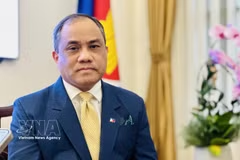
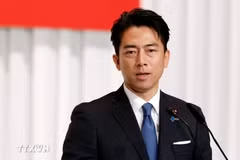
Deputy Prime Minister and Foreign Minister of Thailand Don Pramudwinai (Photo: AFP/VNA)
Bangkok (VNA) – Deputy Prime Minister and Foreign Minister ofThailand Don Pramudwinai talked to Vietnam News Agency correspondents inBangkok about issues discussed at the 37th ASEAN Summit and related meetings, heldvirtually from November 12-15, and the role of Vietnam as the ASEAN Chair in2020.
Following is the full text of the interview.
Could you please highlight some issues which will be discussed or might beraised at the 37th ASEAN Summit and related meetings?
The most crucial agenda across all Summit meetings is COVID-19 response. TheseSummits will be a timely opportunity for ASEAN and external partners to discusshow we can further cooperate on effective response to COVID-19 and strengthenour collective efforts for robust recovery.
Another significant topic of discussion is ASEAN Community-building, where Vietnamhas taken the lead this year on a number of concrete deliverables such as mid-termreview on the implementation of the ASEAN Community Blueprints 2025 andinitiating the discussions on the development of an ASEAN Community Post 2025Vision.
Important regional and international trends and issues will also be discussedin order to further promote mutual understanding and forge closer cooperationfor regional peace, stability and prosperity.
What are the messages and commitments conveyed by Thailand at these Summits,and what outcomes are expected from these Summits?
Our most important message is that it is imperative to advance people agendasto protect our peoples during this challenging time of COVID-19 as well as tocreate a conducive strategic environment for peace and stability in order tocontribute to robust recovery and greater resilience of the region.
In particular, on our collective fight against COVID-19, Thailand fullysupports ASEAN’s initiatives on COVID-19 such as the COVID-19 ASEAN Response Fund,the ASEAN Regional Reserve of Medical Supplies for Public Health Emergenciesand the ASEAN Comprehensive Recovery Framework. Emphasis should also be givento the development of COVID-19 medicines and vaccines as ‘global public goods’as well as support extended to the most vulnerable groups and the hardest hitsectors in ASEAN, including MSMEs whose access to appropriate financingfacilities should be ensured. To build back better, putting people at thecentre and promoting ASEAN’s long-term resilience and sustainability arenecessary. Cooperation in this area can be pursued, including through theutilisation of existing ASEAN frameworks and centres such as the ASEAN Centreon Sustainable Development Studies and Dialogue in Thailand. Sustainability andpost-COVID recovery should go hand in hand.
In addition, against the backdrop of fast-changing geopolitics and regional andglobal landscapes, Thailand will reaffirm our support to ASEAN centrality inthe regional architecture and promote constructive engagement between ASEAN andexternal partners, including major powers. We will encourage the use of the ASEANOutlook on the Indo-Pacific as an important tool to promote such engagementwhich will contribute to the region’s stability and development.
How successful are Vietnam’s efforts as ASEAN Chair together with other membersin accomplishing all targets/goals which were set before the outbreak ofcoronavirus pandemic? What are the significant contributions of Vietnam to theASEAN Year 2020?
I think overall Vietnam has done a commendable job this year in leading ASEAN underthe theme of a “Cohesive and Responsive” ASEAN. This theme is actually appropriateand applicable both before and after the outbreak of COVID-19. It is intendednot only to enhance ASEAN’s unity in our collective actions to advance ASEAN’sinterests but will also help ensure ASEAN’s timely and effective response toexisting and emerging challenges facing ASEAN.
Throughout this year, Vietnam has continued to carry forward ASEAN’s prioritiesfrom the past ASEAN Chairmanships, such as sustainable development, connectivityand smart cities. At the advent of COVID-19, thanks to Vietnam’s leadership,ASEAN was able to quickly set up the ASEAN Coordinating Council Working Groupon Public Health Emergencies in March to coordinate ASEAN’s collective andcomprehensive response to COVID-19. The virtual Special ASEAN Summit and theSpecial ASEAN Plus Three Summit on COVID-19 were timely convened in mid-April,to be followed by a number of virtual ministerial meetings between ASEAN andexternal partners. These high-level engagements have not only demonstrated thestrong political will from ASEAN and external partners to work together but alsotestified to the convening power of ASEAN.
Vietnam’s contributions to ASEAN in 2020 will be culminated at the 37th ASEAN Summitand Related Summits in the forms of concrete deliverables to advance ASEANCommunity-building and various initiatives related to COVID-19 – many of whichwill be carried forward next year. In sum, 2020 is a momentous year with complexchallenges, especially COVID-19. Under Vietnam’s Chairmanship, ASEAN has beenable to deal with them fairly effectively and continues to strengthen ourCommunity-building in a ‘cohesive and responsive’ manner so that ASEAN isbetter prepared for any uncertainties in the future.
Thank you./.
VNA