Thailand’s rice exports expected to benefit from weaker baht

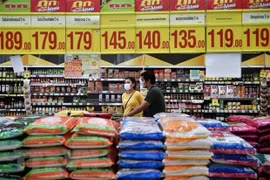
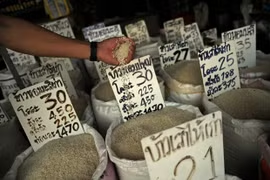
A weaker baht is predicted to increase Thailand’s rice exports in the rest of 2021 by making Thai rice more competitive and prompting higher global demand.
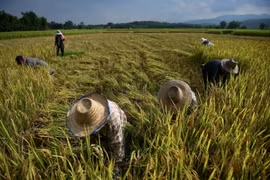
Thailand’s rice exports expected to benefit from weaker baht ảnh 1A rice field in Thailand (Photo: www.bangkokpost.com)
Bangkok (VNA) – A weaker baht ispredicted to increase Thailand’s rice exports in the rest of 2021 by makingThai rice more competitive and prompting higher global demand.

Keerati Rushchano, director-general of the Foreign TradeDepartment was quoted by local media as saying that rice exports startedimproving since June, boosted by higher purchases from China, the Philippines,Cameroon, Malaysia, Mozambique and Singapore.

Thailand's rice exports are expected to continually increasein the last quarter of this year with more than 700,000 tonnes per month, he said.

In the first eight months of this year, Thailand's riceexports totalled 3.18 million tonnes, down 14 percent from the same period oflast year, with export value of 58.68 billion THB (1.75 billion USD), down by23.3 percent year-on-year.  Rice exports inSeptember rose 124.87 percent to 877,555 tonnes, he noted.

Keerati said that the country is on track to export6 million tonnes of rice this year as targeted, citing driversincluding the weaker baht, declining global COVID-19 cases and the relaxationof lockdown measures worldwide.

Chookiat Ophaswongse, honorary president of the Thai Rice ExportersAssociation, said the weaker baht, which has depreciated 13 percent against thedollar this year, has resulted in lower export prices of Thai rice, making itmore competitive against rival exporters.

He said Thai rice production is expected to increase in the2021/2022 harvest season, with milled rice production estimated at 20 milliontonnes, up from 17 million tonnes in the 2020/2021 season.

In 2019, Thailand shipped abroad 7.58 million tonnes of ricefor 131 billion THB, down 32 percent in volume and 25 percent in value overthe previous year. In 2020, the Southeast Asian country exported only 5.7million tonnes of rice./.
VNA

See more

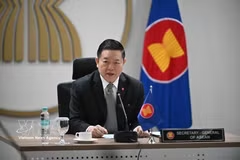
ASEAN Secretary-General Kao Kim Hourn (Photo: VNA)

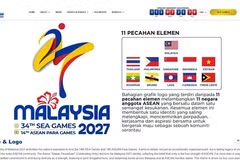
Growing together: 11 nations, one ASEAN home

The new emblem signals an ASEAN that is growing more inclusive while holding to its founding principles of building a peaceful, stable, dynamic region based on equality and cooperation. Its colours come from member states’ national emblems, reflecting diversity inside a single community.

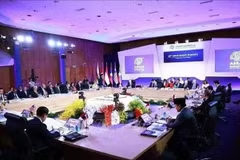
An overview of the dialogue between ASEAN leaders and the ASEAN Business Advisory Council (ASEAN-BAC) in Manila on November 15 (Photo: VNA)

Vietnam puts forward priorities to advance ASEAN cooperation

Appreciating ASEAN-BAC’s report and recommendations, Deputy Minister of Foreign Affairs Dang Hoang Giang, head of Vietnam’s ASEAN Senior Officials’ Meeting (SOM) delegation, called for simplifying procedures, reducing costs, accelerating digitalisation, upgrading the ASEAN Single Window (ASW) and effectively implementing the ASEAN Digital Economy Framework Agreement (DEFA) to make the regional market more accessible.

ASEAN signs Digital Economy Framework Agreement

ASEAN signs Digital Economy Framework Agreement

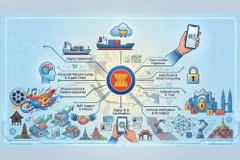
The Digital Economy Framework Agreement (DEFA), the bloc’s first standalone and legally binding digital economy agreement, establishes common rules covering digital trade, cross-border data flows, electronic payments, cyber security and artificial intelligence (AI).

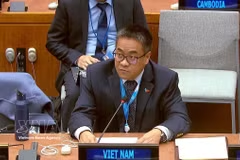
Minister Counsellor Nguyen Hai Luu, Deputy Permanent Representative of Vietnam to the UN, speaks at the discussion on November 12, 2026. (Photo: VNA)

Vietnam supports peace, reconstruction efforts in Gaza: diplomat

Minister Counsellor Nguyen Hai Luu, Deputy Permanent Representative of Vietnam to the UN, expressed deep concern over the dire humanitarian situation in Gaza, particularly as recent heavy rains and flooding have worsened living conditions for residents.

Thailand diversifies oil sources to ensure energy security

Thailand diversifies oil sources to ensure energy security

Although the diversification of oil import sources has helped reduce the risk of domestic oil shortage, it has not immediately reduced energy costs because import prices depend on market mechanisms, transportation costs, foreign exchange rates and the terms of oil contracts.

ST Telemedia Global Data Centres (Thailand), an affiliate of Singapore Telecom, is developing three data cehtres in Thailand including this facility on Rama IX Road in Bangkok. (Photo: bangkokpost)

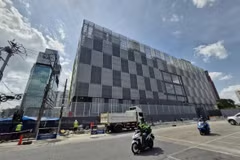
Thailand tightens regulations on data centres

The new rules focus on controlling investment scale, electricity and water consumption, environmental impacts, and preventing investors from reserving resource quotas beyond their actual needs.

A road is under construction in Dong Nai city, Vietnam. (Photo: VNA)

ADB: Southeast Asia needs 7.1 trillion USD in infrastructure investment by 2040

ADB estimates that the region will need an average of 476 billion USD in infrastructure investment annually during 2026–2040, equivalent to 8.7% of GDP. However, at current investment levels, government budget resources would cover only around 45% of this demand, leaving an annual financing gap of 264 billion USD.

Kyodo News publishes an article titled “Sculptures by Japanese, Vietnamese artists on display in Yokohama,” (Screenshot photo)

Japanese media widely cover top Vietnamese leader ’s visit

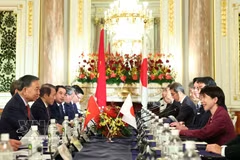
Japanese media have continued extensive coverage of General Secretary of the Communist Party of Vietnam (CPV) Central Committee and President To Lam’s activities in Japan, highlighting his meetings with representatives of leading financial institutions at the Tokyo Stock Exchange, witnessing of cooperation agreement signing and participation in cultural exchanges.

Thailand pushes for establishment of ASEAN emergency public health centre

Thailand pushes for establishment of ASEAN emergency public health centre

The draft agreement stipulates that ACPHEED will comprise three specialised centres based in three ASEAN member states. Vietnam will oversee the centre for prevention and preparedness; Indonesia will host the centre for detection and risk assessment; and Thailand will be responsible for the centre for response and risk communication.