Thousand-year-old tower embodies Oc Eo culture

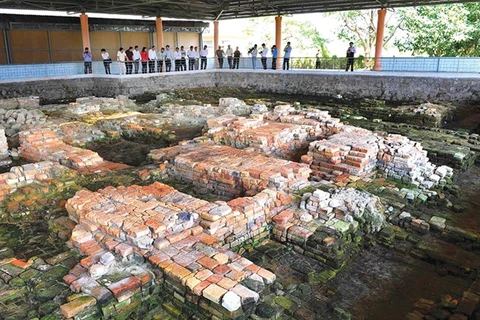
Hindu towers associated with the Oc Eo Culture are found not only in the central provinces like Khanh Hoa, Binh Thuan and Ninh Thuan but also in the Mekong Delta. One such ancient relic in the region is Binh Thanh tower in Tay Ninh province’s Trang Bang district.
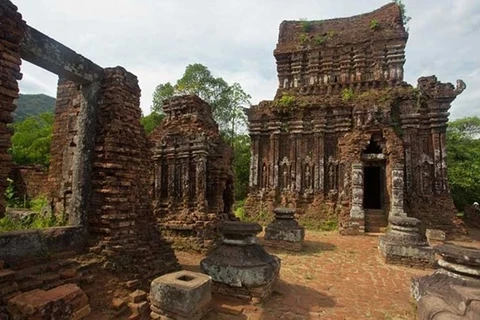
Thousand-year-old tower embodies Oc Eo culture ảnh 1Many reliefs on the tower are quite intact. (Photo: VNA)

Hanoi (VNA) – Hindu towers associated with the Oc Eo Culture are found not only in the central provinces like Khanh Hoa, Binh Thuan and Ninh Thuan but also in the Mekong Delta. One such ancient relic in the region is Binh Thanh tower in Tay Ninh province’s Trang Bang district.

The tower is one of the few remaining ones from the culture existing in the Mekong Delta region. It got the name Binh Thanh from its location on the right bank of Vam Co Dong River in Binh Phu hamlet, Binh Thanh commune.

The Binh Thanh tower was discovered along with Chop Mat tower in Tay Ninh in the early 20th century via an archeological report by the Indochinese archaeological research library.

Located on a high and fairly flat land, the building is hidden under shady trees, creating an extremely poetic, wild, mysterious, pure and peaceful scene.

Belonging to the Oc Eo Culture, its formation was identified to be around the 8th  – 9th centuries. Through ups and downs over a thousand years, the ancient tower’s special architectural features remain almost intact, forming an important part of the nation’s cultural heritage.

It is the only Oc Eo tower that has an almost intact stone wall since discovery. Quite similar to other Champa towers in the central region, its construction technique employed the use of baked brick materials that were stacked skillfully and tightly without using adhesives. However, it is a pity that such technique has so far been lost despite restoration efforts by many scientists and archaeologists over years.

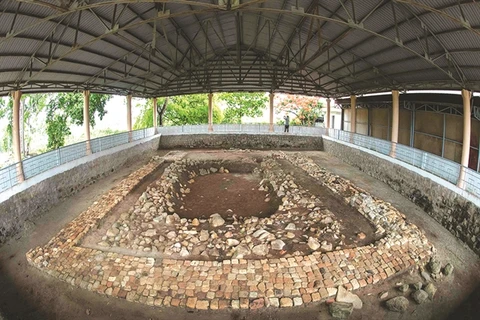
The original architecture of the Binh Thanh ancient tower site consists of three main towers. However, only one of them exists today thanks to being restored in 1998. The other two are now only vestiges.

Built on a square plot, the remaining one is 10 metres high. Each of its sides is 5 metres long. They face the four directions east, west, south and north.

At one metre wide and two metres high, the east-facing main door of the tower protrudes completely. Above it is a 2 m x 0.8 m rectangular stone, which was carved with extremely sophisticated stylised chrysanthemums.

The West, South and North main doors all have fake doors that are embossed with extremely delicate and elaborate patterns.

Decorative motifs are repeated in many parts of the tower and get smaller toward its top, creating angles and edges for the entire construction. Meanwhile, reliefs are embossed around the tower, making it a solid and elaborate work of architecture.

In 1993, the tower was recognised by the then Ministry of Culture and Information (now the Ministry of Culture, Sports and Tourism) as a cultural historical relic site in 1993.

Not only having historical and architectural values, the relic also embodies many special values about the cultural life, religion and belief of ancient people. Its ingenious construction and sculpture techniques reflect the peak development of the Oc Eo Culture.

The Oc Eo Culture was first discovered in 1944 via artifacts found in the sites of Ba The Mountain, now in Oc Eo town, Thoai Son district in An Giang province.

Scientific research has unravelled a brilliant culture with a system of dense monuments on a large scale with a variety of artifacts, diverse in types and high levels of technique, aesthetics, arts, and interactivity with major cultural centres at that time.

Artifacts of the Oc Eo Culture are valued as significant historical documents and evidence of a prosperous culture in the history of Vietnam./.
VNA

See more

Le Y Linh, a music researcher living and working in France (Photo: VNA)

14th National Party Congress expected to continue affirming culture as pillar of Vietnam’s soft power

Talking to a Vietnam News Agency correspondent in Paris, Le Y Linh, a music researcher living and working in France, said culture should be placed on an equal footing with other sectors in the country’s development strategy. According to her, investment in culture should go beyond preservation and be closely linked with creativity, so that cultural values are not only safeguarded but also continue to evolve in contemporary life.

A view of the international conference in Ninh Binh province, which sets course for UNESCO nomination of the Tam Chuc Pagoda Complex and the Van Long Wetland Nature Reserve. (Photo courtesy of Ninh Bình Provincial People’s Committee)

Vietnam advances UNESCO nomination of Tam Chuc – Van Long Complex

During the conference, delegates examined a wide range of themes, including geology, geomorphology and biodiversity; cultural values such as history, archaeology and intangible heritage; human adaptation; site integrity, boundaries and management challenges; and a roadmap for nominating the Van Long – Tam Chuc wetland karst area as a World Heritage Site.

The feature film “Red Rain”* directed by Meritorious Artist Dang Thai Huyen and produced by the People’s Army Cinema (Vietnam Cinema Association). (Photo: VNA)

“Red Rain” wins Golden Kite Award 2025

"Mua Do" (Red Rain), directed by Meritorious Artist Dang Thai Huyen and produced by the People’s Army Cinema also earned its director the Best Director Award in the feature film category, marking a double win and making Red Rain the most honoured work of the night in the cinema section.

The pho museum provides a spot for domestic and foreign visitors to learn more about Vietnam's renowned dish, Pho, and experience its flavour. (Photo: VNA)

First-ever pho museum opens in HCM City

Located in an 800-square-metre area in Ben Thanh ward, the museum is the first private culinary museum in Vietnam licensed by the HCM City Department of Culture and Sports. The museum features three floors offering visitors a journey through pho's 100-year history via a souvenir area, show kitchen, cinema room and cultural exhibition space.

Cover page of Viet Nam hanh phuc (Happy Vietnam) book (Photo: VNA)

VNA publishing house launches books to mark 14th National Party Congress

The three books published by the VNA Publishing House contribute to promoting Vietnam’s image at home and abroad. They also serve as valuable external information products, helping nurture confidence, aspiration and determination to build and safeguard a socialist Vietnam as it advances firmly into a new era of prosperity, strength, civilisation and happiness.

A ceremony to see off the Vietnamese sport delegation to compete at the 13th ASEAN Para Games in Thailand is held at Noi Bai International Airport on January 15, 2025. (Photo: VNA)

Vietnamese delegation sets off for 13th ASEAN Para Games

Vietnam sends 185 members, including 140 athletes, competing in 11 sports including athletics, swimming, weightlifting, badminton, table tennis, chess, judo, boccia, archery, tennis, and fencing. The country aims to win 40–50 gold medals and strives to rank among the top 4–5 countries.

Nguyen Van Than, Chairman of the Vietnam Classical Music Association (VCMA), speaks at a press briefing in Hanoi on January 13. (Photo: The organisers of the concert)

Concert to be held to celebrate 14th National Party Congress

The programme, jointly organised by the VCMA and the Vietnam Association of Small and Medium Enterprises, will feature nearly 150 artists, performers and musicians, representing the finest of Vietnam’s and the international classical music scene.

Visitors to Vietnam's booth at International Cultural Festival 2026 (Photo: VNA)

Vietnamese image introduced at International Cultural Festival 2026 in Greece

The Vietnamese Embassy in Greece took part in the International Cultural Festival 2026, organised by the UNESCO Club of Piraeus and Islands in Greece, marking the embassy’s first activity of the new year and highlighting its efforts to bring the image of Vietnam closer to the Greek public and international friends through traditional Vietnamese cuisine.

A dish of Vietnamese fried spring rolls (Photo: VNA)

Vietnamese rice paper makes way into European kitchens

Vietnamese rice paper is increasingly winning the hearts of European diners thanks to its versatility, easy preparation and ability to pair well with a wide range of Western ingredients. This culinary exchange not only broadens the reach of Vietnamese cuisine but also enriches the multicultural culinary landscape of Belgium and many other countries.

A visitor to the exhibition (Photo: VNA)

Colours of Friendship: Hanoi welcomes Vietnam-RoK artistic encounter

The harmonious mingling of works by artists from both nations conjures a multi-layered, dynamic space where distinct visual languages intersect with shared emotional depth, aesthetic thinking and creative spirit. The result is a rich and refreshing visual experience.