Shrimp breeding ponds in Tien Giang province’s Go Cong Dong district (Photo: VNA)
 HCM City (VNS/VNA) - Saltwater and brackish-water aquaculture production in coastal areas in the Mekong Delta province of Tien Giang has improved farmers’ incomes in the last 10 years under a national marine strategy.
With its 32km of coast, the province has 9,750ha of saltwater and brackish water aquaculture, mostly in Go Cong town, Go Cong Dong, Go Cong Tay and Tan Phu Dong districts, according to the province’s Department of Agriculture and Rural Development.
Nguyen Van Danh, Secretary of the province’s Party Committee, said the area of saltwater and brackish water aquaculture in coastal areas had increased by 2.7 times compared to 2008.
The annual output of saltwater and brackish water aquaculture -- mostly shrimps and clams -- reaches over 43,000 tonnes.
After 10 years of implementing the Vietnam marine strategy towards 2020 in the province, Tien Giang has developed infrastructure to serve aquaculture production in Go Cong town, Go Cong Dong, Go Cong Tay and Tan Phu Dong districts.
The province’s agriculture department has improved fishery extension activities and provided advanced technologies to farmers, including techniques to produce shrimp and clams.
The department’s Agriculture Extension Centre has set up breeding models for clean black-tiger shrimp, white-legged shrimp, tilapia and other aquatic species for farmers to visit and learn.
Tran Quang Thanh in Go Cong Dong district’s Kieng Phuoc commune has turned his two hectares of low-yielding paddy field into a coastal area for breeding black-tiger shrimp and white-legged shrimp.
He harvests an average of 10 tonnes of shrimp a year and earns a profit of about 700 million VND (30,000 USD).
Go Cong Dong district authorities have encouraged farmers to breed shrimp in areas which are near river mouths, and inside sea dykes and saltwater-affected areas.
The district has zoned nearly 2,000 alluvial grounds for breeding clams, with annual output of 20,000 tonnes. The clams are either sold domestically or processed for export.
Nguyen Van Ba, who has three hectares of black-tiger shrimp in Tan Phu Dong district’s Phú Tân Commune, said he had switched from breeding black-tiger shrimp to an industrial farming model and was now breeding white-legged shrimp.
“The profits from breeding shrimp have been stable in recent years because of the use of advanced farming techniques,” he said.
Tran Cong Danh, Deputy Chairman of the Phu Tan commune People’s Committee, said farmers could earn a profit of 20 million VND (850 USD) per ha per crop from extensive shrimp farming and 200 million VND (8,500 USD) per ha per crop from industrial farming.
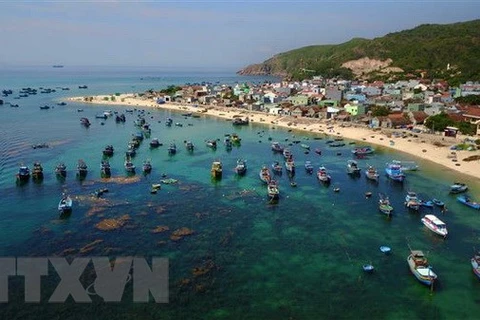
Besides expanding aquaculture areas, the province has also developed a fleet of 1,400 fishing boats with more than 9,800 fishermen, according to its agriculture department.
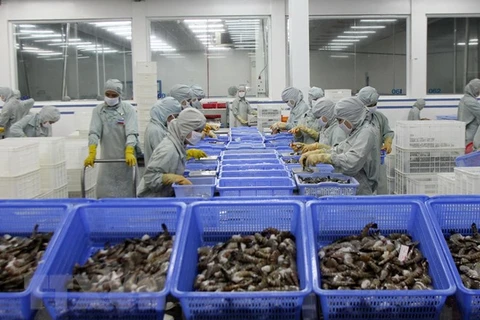
The Vam Lang seafood processing industrial cluster and logistics services have both contributed to the development of the sea-based economy.
More than 300 vessels provide logistics services for vessels operating offshore.
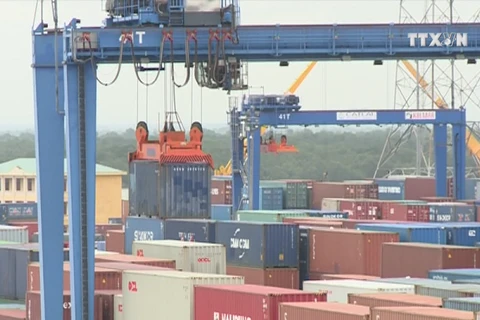
Also, Tien Giang has invested in a system of My Tho and Vam Lang ports, to handle the catches.
It has also built a storm shelter at the mouth of the Soai Rap River that can accommodate 350 fishing vessels.
In the first nine months of the year, the province exported more than 250 million USD of seafood. Its seafood is exported to more than 100 countries and territories, including the US, Spain and China.-VNS/VNA
With its 32km of coast, the province has 9,750ha of saltwater and brackish water aquaculture, mostly in Go Cong town, Go Cong Dong, Go Cong Tay and Tan Phu Dong districts, according to the province’s Department of Agriculture and Rural Development.
Nguyen Van Danh, Secretary of the province’s Party Committee, said the area of saltwater and brackish water aquaculture in coastal areas had increased by 2.7 times compared to 2008.
The annual output of saltwater and brackish water aquaculture -- mostly shrimps and clams -- reaches over 43,000 tonnes.
After 10 years of implementing the Vietnam marine strategy towards 2020 in the province, Tien Giang has developed infrastructure to serve aquaculture production in Go Cong town, Go Cong Dong, Go Cong Tay and Tan Phu Dong districts.
The province’s agriculture department has improved fishery extension activities and provided advanced technologies to farmers, including techniques to produce shrimp and clams.
The department’s Agriculture Extension Centre has set up breeding models for clean black-tiger shrimp, white-legged shrimp, tilapia and other aquatic species for farmers to visit and learn.
Tran Quang Thanh in Go Cong Dong district’s Kieng Phuoc commune has turned his two hectares of low-yielding paddy field into a coastal area for breeding black-tiger shrimp and white-legged shrimp.
He harvests an average of 10 tonnes of shrimp a year and earns a profit of about 700 million VND (30,000 USD).
Go Cong Dong district authorities have encouraged farmers to breed shrimp in areas which are near river mouths, and inside sea dykes and saltwater-affected areas.
The district has zoned nearly 2,000 alluvial grounds for breeding clams, with annual output of 20,000 tonnes. The clams are either sold domestically or processed for export.
Nguyen Van Ba, who has three hectares of black-tiger shrimp in Tan Phu Dong district’s Phú Tân Commune, said he had switched from breeding black-tiger shrimp to an industrial farming model and was now breeding white-legged shrimp.
“The profits from breeding shrimp have been stable in recent years because of the use of advanced farming techniques,” he said.
Tran Cong Danh, Deputy Chairman of the Phu Tan commune People’s Committee, said farmers could earn a profit of 20 million VND (850 USD) per ha per crop from extensive shrimp farming and 200 million VND (8,500 USD) per ha per crop from industrial farming.
Besides expanding aquaculture areas, the province has also developed a fleet of 1,400 fishing boats with more than 9,800 fishermen, according to its agriculture department.
The Vam Lang seafood processing industrial cluster and logistics services have both contributed to the development of the sea-based economy.
More than 300 vessels provide logistics services for vessels operating offshore.
Also, Tien Giang has invested in a system of My Tho and Vam Lang ports, to handle the catches.
It has also built a storm shelter at the mouth of the Soai Rap River that can accommodate 350 fishing vessels.
In the first nine months of the year, the province exported more than 250 million USD of seafood. Its seafood is exported to more than 100 countries and territories, including the US, Spain and China.-VNS/VNA
VNA