Tra fish industry needs makeover

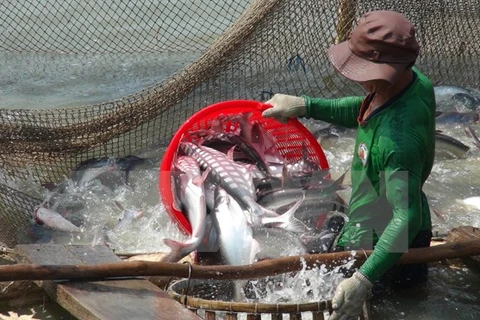
After a hasty start, Vietnam's tra fish industry should now plan an image makeover to improve the quality of exports and be competitive, for the long term, experts said.
 Tra fish industry needs makeover ảnh 1Workers of Go Dang Company in southern Tien Giang Province prepare tra fish on a processing line. (Photo: VNA)

Hanoi (VNA) – After a hasty start, Vietnam's tra fish industry should now plan an image makeover to improve the quality of exports and be competitive, for the long term, experts said.

The tra fish industry grew 2 to 3 times in export value every year between 2002 and 2009, but the export value growth was unchanged in 2010 and started dropping from 2011, Le Xuan Thinh, manager of the project on establishing a sustainable pangasius supply chain in Vietnam (SUPA), said at a seminar on sustainable tra fish development in Vietnam held by the Vietnam Association of Seafood Exports and Producers (VASEP) in Hanoi on November 16.

The total export value of tra fish reached 1.7 billion USD in 2014, a slight increase of 0.4 percent against 2013.

The average export price for tra fish products stood at 3.11 USD per kilo in 2002, but is presently between 2.1 USD and 2.3 USD.

Meanwhile, farmers have not seen much profit from rearing tra fish and even suffered losses due to the lower selling price in 2010.

The industry faced numerous problems in production, processing and exports of tra fish due to hasty development in the past, which led to unsustainable development of the industry now and could possibly affect the future, Thinh said.

Those problems included the unstable quality of export products, effects on the environment and the society, higher production cost and lack of highly-processed tra fish products.

According to Siegfried Bank, a German expert on policy consulting, the European Union is the biggest importer of tra fish products and Vietnamese tra fish must compete with other kinds of white fish like tilapia. Meanwhile, Vietnam has been unable to conduct branding activities for Vietnamese tra fish, and that has also affected production and exports.

Experts at the seminar said the local tra fish industry should have sustainable development and build an image of "green" and "delicious" for its products.

Nguyen Hoai Nam, VASEP Deputy General Secretary, said the industry must engage in trade promotion and provide correct information on the tra fish industry to customers.

The industry has produced 20 new products to meet the demands of the European Union, cut production cost and applied new technology for production and processing of tra fish products.

In addition, the state should initiate policies related to the development of the tra fish industry, increase the quality and diversify its products, Thinh said.-VNA

VNA

See more

A view of the site where the Ninh Thuan 1 Nuclear Power Plant is located in Phuoc Dinh commune, Khanh Hoa province (Photo: VNA)

Nuclear experts urge century-long commitment at 14th Party Congress

VietNuc’s executive board, including Chairman Bui Nguyen Hoang from the Électricité de France SA (EDF) (EDF), Ung Quoc Hung from Setec Nucléaire Group, and Vu Minh Ngoc from French National Radioactive Waste Management Agency Andra, hoped that the Congress would refine mechanisms and policies to better tap OV nuclear talents.

Ahmad Haikal Hasan, Head of the Halal Product Assurance Organising Agency (BPJPH) of Indonesia, speaks at the seminar (Photo: VNA)

Indonesia ready to cooperate with Vietnam in halal sector

Ahmad Haikal Hasan, Head of the Halal Product Assurance Organising Agency (BPJPH) of Indonesia, described Vietnam as a “potential supplier” of halal products with the capacity to play a larger role in the market, particularly in the fast-moving consumer goods (FMCG) sector. He revealed a plan to visit Vietnam next week to discuss the country’s progress in the global halal industry.

Delegates perform the opening ceremony. (Photo: VNA)

Thailand Week 2026 opens in Hanoi

The event brings together more than 100 companies, including Thai enterprises and Vietnamese importers, across about 120 booths. It features a wide range of Thai products aligned with consumer trends in Vietnam, including food and beverages, health and beauty, mother-and-baby and pet products, fashion and jewellery, household goods and tourism services.

Illustrative image (Photo: VNA)

Vietnam remains Singapore’s third-largest seafood supplier in 2025

Data released by the Accounting and Corporate Regulatory Authority of Singapore (ACRA) show that Singapore spent 125.5 million SGD (97.7 million USD) importing seafood from Vietnam last year, up 10.7% year on year, accounting for 10.3% of the city-state’s total seafood import market.

Workers assemble mobile phone components at Diem Thuy Industrial Park in the northern province of Thai Nguyen. (Photo: VNA)

Electronics exports surpass 107 billion USD in 2025

With an export turnover of 107.75 billion USD in 2025, computers, electronic products and components not only maintained their position as Vietnam’s largest export by value, but also contributed more than half of the overall increase in the country’s export turnover in 2025.

Experts said that Vietnam’s economic outlook continues to be underpinned by stable foreign direct investment inflows and public investment, which is playing an important role in driving growth. (Photo: thoibaotaichinh.vn)

Foreign investors maintain strong confidence in Vietnam’s market

Looking ahead to 2026, prospects remain bright as manufacturing, economic growth and foreign investment in Vietnam are expected to stay robust, with the country forecast to post the highest growth rate in the region this year, according to Adam Sitkoff, Executive Director of the American Chamber of Commerce (AmCham) in Vietnam.

Toy production at a Hong Kong-invested factory (Photo: VNA)

Vietnam targets deeper market penetration in Hong Kong in 2026

Vietnam-Hong Kong trade hit 62.3 billion USD in the first 11 months of 2025, soaring 73.1% annually. Vietnamese exports to Hong Kong amounted to 36.8 billion USD, a 90.6% hike, ranking fourth among Hong Kong’s import sources, while imports from Hong Kong stood at 25.5 billion USD, up 52.9% and ranking third.