Tra Vinh: Shrimp-breeding in mangroves protects forest coverage, offers stable income

The Mekong Delta province of Tra Vinh is encouraging farmers to breed shrimp in mangrove forests as the practice offers sustainable incomes and helps to maintain the province's forest coverage.
Tra Vinh: Shrimp-breeding in mangroves protects forest coverage, offers stable income ảnh 1Mangrove forests in Tra Vinh province’s Cau Ngang district. The province is encouraging farmers to breed shrimp in mangrove forests. The environmentally friendly practice offers sustainable profits and helps to maintain forest cover. (Photo: VNA)
TraVinh (VNS/VNA) - The Mekong Delta province of Tra Vinh is encouragingfarmers to breed shrimp in mangrove forests as the practice offers sustainableincomes and helps to maintain the province's forest coverage.

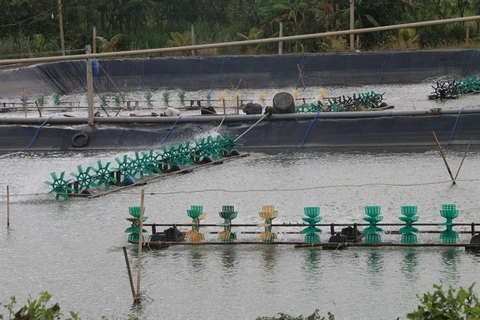
Witha coastline of 65 kilometres, the province has advantages for aquaculturedevelopment, but climate change and changes in the aquaculture environment havecaused risks of disease.

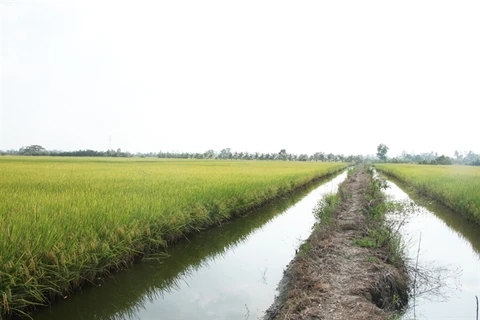
Toadapt to climate change, the province has shifted to other methods, includingthe shrimp – forest farming model, which is mostly implemented in thecoastal districts of Cau Ngang, Chau Thanh and Tra Cu, and Duyen Hai township.

Underthe model, shrimp bred under extensive farming methods eat mostly natural foodin the mangrove forest. The shrimp is 'clean' and is popular with consumers. 

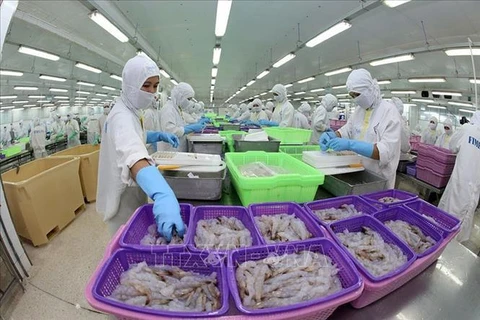
Thevariety that is mostly bred is black tiger shrimp, one of the country’s keyshrimp exports. 

FarmerPham Thai Binh in Duyen Hai district’s Long Vinh commune has bred shrimp in a3ha mangrove forest for nearly 20 years and earns an average profit of about 100million VND (4,300 USD) a year.

Theprofit is not as high as that from breeding shrimp under industrial farming,but it is stable. 

“Theshrimp – forest farming model is a sustainable livelihood as it reduces therisk of shrimp disease,” he said. 

Binhbreeds about 200,000 shrimp a year and staggers the release of shrimp fry intoponds in the forests four times a year in the dry season to avoid an oversupplyin the main harvest season. As a result, the shrimp sells at high prices. 

Inthe rainy season when the salinity of water fluctuates and shrimp are easilyaffected by disease, Bình breeds crabs in the mangrove forest. 

DuyenHai district’s authorities have encouraged farmers with modest financeswho breed shrimp under intensive or super - intensive farming models toswitch to shrimp – forest farming. 

DuyenHai has more than 8,500ha of shrimp, according to the district’s Bureau ofAgriculture and Rural Development.

Theshrimp – forest farming model accounts for nearly 60 percent of the district’sshrimp farming areas.

TranKien Chuc, Chairman of the Dong Hai Commune People’s Committee in Duyen Hai,said that most farmers who breed shrimp in mangrove forests have stable incomes.

Theshrimp - forest farming model offers a profit of 100 – 200 million VND (4,300 –8,600 USD) per hectare a year.

Theprovince’s Agriculture Extension Centre last year supported 22 shrimp breedinghouseholds in Duyen Hai’s Dong Vinh and Long Vinh communes on a total breedingarea of 36ha. 

Thehouseholds were provided 12 million VND (520 USD) per hectare forproduction costs, including 50 percent of the cost to buy black tiger shrimpfry, 50 percent of the cost to buy water - quality measuring tools, and a partof the cost to buy food and other material inputs. 

Theywere also trained in advanced farming techniques, which help reduce productioncosts. 

Thesupported households had an average yield of 700 kilogrammes of black tigershrimp after breeding for three months and an average profit of 74 million VND(3,200 USD) per hectare.

HuynhHoang An, in Long Vinh commune, said he received support to breed shrimp in a2.5ha cajuput forest.

Thecosts to feed the shrimp are not high because they eat mostly naturalfood. “Shrimp bred under the model grow well and have few diseases,” he said. 

Anhas expanded his shrimp – forest farming area to 7ha.

NguyenVan Phung, deputy director of the centre, said the shrimp – forest farmingmodel has adapted to climate change well.

Theprovince has encouraged farmers to expand as it offers sustainable profits andkeeps forests protected.

Theprovince has more than 9,000ha of forests, mostly mangrove forests, with aforest coverage rate of 3.63 percent.

Ofthe province’s total forests, more than 4,000ha were planted by localhouseholds who breed shrimp in the forests, according to the province’sDepartment of Agriculture and Rural Development.

Theprovince plans to grow more new forests, aiming to increase its total forestarea to 10,000ha by 2025./.
VNA

See more

Teachers and children at Hoa Hong Kindergarten in Ha Giang 2 ward, Tuyen Quang province (Photo: VNA)

Vietnam to provide tuition support for preschoolers

Eligible children will be entitled to tuition exemptions, reductions or support, assistance with learning costs and other benefits in accordance with laws on education, children, people with disabilities, ethnic affairs and social assistance.

More than 100 delegates, including nearly 30 delegates from countries in Asia and Africa, attend the event. (Photo courtesy of the ActionAid)

Ecological agriculture for sustainable future

The workshop “Ecological agriculture for a sustainable future”, organised by ActionAid International in Vietnam, emphasised that women and young people must be the subjects and leaders of change, rather than merely participants or beneficiaries.

International delegates attend the 7th national congress of the Vietnam Union of Friendship Organisations in Hanoi on September 14. (Photo: VNA)

Phan Anh Son re-elected VUFO president

For the 2026–2031 term, the Vietnam Union of Friendship Organisations (VUFO) will follow the motto “Proactive adaptation, creative breakthroughs, practical effectiveness”.

Deputy Prime Minister Pham Thi Thanh Tra encourages the staff of the Centre for DNA Identification. (Photo: VNA)

Identifying martyrs’ remains requires whole political system’s efforts: Deputy PM

Deputy Prime Minister Pham Thi Thanh Tra inspected the practical implementation of DNA identification technology at the Centre for DNA Identification under the Institute of Biology of the Vietnam Academy of Science and Technology, and the Military Institute of Forensic Medicine under the Military Medical Department of the Ministry of National Defence on September 14.

Doan Duc Hao, Director of the Department of Youth Affairs and Gender Equality under the Ministry of Home Affairs, speaks at a working session with a 16-member delegation of young Korean civil servants in Hanoi on September 14, 2026. (Photo: VNA)

Vietnam, RoK promote cooperation, youth’s role

Le Thi Viet Lam, Deputy Director of the Department of International Cooperation under the Ministry of Science and Technology, said Vietnam wishes to continue building an ecosystem that connects the State, research institutes, universities and businesses, enabling them to share resources and create value. This is also an area in which Vietnam is interested in learning from Korean experience.

To operate Metro Line No. 1 (Ben Thanh–Suoi Tien), Ho Chi Minh City Urban Railway Company No. 1 (HURC1) currently employs 700 people to keep nearly 200 train trips running each day. (Photo: nhandan.vn)

Ho Chi Minh City addresses manpower shortage for urban railway development

Under the human resources training scheme serving the development of the urban railway network approved by the municipal People’s Committee, the city will need around 70,000 workers by 2030 to support investment in and development of its metro system, including project management personnel, operations and maintenance staff, engineers, technical workers, consultants and designers.

VBUK Vice Chairman Trinh Ngoc Cuong speaks at the ceremony to launch a publication marking VBUK's 20th anniversary,(Photo: VNA)

Resolution No.23: Vietnamese community in UK looks toward homeland

Politburo Resolution No. 23 calls for stronger links among overseas Vietnamese through sustainable networks connecting experts, intellectuals, entrepreneurs and young people. Each entrepreneur and professional can thus become a bridge, ensuring that despite being half a world away, the Vietnamese community remains closely connected to the homeland.

NA President Tran Thanh Man presents the Labour Hero title to BRG Group Chairwoman and Standing Vice Chairwoman of SeABank’s Board of Directors Nguyen Thi Nga (Photo: VNA)

NA President attends ceremony honouring BRG Group, SeABank

As Vietnam enters a new development phase, with a target of double-digit growth and strategic milestones in 2030 and 2045, National Assembly President Tran Thanh Man called on BRG Group and SeABank to build on their established foundations and effectively implement major Party, National Assembly and Government policies on socio-economic development.

Martyrs’ remains are found in Quang Tri province. (Photo: VNA)

Search area expanded to recover more martyrs’ remains in Quang Tri

The continued recovery of martyrs’ remains provides valuable information and further evidence of those who fought and sacrificed their lives for national independence and freedom. It also encourages search teams to persist in locating fallen soldiers still lying on former battlefields, contributing to the effective implementation of the 500-day campaign and reflecting Vietnam’s long-standing tradition of gratitude.

General Secretary of the Communist Party of Vietnam Central Committee and President To Lam (first, left) and French President Emmanuel Macron (first, right) witness the exchange of bilateral cooperation documents and agreements on September 10, 2026 during the former's official visit to France. (Illustrative photo: VNA)

Intellectual cooperation deepens Vietnam–France relations: expert

Dr Frederic Roustan highlighted the importance of scientific and intellectual cooperation, saying that despite ups and downs in bilateral diplomatic, political and economic relations over the decades, connections between French and Vietnamese scientists and intellectuals have been maintained, contributing to exchanges between the two countries.