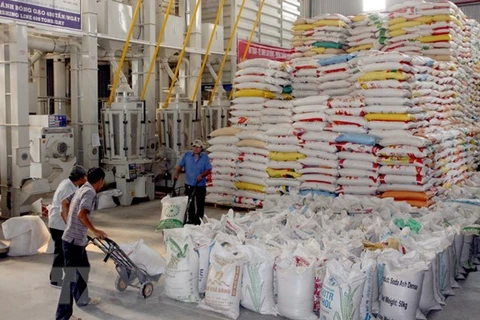
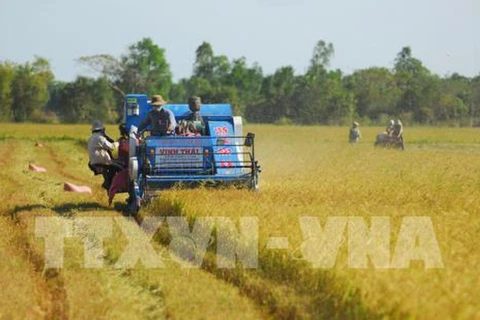
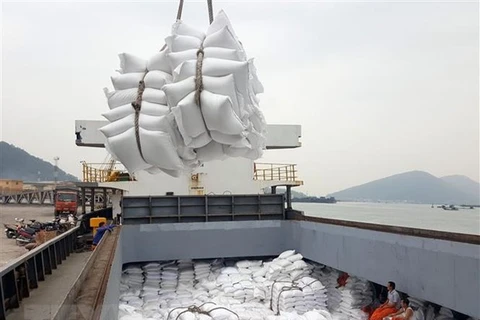
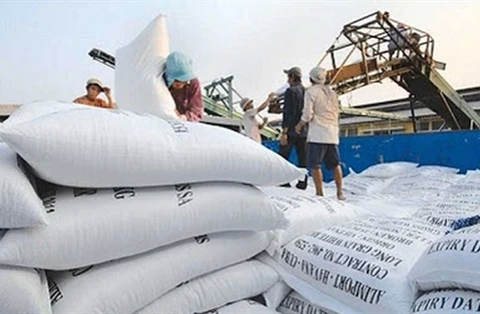
Illustrative image (Photo: VNA)
 Hanoi (VNA) - The Ministry of Industry and Trade (MoIT) has asked the Government to resume rice exports. However, the export volume would be limited at 800,000 tonnes for April and May.
Minister of Industry and Trade Tran Tuan Anh on April 6 sent an urgent official dispatch to Prime Minister Nguyen Xuan Phuc after collecting opinions from relevant ministries and agencies relating to rice export management.
Accordingly, the MoIT proposed to allow rice exports but strictly control monthly quota after careful consideration to ensure food security amid the COVID-19 pandemic.
The plan takes into account suitable solutions to maintain rice production to ensure economic growth while ensuring food security.
Especially, the plan was also based on the official announcement from the Ministry of Agriculture and Rural Development on the rice volume of 3.2 million tonnes which could be exported in the winter-spring crop. This is the remaining quantity after ensuring normal domestic consumption and reserves.
The ministry said the country shipped around 1.7 million tonnes of rice under signed export contracts as of March 31. Therefore, the rice export volume in the future would be 1.5 million tonnes. Meanwhile, the total rice reserves in the next two months before the summer-autumn crop would be 700,000 tonnes.
Notably, the rice exports would be only allowed through international border gates including road, railway, seaway and airway which were connected to the General Department of Customs for observation.
In addition, the ministry required the 20 biggest rice exporters to sign agreements with at least a supermarket system to ensure food reserves for circulation. The MoIT could revoke the licences for rice exports if exporters do not meet the requirement.
Earlier, the Government announced on March 25 to ban signing new rice export contracts to ensure sufficient domestic supplies to cope with the COVID-19 pandemic./.
Minister of Industry and Trade Tran Tuan Anh on April 6 sent an urgent official dispatch to Prime Minister Nguyen Xuan Phuc after collecting opinions from relevant ministries and agencies relating to rice export management.
Accordingly, the MoIT proposed to allow rice exports but strictly control monthly quota after careful consideration to ensure food security amid the COVID-19 pandemic.
The plan takes into account suitable solutions to maintain rice production to ensure economic growth while ensuring food security.
Especially, the plan was also based on the official announcement from the Ministry of Agriculture and Rural Development on the rice volume of 3.2 million tonnes which could be exported in the winter-spring crop. This is the remaining quantity after ensuring normal domestic consumption and reserves.
The ministry said the country shipped around 1.7 million tonnes of rice under signed export contracts as of March 31. Therefore, the rice export volume in the future would be 1.5 million tonnes. Meanwhile, the total rice reserves in the next two months before the summer-autumn crop would be 700,000 tonnes.
Notably, the rice exports would be only allowed through international border gates including road, railway, seaway and airway which were connected to the General Department of Customs for observation.
In addition, the ministry required the 20 biggest rice exporters to sign agreements with at least a supermarket system to ensure food reserves for circulation. The MoIT could revoke the licences for rice exports if exporters do not meet the requirement.
Earlier, the Government announced on March 25 to ban signing new rice export contracts to ensure sufficient domestic supplies to cope with the COVID-19 pandemic./.
VNA