Traditional Tet food offerings to ancestors

During the Lunar New Year (Tet) festival, each ethnic group in Vietnam has its own culinary specialties that reflect the culture of their people and are used as offerings to worship their ancestors.
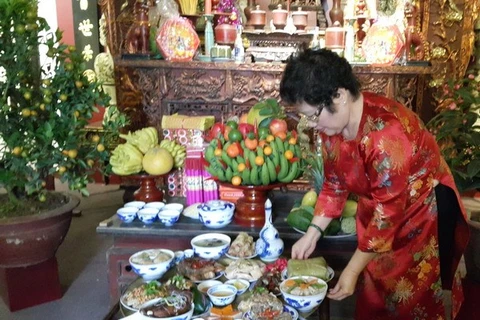
Traditional Tet food offerings to ancestors ảnh 1Food offerings to ancestors in Hue on Lunar New Year's Day (Photo: VNA)

Hanoi (VNA) – During the Lunar New Year (Tet) festival, each ethnic group in Vietnam has its own culinary specialties that reflect the culture of their people and are used as offerings to worship their ancestors.

Most Kinh (Vietnamese ethnic majority) people start preparations a month before the festival.

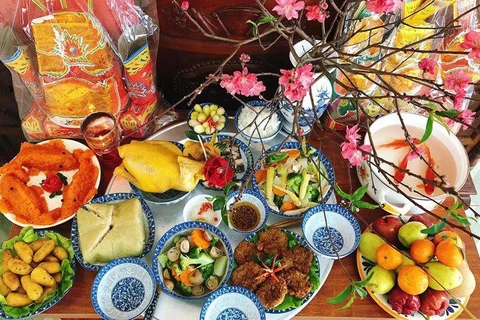
Many people usually prepare nine dishes: banh chung (square sticky rice cake), dua hanh (pickled onions), gio nac (boiled lean pork sausage) and gio thu (boiled pork head sausage), thit dong (frozen meat), nem ran (spring rolls), canh mang (bamboo shoot soup), canh bong tha (pork rind soup), boiled chicken, and che kho (sweet green bean paste).

These carefully cooked traditional dishes are put on the home altar to worship their ancestors during Tet festival.

Of all the dishes, banh chung is the soul of Tet, reflecting the quintessence of heaven and earth through the skilled hands of humans. To make the cake, the most fragrant and fibrous sticky rice are chosen and the cakes often have pork, green beans, dried onions and pepper in the centre.

The cakes are often eaten with pickled onion because its sour and light peppery flavour helps digestion. Meanwhile, gio nac and gio thu have remained on the offering food tray at Tet from the past to the present.

Nem (spring rolls) is a popular dish in the north that always has a place on a Tet food tray because it is so flavourful and healthy. It is made out of minced pork, carrots, wood ear fungus, green-bean sprouts, bean glass noodles and other ingredients. The fried rolls are then dipped into a bowl of sauce of mixed fish sauce, sugar, lemon or vinegar, chili and minced garlic.

The Tet food tray of northerners never lacks a big bowl of canh mang kho (dried bamboo shoot soup).

Ethnic groups, such as the Mong, Thai, Muong, Tay, Nung, Dao, and Co Tu, have their own New Year dishes. 

For the Mong, their Tet tray should include dishes such as pork, wine, round cakes made from glutinous rice and maize cakes.

Fried fish is the specific dish of the Thai. They believe the stream deity will protect them from danger.

The Nung group often made banh khao from dried glutinous rice powder, minced pork fat and sugar to worship their ancestors. The elderly said the sweet fat in the cake would prevent unlucky happenings in the New Year.

Meanwhile, the Co Tu in Tay Nguyen (the Central Highlands) make their own wine known as ruou Ta Vat and ruou can to welcome Tet. All visitors at New Year are invited to enjoy these wines.

Each Dao household has its own thit lon chua (sour pork), locally known as o sui, in New Year holidays. Ingredients include pork, salt, and cool rice. The dish should be eaten with la lot (wild lolot leaves) and la prang lau (a kind of wild leaf), and dipped in a bowl of mixed lemon and chili. 

The Tay welcome Lunar New Year with a roast piglet. They often choose local piglets with small bones, firm and lean meat weighing from 20kg to 30kg. People often put mac mat (a kind of wild leaf and fruit) mixed with spices in the pig’s belly and cover the skin with honey. They then roast it on charcoal for three hours until well done. The food is dipped in a sweet and fragrant sauce gotten from the pig’s belly./.
VNA

See more

Artisans and students take part in cultural activities and exchanges in the Xoan singing performance space at Hung Lo ancient communal house in Phu Tho province (Photo: VNA)

Ancestral legends revived through contemporary performance

Beyond cultural value, well-organised festival programmes linked with tourism and media can contribute to the development of cultural industries and enhance Vietnam’s cultural soft power, positioning heritage-based events as distinctive national cultural brands in the international arena.

Khue Van Cac (Khue Van Pavilion) stands as a defining cultural symbol of Hanoi, closely associated with Vietnam’s long-standing tradition of valuing education and honouring knowledge. (Photo: VNA)

Greater efforts needed for heritage to shape Hanoi’s identity

As suggested by UNESCO experts, heritage should be approached as an integrated system encompassing space, people and everyday life. This perspective can inform urban planning, cultural tourism development and the creation of clear economic drivers.

Participants at the gathering (Photo: VNA)

Lao, Cambodian students welcome traditional New Year in Ho Chi Minh City

In his speech, Vice Chairman of the municipal People’s Committee Nguyen Manh Cuong said the municipal Party organisation, authorities and people always value the close ties and solidarity among Vietnam, Laos and Cambodia. He described the three nations’ longstanding ties, forged through shared hardships, as an invaluable spiritual asset and a bedrock for sustainable development.

Vietnamese kickboxers win 32 gold medals at the Kickboxing World Cup 2026. (Photo: Vietnam Kickboxing Federation)

Vietnam finish third at Kickboxing World Cup 2026

According to Vu Duc Thinh, President of the Vietnam Kickboxing Federation, the strong results reflected careful preparation by local training centres and the determination of Vietnamese fighters. The team’s participation, funded largely through socialised and local resources, also demonstrated growing support for the development of kickboxing in Vietnam.

Politburo member, Secretary of the Party Central Committee and Head of the Party Central Committee’s Commission for Information, Education and Mass Mobilisation Trinh Van Quyet speaks at the event (Photo: VNA)

National Radio Festival opens in Quang Ninh

The opening night was combined with an artistic programme titled “sounds of the new era,” drawing around 50,000 spectators. The programme was structured in three chapters: Origins of Sound, Heritage Sound, and Sound of the New Era.

Vietnamese puppetry faces pressure to adapt to modern lifestyles, particularly amid growing competition from diverse entertainment forms (Photo: VNA)

Vietnamese puppetry seeks renewal amid preservation challenges

People’s Artist Nguyen Hoang Tuan, Chairman of the Hanoi Theatre Association, noted that while northern Vietnam had 27 puppetry guilds in 1986, only 14 remain today. Many traditional plays and original scripts have been lost, hurting restoration and preservation efforts.

Visitors enjoy the "Stone History Preserves Memories" exhibition, featuring a traditional format combined with digital technology solutions (Photo: VNA)

Project on digital transformation in cultural sector approved

By 2030, the project targets the establishment of shared digital platforms across 100% of cultural sectors. All digitised cultural heritage will be standardised under the national data framework and shared in accordance with regulations, while 80% of public digital heritage assets are expected to receive digital identifiers to clarify ownership and management, encouraging organisations and individuals to do the same and support market development.