Uber, Grab hit Vinasun revenues

In the last three years, ride-hailing applications Uber and Grab have decimated the business of local taxi firms. Now, taxi companies’ foreign shareholders are feeling the pain.
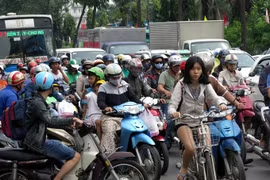
Uber, Grab hit Vinasun revenues ảnh 1In the first half of 2017, Vinasun performed even worse as its net revenue dropped 16 percent year on year to 1.9 trillion VND and its post-tax profit declined by a third to 100 billion VNA. (Photo: tuoitre.vn)
Hanoi (VNS/VNA)– In the last three years, ride-hailing applications Uber and Grab havedecimated the business of local taxi firms. Now, taxi companies’ foreignshareholders are feeling the pain.

One of the most affected companies is Vinasun, which mainly operates in thesouth and has 678.6 billion VND (30.16 million USD) in charter capital.According to the economic and financial news site cafef.vn, Vinasun hasreported slower growth rates in both net revenue and profit since the two appsentered Vietnam in mid-2014.

From 2010-15, Vinasun’s net revenue increased from over 1.64 trillion VND to 4.25trillion VND. The HCM City-based taxi company also recorded that its post-taxprofit grew from 179.4 billion VND to 329.3 billion VND. In 2016, however, thecompany’s net revenue grew at a slower pace to reach 4.5 trillion VND, whileits post-tax profit fell to roughly 312 billion VND.

In the first half of 2017, Vinasun performed even worse as its net revenuedropped 16 percent year on year to 1.9 trillion VND and its post-tax profitdeclined by a third to 100 billion VND.

In the past nine months, the company also had to cut its payroll by nearly8,000 employees to about 9,200 from 17,170 in 2016. The 2016 figure representedan increase by a fifth from around 14,200 employees in 2013.

Much of the downward trend in Vinasun’s business is attributed to strongcompetition since Uber and Grab entered Vietnam in2014, cafef.vn reported.

A large number of drivers that were removed from Vinasun’s payroll have turnedto work for Uber and Grab.

Lower performance in recent years has sent shares of Vinasun on the HCM StockExchange down by 51 percent from the record high of 37,580 VND (1.67 USD) pershare in early December 2014.

Vinasun’s shares, listed under code VNS, closed on October 10 at 18,450 VND pershare.

Over time, the fall of Vinasun’s shares has caused big losses for shareholders,especially the two Singaporean investment funds TAEL Partners and Government ofSingapore (GIC), as those two funds started investing in Vinasun in 2013-14when the company was at its strongest.

In late 2013, TAEL Partners bought three million shares of Vinasun, equal to a6.9 percent stake, via a private placement at 45,000 VND per share.

In 2014, TAEL Partners increased its ownership in Vinasun to 18.3 percent,equal to more than 12.4 million shares, becoming the biggest shareholder of thecompany.

Cafef.vn reported that the total value of purchases made by TAEL Partnerswas 383 billion VND. As shares of Vinasun have dropped 51 percent in value,TAEL Partners’ investment in the taxi firm has lost 40 percent, and is nowworth 221 billion VND.

GIC bought 4.5 million shares of Vinasun in August 2014, equal to a 7.96 percentstake, for 203 billion VND, and its ownership in the taxi firm has remainedsteady since then.

At the moment, the value of VNS shares held by GIC is around 96 billion VND,down 53 percent from the initial figure.-VNA 
VNA

See more

Phuong Dinh Anh, Deputy Chief of the Office of the Central Coordination Office for the National Target Programme, speaks at the event.( VNA)

Turning OCOP products into rural tourism experiences

Experts stressed that rural tourism can develop sustainably only when local communities actively participate and benefit from it. Investment in transport, accommodation and attractions must go hand in hand with clean water, waste treatment, hygiene, traditional craft preservation and environmental protection.

Prime Minister Le Minh Hung and his Cambodian counterpart Hun Manet witness the exchange of cooperation agreements between businesses of the two countries (Photo: VNA)

Vietnam, Cambodia look to elevate economic links

Prime Minister Le Minh Hung said that economic, trade and investment cooperation constitutes an important pillar of bilateral ties, which has achieved positive results. However, considerable room remains for further expansion to match the strong political ties and the potential of both countries.

An overview of the meeting (Photo: chinhphu.vn)

Deputy PM calls for tighter price management of essential goods

Deputy PM Thang, who is also head of the committee, urged ministries and agencies to coordinate closely to deliver effective fiscal and macroeconomic policies. The aim is to control inflation, stabilise the macroeconomy, ensure major economic balances, create room to support growth and bolster the economy’s resilience to external shocks.

 Khanh Binh International Land Border Gate in An Giang province.( Photo: VNA)

Vietnam-Cambodia trade gathers pace towards 20 billion USD target

After setting a record of more than 11.3 billion USD in 2025, bilateral trade reached about 8.7 billion USD in the first eight months of 2026, up 8.3% year on year. Vietnam is currently Cambodia’s third-largest trading partner, its second-largest source of imports and second-largest export market.

Vietnamese Ambassador to India Trinh Minh Manh discusses potential areas and strengths for cooperation between Vietnam and India’s Gujarat state. (Photo: VNA)

Vietnam, India’s Gujarat state seek to unlock cooperation potential

Vietnam attaches importance to strengthening cooperation with Indian states boasting strong economic potential, including Gujarat, to further advance the two countries’ Enhanced Comprehensive Strategic Partnership, particularly in the economy, trade and investment, said Ambassador Trinh Minh Manh.

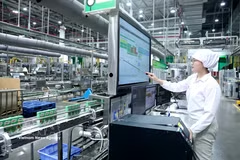
At Nestlé Vietnam factory in Hung Yen province (Photo: VNA)

Vietnam seeks to build stronger ecosystem for FDI

The World Bank has stressed the need to connect global companies with domestic suppliers, improve the business climate and develop supply-chain finance solutions. Those steps will let domestic firms gradually meet requirements on quality, technology, costs and delivery times, and position them to become suppliers to multinational corporations.

Construction of technical infrastructure facilities serving APEC 2027 in Phu Quoc Special Zone, An Giang province. (Illustrative photo: VNA)

Vietnam enters investment grade credit rating category for first time

Vietnam has maintained robust growth, outperforming other Southeast Asian economies. Its ongoing government reforms aimed at streamlining the state apparatus, promoting the private sector, improving the institutional framework and developing capital markets will strengthen the country’s growth potential and economic resilience.

Vietnamese Prime Minister Le Minh Hung and Lao Prime Minister Saleumxay Kommasith witness the presentation of investment certificates and investment cooperation agreements between businesses of the two countries. (Photo: VNA)

Vietnam, Laos strengthen “strategic cohesion” in economic sector

The great friendship, special solidarity, comprehensive cooperation and strategic cohesion between Vietnam and Laos, and between Laos and Vietnam, are an invaluable asset of the Vietnamese and Lao Parties, States and people. It is the responsibility of today's generation to transform this invaluable political asset into new resources for the development of the two countries’ people.

West Food Hau Giang JSC’s factory at the Nam Song Hau Industrial Park – Phase 1, Can Tho city (Photo: VNA)

Southern industrial property market enters new phase of competition

Industrial site selection was previously driven largely by land prices, location and access to markets. However, as supply chains become more complex and manufacturing projects face higher technical requirements, businesses are increasingly assessing sites based on their long-term operational capabilities.

Members of the RoK delegation visit booths showcasing signature agricultural products of Da Lat – Lam Dong. (Photo: VNA)

Lam Dong seeks stronger economic, tourism links with RoK

Lam Dong is particularly interested in sectors in which Korean businesses have strengths, including agriculture, green energy, the circular economy, high-quality tourism, healthcare, education, human resources training and digital transformation, an official said.