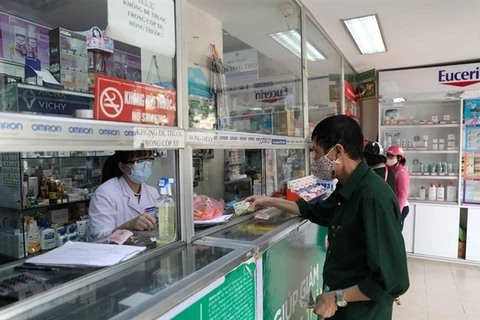
The 2021-2023 Partnership to fight against AMR in Vietnam between the Vietnamese Ministry of Health (MoH)’s Medical Service Administration, the British Embassy in Vietnam and the Representative Office of GSK Pte Ltd in Vietnam is signed on November 26. (Photo: VNA)
 Hanoi (VNA) – Vietnam and the United Kingdom will cooperate in fighting against antimicrobial resistance (AMR) in Vietnam over the next three years, according to a Memorandum of Understanding signed in Hanoi on November 26.
The 2021-2023 Partnership to fight against AMR in Vietnam between the Vietnamese Ministry of Health (MoH)’s Medical Service Administration, the British Embassy in Vietnam and the Representative Office of GSK Pte Ltd in Vietnam was signed on the occasion of the World Antibiotic Awareness Week.
This healthcare partnership aims to support the Vietnamese government’s long-term strategy articulated in the “National Action Plan on AMR”, and aligns with the initiatives of the UK Government to support developing countries in solving the AMR problem.
“The National Action Plan on Antimicrobial Resistance for the 2013-2020 period and development of a strategy for the next five years are among the most important focuses of the health sector,” said Assoc. Prof. Luong Ngoc Khue, Director of the Medical Service Administration and Deputy Head of the MoH’s Vietnam National Steering Committee for AMR.
“With the companionship of the UK Government and companies in the health sector such as GSK, the fight against AMR in Vietnam will be approached in a more comprehensive way. Ongoing medical training programmes for healthcare professionals and awareness raising support, community education are also planned to improve the effectiveness of fighting against this medical burden”, he said.
British Ambassador to Vietnam Gareth Ward said: “The UK is committed to working with Vietnam on tackling health issues like AMR and we have raised the level of ambition within our strategic partnership agreement."
“Antimicrobial resistance is becoming a global health crisis and we need to increase our collective efforts to address this challenge in order to secure the health and wellbeing of our future generations.”
AMR is one of the world’s most critical healthcare challenges. It is caused by the inappropriate use of medicines, for example using antibiotics for viral infections such as cold or flu, or sharing antibiotics; low-quality medicines, wrong prescriptions and poor infection prevention and control also encourage the development and spread of drug resistance. It is estimated that by 2050, the number of people dying from antimicrobial resistance could reach 10 million.
In Vietnam, the rate of AMR is among the highest in Asia, causing thousands of deaths annually./.
The 2021-2023 Partnership to fight against AMR in Vietnam between the Vietnamese Ministry of Health (MoH)’s Medical Service Administration, the British Embassy in Vietnam and the Representative Office of GSK Pte Ltd in Vietnam was signed on the occasion of the World Antibiotic Awareness Week.
This healthcare partnership aims to support the Vietnamese government’s long-term strategy articulated in the “National Action Plan on AMR”, and aligns with the initiatives of the UK Government to support developing countries in solving the AMR problem.
“The National Action Plan on Antimicrobial Resistance for the 2013-2020 period and development of a strategy for the next five years are among the most important focuses of the health sector,” said Assoc. Prof. Luong Ngoc Khue, Director of the Medical Service Administration and Deputy Head of the MoH’s Vietnam National Steering Committee for AMR.
“With the companionship of the UK Government and companies in the health sector such as GSK, the fight against AMR in Vietnam will be approached in a more comprehensive way. Ongoing medical training programmes for healthcare professionals and awareness raising support, community education are also planned to improve the effectiveness of fighting against this medical burden”, he said.
British Ambassador to Vietnam Gareth Ward said: “The UK is committed to working with Vietnam on tackling health issues like AMR and we have raised the level of ambition within our strategic partnership agreement."
“Antimicrobial resistance is becoming a global health crisis and we need to increase our collective efforts to address this challenge in order to secure the health and wellbeing of our future generations.”
AMR is one of the world’s most critical healthcare challenges. It is caused by the inappropriate use of medicines, for example using antibiotics for viral infections such as cold or flu, or sharing antibiotics; low-quality medicines, wrong prescriptions and poor infection prevention and control also encourage the development and spread of drug resistance. It is estimated that by 2050, the number of people dying from antimicrobial resistance could reach 10 million.
In Vietnam, the rate of AMR is among the highest in Asia, causing thousands of deaths annually./.
VNA