Unique style of Red Dao traditional outfits

Vietnam is home to 54 ethnic groups, each of which has its own identity and unique values in terms of customs and traditions, contributing to the cultural diversity in the country.
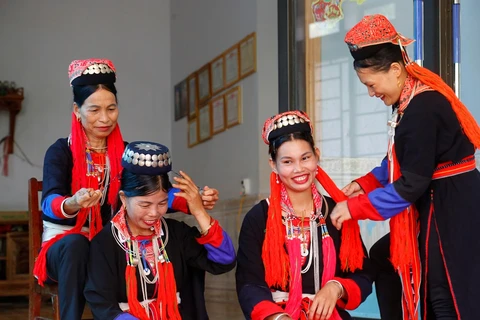
Unique style of Red Dao traditional outfits ảnh 1The Red Dao are a subgroup of the Dao people. (Photo: VNA)

Hanoi (VNA) – Vietnam is home to 54 ethnic groups, each of which has its own identity and unique values in terms of customs and traditions, contributing to the cultural diversity in the country.

One of the groups is the Dao ethnic minority people who reside, for the most part, in the mountainous northern provinces of Tuyen Quang, Cao Bang, Ha Giang and Lang Son. The Red Dao are a subgroup of the Dao people, renowned for their colourful traditional costumes that leave an indelible impression on visitors.

Tuyen Quang is home to nearly 91,000 Dao people from nine different subgroups, with the Red Dao people living mostly in the districts of Na Hang and Lam Binh.

For the Red Dao, the way they dress symbolises their ethnicity and distinguishes them from others. They are easily identifiable by the predominance of red in their clothing as the colour is believed to bring luck, happiness, prosperity and positive energy to everybody.

The traditional Red Dao art of costume decoration in Tuyen Quang’s districts of Na Hang, Lam Binh, Chiem Hoa, Ham Yen and Son Duong was recognised by the Ministry of Culture, Sports and Tourism as a national intangible heritage last year.

Unique style of Red Dao traditional outfits ảnh 2Red Dao women’s traditional costumes are decorated with unique patterns and jewellery. (Photo: VNA)

This traditional art has a long history. In the remote villages of the Red Dao people, women still make traditional clothing for themselves and other family members.

It is said that the traditional costume of the Red Dao is the most famous of all in Vietnam, with a typical outfit including a tunic, trousers, headscarf, cloth belt and jewellery.

There are five colours – red, blue, white, yellow and black – needed in making a traditional Red Dao costume, but red should be the most prominent.

With women’s clothing, the most important piece is the long indigo or black tunic with highlighted brocade patterns on the front or cuffs. The blouse, divided into four parts, reaches down to mid-thigh, accompanied by a belt with many different coloured tassels. The embroidered patterns and designs are composed of coloured trees, flowers, mountains and animals. The trousers are often in plain black and tailored with rich patterns, such as squares, rectangles, pine trees and rhombuses, in the lower parts.

The most eye-catching feature must be the colourful headscarf, which is the main thing that differentiates the Red Dao from other minorities. The headscarf is folded to make it thicker and larger than many other ethnic headscarves.

Unique style of Red Dao traditional outfits ảnh 3Unique decorative motifs and jewellery on Red Dao women’s traditional outfits. (Photo: VNA)

All the patterns on a Red Dao traditional costume are entirely hand-sewn by Red Dao women which takes a tremendous amount of time. Each costume takes at least a year to make, some even up to two years. They are highly individualised yet convey a solid cultural message through each decorative pattern.

The Red Dao girls are taught from the age of nine or ten how to embroider and sew. They will use these skills to attract a future husband and show their value as a wife to their families-in-law.

The men’s traditional outfits are simpler, including only a headscarf, a short tunic, and trousers.

Red Dao costumes vary by regions. There are differences in the way Red Dao people in each region wear tunics, headscarves, belts and other accessories. In some places, Red Dao people wear a string of nine or 11 large red cotton balls around their neck.

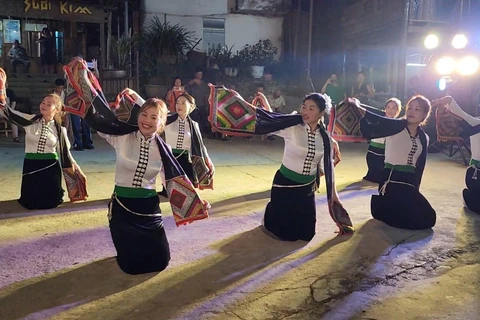
They often dress in their most beautiful and colourful outfits during traditional festivals, for weddings or on the occasion of welcoming special guests to their home./.
VNA

See more

The Executive Committee of the Vietnam Ao Dai Heritage Club in Laos make debut. (Photo: VNA)

Ao dai helps promote Vietnamese culture in Laos

The club operates under the Vietnam Ao Dai Heritage Club of the Vietnam Cultural Heritage Conservation Support Fund, aiming to preserve and promote the values of the Vietnamese traditional dress among the Vietnamese community in Laos.

Head of the Party Central Commitee's Commission for Information, Education and Mass Mobilisation Trinh Van Quyet (first, right) presents A prize to the winning authors and groups of authors. (Photo: VNA)

More than 50 outstanding books honoured at 8th National Book Awards

Two A prizes, the highest distinction of the awards, were granted to Lich su Vietnam bang hinh (Vietnamese History in Pictures) by Dong A and multiple authors, jointly published by the Publishing House of Hanoi National University of Education and Dong A Culture Joint Stock Company.

An Ao dai collection of Lan Huong brand is introduced at the event (Photo: VNA)

Journey to bring Vietnam’s 'Ao dai' to global fashion stage

With support from the Embassy of Vietnam in the UK, Vietnamese associations across Europe, as well as business and artistic communities, the initiative seeks to establish the 'Ao dai' brand on the world fashion map. After London, the project is expected to travel to Paris and Milan, two of the world’s leading fashion capitals, to further showcase Vietnam’s cultural identity.

Tokyo Girls Collection will launch a fashion and music festival in Vietnam. (Photo: www.sggp.org.vn)

Tokyo Girls Collection Vietnam 2026 to debut in Ho Chi Minh City

The first day of TGC Vietnam will be open to the public free of charge and focus on fashion and lifestyle experiences. Activities will include Vietnam–Japan cultural exchanges, food and shopping spaces, Harajuku-inspired check-in areas, and runway shows featuring Japan’s distinctive fashion DNA.

An art performance at the event (Photo: VNA)

Vietnamese culture promoted in France

It featured traditional melodies such as the ‘dan tinh’ (a kind of musical instrument) and 'then' singing of the Tay ethnic group, Quan ho (love duet) folk songs from Bac Ninh, as well as northern and southern Vietnamese folk music, 'cai luong' (reformed opera) excerpts and well-known songs celebrating the homeland, spring and love.

An exhibition of paintings and books titled “Vietnamese Soul on French Soil” opens on March 7 in Val-de-Marne, part of the Ile-de-France region. (Photo: VNA)

Exhibition of paintings and books celebrates Vietnamese spirit in France

More than an art exhibition, the event brought together Vietnamese intellectuals and artists living in France who, despite building successful careers abroad, have continued to maintain strong ties with the homeland. It also attracted French friends who have long-standing connections with Vietnam and hold deep affection for the country.

Ao dai (traditional long dress) and other traditional Vietnamese attire showcased at the Vietnam Festival 2026 in Osaka (Photo: VNA)

Vietnam Festival 2026 in Osaka spreads Vietnamese culture

Vietnam Festival 2026 in Japan is not only a cultural celebration rich in Vietnamese identity for the community in Japan, but also a vivid symbol of solidarity and close ties among overseas Vietnamese towards their homeland.

Chef Anna Le (in red dress) shares techniques and secrets for preparing Vietnamese vegetarian dishes using simple yet flavourful ingredients. (Photo: VNA)

Vietnamese vegetarian cuisine promoted to diplomatic community in US

In Vietnam, vegetarian food is not merely a dietary choice but also a philosophy rooted in peace, compassion, and a deep respect for nature. It reflects the Vietnamese soul - gentle yet flavourful, simple yet sophisticated. Familiar ingredients such as lotus seeds, tofu, mushrooms and fresh herbs are transformed into light, nutritious dishes that embody the essence of Vietnamese gastronomy.

A performance of Vietnamese artists at the opening ceremony of the 11th Japan-Vietnam Festival (Photo: The organising board)

Vietnam–Japan festival strengthens people-to-people ties

After more than a decade of development, the Japan-Vietnam Festival in Ho Chi Minh City has become a significant international cultural exchange event and a vivid symbol of the strong and enduring friendship between the two nations.

Visitors admire a large driftwood sculpture measuring nearly 25 metres in length and weighing around 20 tonnes, regarded as one of the most intricate works of its kind in Vietnam. (Photo: VNA)

Driftwood “museum” in middle of Tien River

What were once tree trunks lying silently beneath the muddy waters have, through his hands, become singular sculptural works, forming an unusual visitor attraction amid the waterways of southern Vietnam.

Coaches and players of the national women's U20 team discus before their training. The team will compete in the AFC U20 Women’s Asian Cup 2026 next month in Thailand. (Photo: VNA)

Vietnam women chase U20 World Cup dream

The Vietnamese women squad will compete in the AFC U20 Women’s Asian Cup 2026, the crucial World Cup qualifying tournament, from April 1-18 in Thailand. Drawn in Group A, they will face stiff competition from China, Bangladesh and the host nation.

UBD students decorate traditional Vietnamese and Bruneian motifs during a cultural exchange (Photo: VNA)

Vietnamese embassy in Brunei promotes cultural diplomacy

The Vietnamese Embassy in Brunei has partnered with Universiti Brunei Darussalam (UBD) and the Veteran Association of the Royal Brunei Armed Forces (VARBAF) to host a series of events introducing Vietnam’s traditional Tet festivities, creating a lively platform for cultural exchange while spreading the Vietnamese language and traditional handicrafts to Bruneian friends and students.