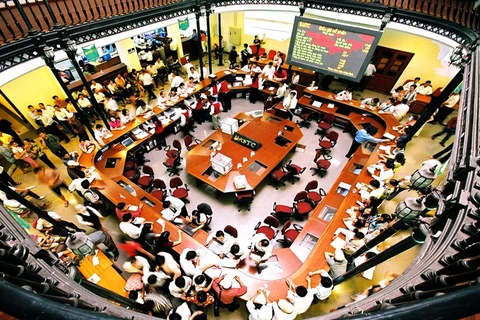
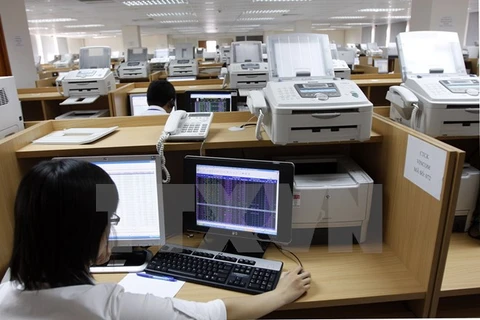
Outside the Hanoi Stock Exchange (Photo: VNA)
 Hanoi (VNA) - The capitalisation of the Unlisted Public Company Market (UPCoM) has rocketed 100 times to reach 444 trillion VND (19.73 billion USD) after eight years of operation.
The number of traded companies has also risen from about 40 in 2009 to 568 in 2017, making the scale of UPCoM 2.4 times bigger than the listed market on the Hanoi Stock Exchange.
The secondary market for unlisted companies also recorded a 50-times increase in its daily trading value, which has reached an average of 197.7 billion VND from 4 billion VND in 2009.
UPCoM was first launched by the HNX on June 24, 2009 to narrow and limit the trading of companies’ shares on the free, unmanaged market and expand the Government-managed market.
After eight years of operation, UPCoM has undergone significant changes to draw attention from businesses and increase its attractiveness to investors by improving its trading criteria and applying the online trading mechanism.
Those efforts have helped companies, whose shares are traded on UPCoM, become listed companies on the HCM and Hanoi stock exchanges and raise the transparency of both markets and their businesses.
To celebrate the eighth anniversary of UPCoM, the HNX has issued a new mechanism that divides UPCoM into three categories by companies’ market capitalisation in order to improve trading conditions for the secondary market.
The three levels are the UPCoM Large for 40 companies, which have more than 1 trillion VND in their charter capital, UPCoM Medium for 70 companies, which have charter capital of between 300 billion VND and 1 trillion VND, and UPCoM Small for the remaining 379 companies that have charter capital of between 10 billion VND and 300 billion VND.
The new firm categorisation also marks new efforts of HNX to improve its monitoring and supervision over UPCoM, which has a variety of companies, capitalisation, quality and sectors.
On the listed market, the number of listed companies has increased to 377 in 2017 from 257 in 2009 with total market capitalisation of 183 trillion VND and average market trading liquidity in each session reaching 500-600 billion VND.
A lot of large-cap firms have become listed on the northern bourse, such as Asia Commercial Bank (ACB), Hai Phong Port JSC (PHP), insurance-finance group PVI Holdings (PVI) and PetroVietnam Technical Services (PVS).
In the future, the HNX will apply the market maker mechanism to increase and improve the trading of listed shares.
Market makers will be able to connect investors together, creating opportunities for low-liquidity shares to be attractive to investors.
The number of traded companies has also risen from about 40 in 2009 to 568 in 2017, making the scale of UPCoM 2.4 times bigger than the listed market on the Hanoi Stock Exchange.
The secondary market for unlisted companies also recorded a 50-times increase in its daily trading value, which has reached an average of 197.7 billion VND from 4 billion VND in 2009.
UPCoM was first launched by the HNX on June 24, 2009 to narrow and limit the trading of companies’ shares on the free, unmanaged market and expand the Government-managed market.
After eight years of operation, UPCoM has undergone significant changes to draw attention from businesses and increase its attractiveness to investors by improving its trading criteria and applying the online trading mechanism.
Those efforts have helped companies, whose shares are traded on UPCoM, become listed companies on the HCM and Hanoi stock exchanges and raise the transparency of both markets and their businesses.
To celebrate the eighth anniversary of UPCoM, the HNX has issued a new mechanism that divides UPCoM into three categories by companies’ market capitalisation in order to improve trading conditions for the secondary market.
The three levels are the UPCoM Large for 40 companies, which have more than 1 trillion VND in their charter capital, UPCoM Medium for 70 companies, which have charter capital of between 300 billion VND and 1 trillion VND, and UPCoM Small for the remaining 379 companies that have charter capital of between 10 billion VND and 300 billion VND.
The new firm categorisation also marks new efforts of HNX to improve its monitoring and supervision over UPCoM, which has a variety of companies, capitalisation, quality and sectors.
On the listed market, the number of listed companies has increased to 377 in 2017 from 257 in 2009 with total market capitalisation of 183 trillion VND and average market trading liquidity in each session reaching 500-600 billion VND.
A lot of large-cap firms have become listed on the northern bourse, such as Asia Commercial Bank (ACB), Hai Phong Port JSC (PHP), insurance-finance group PVI Holdings (PVI) and PetroVietnam Technical Services (PVS).
In the future, the HNX will apply the market maker mechanism to increase and improve the trading of listed shares.
Market makers will be able to connect investors together, creating opportunities for low-liquidity shares to be attractive to investors.
In the past eight years, listed companies have raised more than 69 trillion VND for their business activities in the context that they have difficulties getting access to bank loans due to high lending rates.
The HNX has worked with the Vietnam Securities Depository (VSD) and the State Securities Commission (SSC) to develop the derivatives market in order to provide a new product for investors and improve the quality of the Vietnamese securities market.
To make sure the derivatives market operates properly in its early stage, the HNX will launch the first product, which is the futures contract for the VN30 Index, which contains shares of the 30 largest companies by market capitalisation.
After two years of preparation, the HNX has completed developing the facility and infrastructure for the new market and connected with banks, as settlement units, and brokerages, as market members.
Transforming from the Hanoi Securities Trading Centre on June 24, 2009, the HNX has risen and affirmed its positive position in Vietnam’s securities market and received a lot of honourable awards from the Government, the State and the finance ministry.-VNA
The HNX has worked with the Vietnam Securities Depository (VSD) and the State Securities Commission (SSC) to develop the derivatives market in order to provide a new product for investors and improve the quality of the Vietnamese securities market.
To make sure the derivatives market operates properly in its early stage, the HNX will launch the first product, which is the futures contract for the VN30 Index, which contains shares of the 30 largest companies by market capitalisation.
After two years of preparation, the HNX has completed developing the facility and infrastructure for the new market and connected with banks, as settlement units, and brokerages, as market members.
Transforming from the Hanoi Securities Trading Centre on June 24, 2009, the HNX has risen and affirmed its positive position in Vietnam’s securities market and received a lot of honourable awards from the Government, the State and the finance ministry.-VNA
VNA