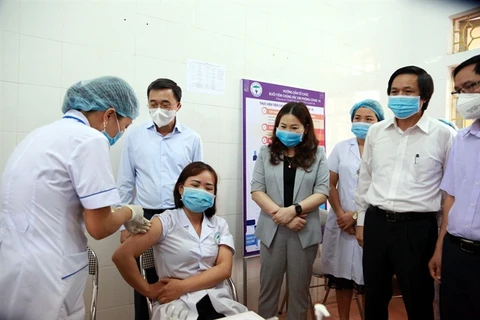
Fontline workers in the northern province of Ninh Binh receive COVID-19 vaccines. (Photo: VNA)
Hanoi (VNA) – US’s news outlets have highlighted Vietnam’s strategies to stamp out the COVID-19 outbreak which they describe as effective and credit as a key factor that help the country keep coronavirus deaths to just 35 and expand its economy in 2020.
Early last year, when the US and European countries still focused on keeping out travelers from places with known COVID-19 cases, Vietnam closed its borders to the world, Vox.com said in a story published earlier this week.
When China locked down Wuhan last January and bought other countries time to react, Vietnam was one of only a handful of countries that used that time wisely, it said, adding that officials in Vietnam didn’t entertain the possibility that the coronavirus was just like the seasonal flu, nor did they consider herd immunity.
Everybody who enters needs special government permission and must complete up to 21 days of state-monitored quarantine with PCR tests. Positive cases are immediately isolated in hospitals, regardless of disease severity.
In January, the Vietnamese government set up a national task force specialised in handling pandemic, headed by a deputy prime minister, and defined a “double goal” of combating the virus and growing the economy.
 Hanoi tests all arrivals from areas with coronavirus infections between February 18 – 22. (Photo: VNA)
 The country’s officials and Party made battling COVID-19 a patriotic act. “Fight this epidemic like fight the enemy,” the prime minister said in a government meeting last January.
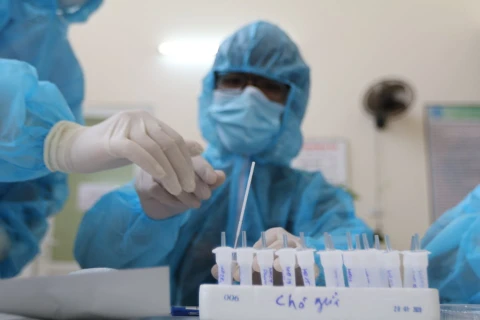
They transmitted health messages to the public using creative tactics, like texts to mobile phones or a viral pop song about hand-washing. They ramped up testing, starting in January 2020, and shortly thereafter began checking even asymptomatic people for the virus. By the end of last year, Vietnam was processing 1,000 tests per COVID-19 case, compared to 12.8 in the US or 21.7 in the UK.
Because the virus was quickly contained internally, the domestic economy rebounded and posted a 2.9 percent growth in 2020, it concluded.
The successes also helped foster public support for the anti-virus measures. According to a survey released in December by the UN Development Program and the Mekong Development Research Institute, 89 percent of the Vietnamese respondents said they supported the government’s approach — higher than the global average of 67 percent.
“Vietnamese people supported the government to continue having strict measures,” said Nguyen Xuan Thanh, a member of the Prime Minister’s Economic Advisory Group.
 Vietnamese returnees from the Republic of Korea arrive at Can Tho International Airport on March 14. (Photo: VNA)
Prudentpressagency.com, meanwhile, reported that while still half of the world is struggling against the COVID-19 pandemic, there are cases like Vietnam and Taiwan (China) that seem to have really defeated the virus.
In Vietnam where aside from a few small local closures, it is almost back to normal, with schools and restaurants opening, people going to concerts and clubs, with alert kept.
The country has closed itself literally since last March, and kept its borders shut even when it reached zero daily cases of coronavirus, especially due to fear of arrivals from neighbours.
“The fewer infections, the more valuable the border restrictions: they work better when they appear excessive, before or after virus transmission,” said Mark Jett, an epidemiologist at the London School of Hygiene and Tropical Medicine.
Even today, only certain groups of people, such as businessmen or experts, can enter the country, and in any case, anyone who wants to enter needs special government permits and must then proceed quarantine for 21 days under state control.
Added to this are other measures, such as contact tracing and targeted and timely testing, that allowed Vietnam to halt the circulation of the virus even before the start of the vaccination campaign./.