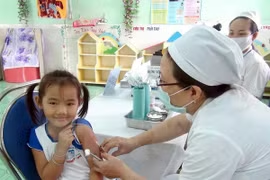
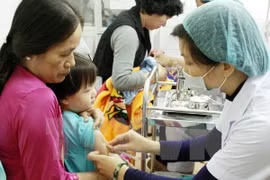
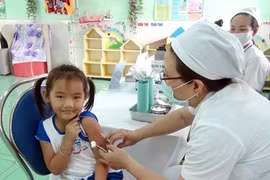
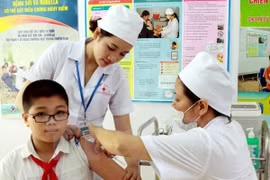
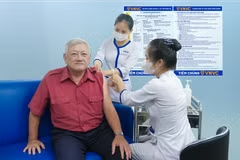
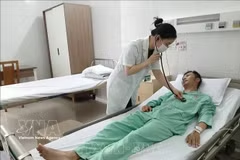
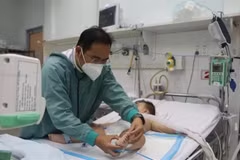
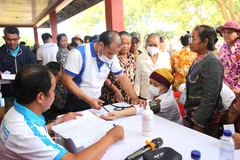
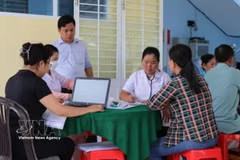
A baby receives vaccine against measles and rubella at Song Mai Health clinic in Song Mai commune, Bac Giang province (Photo: VNA)
Tran Dac Phu, Director of the Preventive Medicine Department, speaks to Vietnam News Agency about the quality of vaccines under the national programme on immunisation.
* What kinds of vaccine against infectious diseases are available in Vietnam and in the world?
As many as 30 vaccines against infectious diseases are available all over the world including tuberculosis, cholera, diphtheria, influenza B, hepatitis A, hepatitis B, seasonal influenza, Japanese encephalitis B, measles.
The new vaccines for prevention and treatment of diseases such as HIV, hepatitis C, cancer, malaria, TB are also being tested and are expected to give good results. Most of the vaccines have been used in Vietnam.
Vietnam is implementing 10 kinds of vaccines against 12 diseases in the EPI. All the vaccines are free of charge and being vaccinated at local health centres nation-wide. In addition, a number of other vaccines – foreign-produced vaccines that must be paid for – include vaccines against rabies, mumps, chickenpox, cervical cancer.
* What's your opinion on the quality of the vaccines in the EPI programme, specifically Hepatitis B and five-in-one Quinvaxem vaccine?
I have to confirm that the vaccines used in the expanded programme on immunisation are safe and effective in disease prevention for infants.
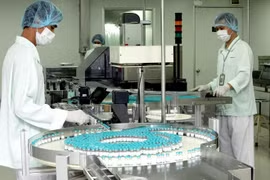
The hepatitis B vaccine birth dose immunisation, which has been used in the EPI in Vietnam since 2005, is a product of Vaccine and Biological Production No 1 Company. It is produced with advanced technology like the one currently being used in the US and other countries.
More than 6.5 million doses of this vaccine is given to infants between 2010-14. During that period, a number of complications after vaccination have been recorded but the ratio is within the limit given by the World Health Organisation (WHO). Families should not worry too much about the safety of vaccines that their children are not immunised. This might result in children infected with hepatitis B – a major cause of liver cancer in the future.
Quinvaxem Vaccine (five in one) is currently used for free in the expanded vaccination programme and is the combination vaccines to prevent five diseases in one shot, including diphtheria, pertussis, tetanus, hepatitis B, pneumonia and meningitis caused by Haemophilus influenza type B bacteria. This kind of vaccine, provided by the United Nations Children's Fund, is manufactured in the Republic of Korea and certified by the World Health Organisation.
The vaccines are used in 90 countries with over 400 million doses used safely. Therefore, families should take children to get Quinvaxem vaccine in the EPI programme without any worry. Like other vaccines, the Quinvaxem also has some side effects, such as fever, pain and swelling at the injection site. Severe reactions such as anaphylaxis after receiving vaccination are rare.
* Due to a shortage of relevant vaccines in paid vaccinations like six-in-one (Infranrix hexa) vaccine or five-in-one (Pentaxim), many mothers have recently been willing to wait and defer vaccination for their children. What is your advice for those families?
Currently, the six-in-one vaccines are scarce and the shortage should last until next year. The reason is manufacturers are changing locations and modifying their production lines.
Vietnam has recently been certified by WHO as eligible for exporting vaccines and the process of vaccination is strictly regulated by the Ministry of Health. Thus, people should trust the quality of the vaccines and take their children for Quinvaxem vaccine and other vaccines under the EPI at the right time instead of waiting for paid vaccinations.
* The expanded immunisation programme has made a lot of achievements over the past years. Can you talk about the effectiveness of the programme as well as difficulties and challenges that the health sector is facing?
Every year, Vietnam must inject millions of new-born children and each child must be vaccinated approximately 10 vaccines to prevent diseases.
This programme requires health workers skillful enough to ensure immunizations that are effective and safe. The vaccines should follow strict procedures.
The EPI has been implemented in Vietnam since 1985. Since then, hundreds of millions of doses of vaccines have been given free of charge for children and women to prevent serious diseases such as tuberculosis, diphtheria, pertussis, tetanus, hepatitis B.
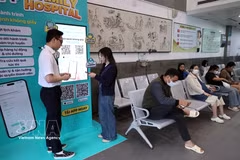
However, EPI work in Vietnam is facing many difficulties and challenges. Currently, vaccination is conducted regularly every month. Every year, Vietnam has to inject more than 1.5 million children and millions of women of childbearing age at over 30,000 vaccination centres.
Such an amount of work requires tight guidance on technique and responsibility of health workers to ensure the safety and efficiency of vaccinations.
The living conditions of health workers are poor because their wage is rather low compared with daily needs and they have no source of extra income. The state funding for the vaccinations is still limited while the actual demand is high.-VNA