Vietcombank’s bad debts lowest ever in 2020

The Joint Stock Commercial Bank for Foreign Trade of Vietnam (Vietcombank) recorded a bad debt ratio of 0.6 percent last year, the lowest so far and in the sector, compared to 0.78 percent in 2019.
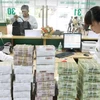
Vietcombank’s bad debts lowest ever in 2020 ảnh 1At a Vietcombank branch (Photo: VNA)

Hanoi (VNA) - The Joint Stock Commercial Bank for Foreign Trade of Vietnam (Vietcombank) recorded a bad debt ratio of 0.6 percent last year, the lowest so far and in the sector, compared to 0.78 percent in 2019.

Chairman of its Board of Directors Nghiem Xuan Thanh told the media that this is the first time in five years its profit has still stood at around 23 trillion VND (1 billion USD).

Vietcombank has introduced five lending interest rate cuts since early last year, the most among credit organisations, with a total reduction of around 3.7 trillion VND in profit.

The bank also rose provisional funds for bad debts up to 380 percent, or 380 VND for each 100 VND of bad debt; a record to date.

It posted credit growth of 13.95 percent last year, or some 110 trillion VND worth of new loans; much higher than the 8 percent recorded by the sector.

It contributed 9 trillion VND to the State budget. With stock market shares standing at 100,000 VND each on January 6, Vietcombank became the largest listed company, with capitalisation of around 390 trillion VND./.

VNA

See more

Businesses introduce Halal market products at the workshop. (Photo: VNA)

Da Nang businesses eye growth in booming global Halal market

Huynh Xuan Son, Deputy Director of the Da Nang Department of Industry and Trade, said the Halal market has emerged as a strategic destination for Vietnamese exporters amid persistent global economic uncertainties. Serving more than two billion consumers across over 110 countries and territories, the market offers significant opportunities for business expansion.

Vietnamese bananas are sold at an AEON supermarket in Japan. (Photo: VNA)

Vietnamese products promoted at AEON stores across Japan

Speaking at the opening ceremony, Deputy Minister of Industry and Trade Phan Thi Thang highlighted the significance of 2026, which marks a decade of cooperation between the ministry and AEON in organising Vietnam Week in Japan.

Growing demand for financing for infrastructure and green transition projects is driving Vietnam’s search for new sources of capital. In the photo: A section of Noi Bai – Lao Cai Expressway. (Photo: VNA)

Vietnam seeks to unlock capital for infrastructure, green transition

As Vietnam advances its sustainable growth agenda and commitment to achieving net-zero emissions by 2050, the need for long-term capital is rising rapidly. Experts say meeting these financing requirements will depend not only on expanding available resources but also on broadening funding sources and improving project financing models.

Private technology enterprises are increasingly viewed as a driving force at the heart of the innovation ecosystem. (Photo: VNA)

Vietnam pushes to develop world-class technology startups

Vietnam’s startup ecosystem now comprises roughly 4,000 startups, 208 investment funds, 84 incubators and more than 20 startup support centres. With an estimated valuation of 75 billion USD, the ecosystem has established most of the key foundations needed for long-term growth.

Officials of the Vietnamese Ministry of Finance and the Japan International Cooperation Agency (JICA) at the meeting in Hanoi (Photo: Ministry of Finance)

Finance Ministry, JICA to hasten major joint projects

JICA President Tanaka Akihiko said he is pleased to return to Vietnam and see landmark projects of bilateral ties now operational and delivering clear benefits to the public, including Nhat Tan Bridge and Ho Chi Minh City’s metro line No. 1.