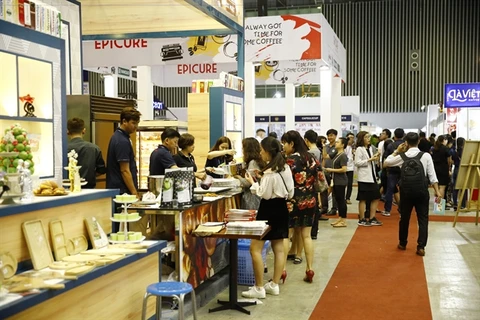
Mixue, a Chinese brand, is popular among young Vietnamese with some 1,000 shops set up across the nation. (Photo: VietnamPlus)
 Hanoi (VNA) - The explosive growth of beverage brands, especially milk tea in Vietnam, proves the attractiveness of a market of one hundred million people and is a result of franchising business activities.
However, how to manage the product quality across a chain of stores is a problem.
In Vietnam, franchise businesses are very popular, especially for products such as lemon and milk tea.
A recent report by Reputa, a data collection and analysis company, shows that in the field of food and beverage (F&B), milk tea continues to lead the list of drinks that receive the most discussions on social networks, accounting for nearly 40 per cent of all consumer discussions, followed by tea, juice and coffee.
 Vietnam’s food and beverage sector is promising for the franchise model. (Photo: VietnamPlus)
 Popular brands, such as Dingtea, TocoToco, Tiger Sugar, Phúc Long, and Gong Cha, have developed early in Vietnam and have a large market share.
For Mixue, a Chinese brand with two main ice cream and milk tea businesses, it has only been in Vietnam for about five years. But it has still experienced a very fast growth rate despite its relatively short tenure.
On the company's website, updated to April 11, Mixue has reached 1,000 stores in Vietnam.
Facing the exciting picture of this sector, economic experts believe that franchising is a quick and effective solution for new businesses entering the market by applying established business models.
More specifically, Quang San, an expert in the field of branding, said that the Vietnamese market is very attractive not only to domestic enterprises but also foreign investors due to the middle class and rising purchasing power.
With a small amount of capital, from 500 million VND (21,150 USD) to 1 billion VND, many people could own a shop without having to worry about building a brand.
For the beverage industry, specifically milk tea, he assessed that the product's life cycle was very short, so businesses speed up the building of chain stores.
“Because the recipe is simple, in the context of fierce competition, other businesses will also jump in, so it is very difficult to maintain a position in this field for a long time,” San told VietnamPlus online newspaper.
Let the market decide for itself
It can be seen that the Vietnamese beverage market, especially milk tea, is a potential market with dozens of competing brands.
However, many people think that businesses have not yet reached the professionalism necessary to support the franchising model.
Associate Professor Dr. Dinh Trong Thinh, lecturer at the Academy of Finance, said that franchising is a form of direct investment and this is a model that has existed for a long time in foreign countries.
Accordingly, the brand owner must comply with the franchising contract law, at the same time strictly control the production stages and processing technology and directly inspect the production process for which they have registered the copyright in the host country.
In Vietnam, this model has only developed within the last 10 years. Although some businesses have focused on controlling the chain system, from layout to recipe, many rely on selling the brand name, leaving franchisees to handle product quality and consistency themselves. Thus product quality is far from ensured.
In order for this field to develop, the expert said that the most important thing is to manage quality, ensuring it is true to the original business.
 Mixue, a Chinese brand with two main ice cream and milk tea businesses, has seen strong growth in the Vietnamese market. (Photo: VietnamPlus)
 Sharing the issue of the distance of selling points, Le Viet Nga, deputy Director of the Ministry of Industry and Trade’s Domestic Market Department, said that businesses could do things that are not prohibited by law.
That businesses opened consecutive stores next to each other depended solely on the decision of their owners, she said.
An official of the Vietnam Directorate of Market Surveillance said that except for conditional business items, which must follow far more detailed technical planning such as petrol and oil, other items are left to the whims of the franchisor and franchisee.
However, he also emphasised that those doing business following market rules without utilizing the competitive advantages of their products would eliminate themselves.
Franchise chain quality management requires strict adherence from business owners. When production is large-scale, it becomes difficult to maintain consistency and quality, he added./.