Vietnam climbs two places in global innovation index in 2023

Vietnam has continued to show progress in converting innovation input into output performance, climbing from 59th to 57th place, according to the Global Innovation Index (GII) in 2023.
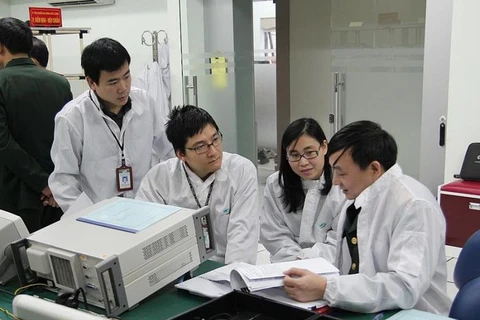
Vietnam climbs two places in global innovation index in 2023 ảnh 1Illustrative image (Photo: wipo.int)

Hanoi (VNA) - Vietnam has continued to show progress in converting innovation input into output performance, climbing from 59th to 57th place, according to the Global Innovation Index (GII) in 2023. 

The country leapt two places in the GII in 2023, ranking 46th out of 132 countries and territories, according to a GII report released by the World Intellectual Property Organisation (WIPO) on September 27.

According to the report, Vietnam continues to show progress in converting innovation input into output performance.

The country has jumped from 59th position last year to 57th position this year in terms of input level, while its output level rose one place to 40th position.

The GII input pillars include institutions, human capital and research, infrastructure, market sophistication, and business sophistication.

Meanwhile, the output performance indicators are knowledge and technology outputs and creative output.

Particularly, the country has maintained second position among lower middle-income countries in the overall GII after India (40th). Among ASEAN countries, Vietnam is behind Singapore, Malaysia, and Thailand.

According to WIPO, the country is among the most impressive innovation climbers of the last decade.

Vietnam , continues to be one of the three record holders by being innovation overperformers for a 13th consecutive year, along with India and the Republic of Moldova.

This year, Vietnam ranks 33rd in the unicorn valuation, and 66th in research and development (R&D) expenditure.

However, some indicators remain at low levels. Although the ecological sustainability index group improved by three places compared to last year, the ranking is still very low, at 110th place.

Among them, the most notable is the environmental performance index ranked 130th, continuing to decrease by two places year-on-year. This is an index that has consistently had a low ranking since 2017.

Institutional issues still require significant improvement to create favourable conditions for socio-economic development based on science, technology, and innovation.

The rule of law index ranked 72nd, down two places.

The regulatory quality index, after improving 10 places from 93rd to 83rd last year, dropped to 94th place this year.

The GII is a set of tools to evaluate the global innovation capacity of countries in the world, reflecting the socioeconomic development model based on science, technology, and innovation.

Countries can see the overall picture as well as their strengths and weaknesses via these indicators.

Recently, the Government has used this set of indicators as one of the important management tools and has assigned ministries, agencies and localities to be jointly responsible for improving the index.

In particular, the Ministry of Science and Technology is in charge of monitoring and general coordination.

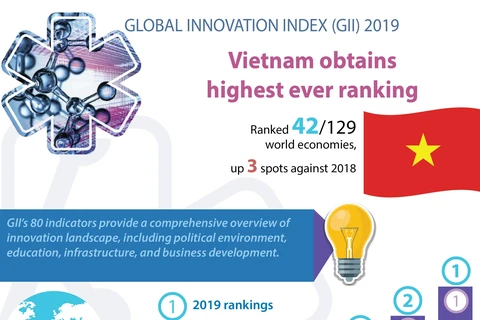
The country's GII has continuously improved from 2017 onwards, increasing from 59th position in 2016 to 42nd in 2019 and 2020, 44th in 2021, 48th in 2022, and 46th in 2023.

The GII takes the pulse of innovation against a background of an economic and geopolitical environment fraught with uncertainty. It reveals the most innovative economies in the world, ranking the innovation performance of around 132 economies while highlighting innovation strengths and weaknesses.

Envisioned to capture as complete a picture of innovation as possible, the index comprises around 80 indicators, including measures on the political environment, education, infrastructure and knowledge creation of each economy.

The different metrics that the GII offers help to monitor performance and benchmark developments against economies within the same region or income group./.
VNA

See more

Illustrative photo (Photo: VNA)

An Giang identifies key tasks in science-technology development

The priorities focus on four pillars: science and technology, innovation, digital transformation, and real-world applications to boost socio-economic development. These are expected to create breakthroughs in governance, production, and daily life.

Illustrative image (Photo: VNA)

Vietnam Research Excellence Fellowship for 2026-2030 approved

Under the Vietnam Research Excellence Fellowship (VREF) for the 2026–2030 period, PhD students are identified as a core research force directly contributing to breakthroughs in sci-tech and innovation. Investing in top-tier doctoral candidates is more than workforce development, but a high-stakes strategic bet to forge a cohort of world-class scientists and technologists who can power Vietnam’s long-term economic ambitions.

Participants in the ASEAN Plus Photonics Symposium in Gia Lai province on April 8 (Photo: baogialai.com.vn/)

Gia Lai province hosts ASEAN Plus Photonics Symposium

Participants presented and discussed a wide range of advanced topics shaping the future of photonics, including nanophotonics and metasurfaces; topological and non-Hermitian photonics; photonic crystals and optical lattices; light–matter interactions and polariton systems.

Vietnamese Ambassador to Brazil Bui Van Nghi (right) and Professor and quantum physicist Olival Freire Juniorin, President of Brazil's National Council for Scientific and Technological Development, at their meeting on April 7. (Photo: Vietnamese Embassy in Brazil)

Vietnam, Brazil to strengthen cooperation in science, technology

Ambassador Bui Van Nghi expressed Vietnam’s interest in strengthening cooperation with Brazil in areas such as renewable energy and environmental technologies, as well as high-tech sectors including artificial intelligence (AI), quantum technology, and the semiconductor industry.

Teachers guide students in experiencing the application of science (Photo: VNA)

Results become benchmark for science-technology governance

The transition to facilitative governance marks not only an operational reform but also a shift in development thinking. With expanded autonomy and controlled risk acceptance, science, technology, innovation and digital transformation are expected to become key drivers of rapid and sustainable growth in the years ahead.

Students experience robotic products (Photo: VNA)

AI powers sweeping overhaul of Vietnam’s education system

Nguyen Son Hai, Deputy Director General of the Department of Information and Communication Technology under the Ministry of Education and Training (MoET), said the sector has made rapid strides in digital transformation, from online classes during the COVID-19 pandemic to nationwide platforms covering the national education database, registration for high school graduation exam, and online university admissions.

Voters can access essential information about candidates on the VNeID app, enabling them to proactively learn and enhance their awareness when participating in elections. (Photo: VNA)

Digital transformation gathers pace nationwide

Adopted by the Politburo in late 2024, Resolution 57 positions science – technology development, innovation, and digital transformation as a top important breakthrough and strategic pillar for Vietnam’s development in the new era. Early implementation shows a clear shift toward data-driven governance and technology-enabled public services.

Can Tho city pledges to allocate at least 1% of total budget spending to science, technology and innovation (Illustrative image. Source: VNA)

Plan issued to implement Vietnam–France agreement on science-technology cooperation

Under the plan, the Ministry of Science and Technology will take the lead, in coordination with relevant ministries and agencies, in directing, guiding, monitoring and inspecting the implementation of the agreement. The ministry will also prepare reports on the signing and implementation progress for submission to the Ministry of Foreign Affairs for consolidation and reporting to competent authorities as required.

An overview of the provincial steering committee of Tay Ninh on implementing Resolution 57 on April 2 (Photo: VNA)

Tay Ninh moves to accelerate digital transformation

In science, technology and innovation, Tay Ninh has identified six major priorities: development of the digital economy, a carbon credit market, a Halal ecosystem, renewable energy, enterprise innovation support, and applications of artificial intelligence and big data.

Vietnam successfully held its first auction of national “.vn” domain names from March 18 to 20. (Photo: VNA)

Sci-tech revenue up 17% in March

The sci-tech sector contributed 133.5 trillion VND to the country’s gross domestic product (GDP) in March, a 28% increase from the same period last year.