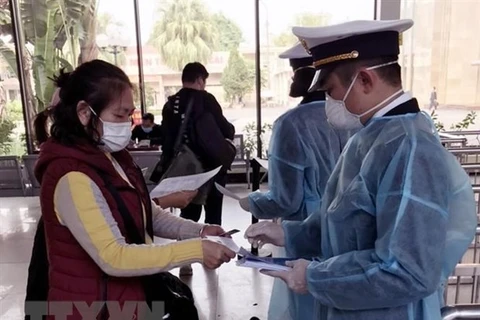
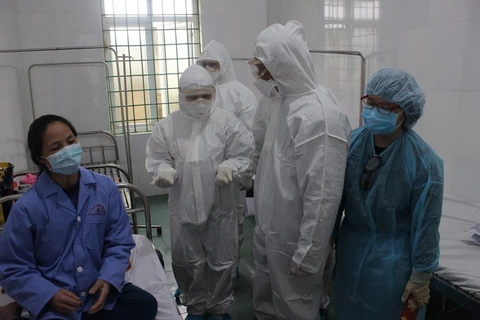
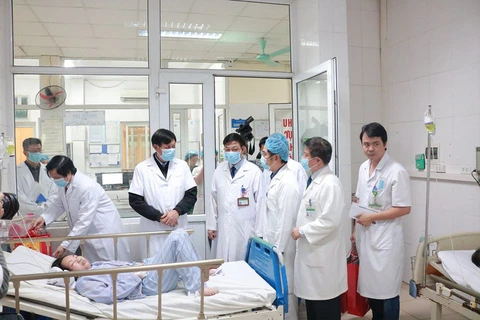
Medical workers at an isolation area (Source: VNA)
Hanoi (VNA) – Vietnam has confirmed the 14th novel coronavirus (2019-nCoV) infection case, the Ministry of Health announced on February 9.
The 55-year-old female patient is a neighbour of a worker in Son Loi commune, Binh Xuyen district, northern Vinh Phuc province, who had been tested positive for the virus after coming back home from a training course in China’s Wuhan city.
The newly-detected patient paid a visit to the infected worker’s home on January 28 during the Lunar New Year (Tet) festival. She is among those who had close contact with the confirmed patient and has been closely monitored since then by the provincial disease control centre.
She showed symptoms of fever, headache and sniveling on February 4. She was then brought to a clinic in Binh Xuyen district, Vinh Phuc province, for quarantine, check-up and treatment.
Her sample was tested positive for the virus by the National Institute of Hygiene and Epidemiology. She is now in stable health conditions at the local clinic.
By 11:00 on February 9, a total of 759 cases had samples tested in Vietnam and 14 of them positive for nCoV, including nine in Vinh Phuc province./.
The Ministry of Culture, Sports and Tourism has asked municipal and provincial tourism departments to keep track of visitors who come from or transit through new coronavirus (nCoV)-hit areas of China in order to quarantine any suspected infection cases.
If the 2019 novel coronavirus (2019-nCoV) epidemic lingers, production, trade and State budget revenue will be greatly affected, according to the Ministry of Finance (MoF).
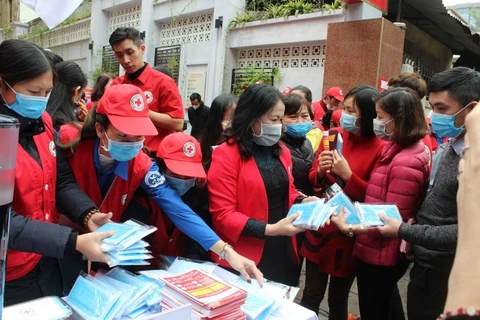
The Vietnam Red Cross Society (VRCS) on February 7 launched a campaign to bolster public awareness of the prevention against the acute respiratory disease caused by a new strain of coronavirus (nCoV).
The World Health Organisation (WHO) noted that Vietnam has been managing “very well” the outbreak of the acute respiratory disease caused by the novel coronavirus (nCoV), WHO representative in Vietnam Park Ki-dong said on February 7 about Vietnam’s efforts in the fight against the spread of the disease.
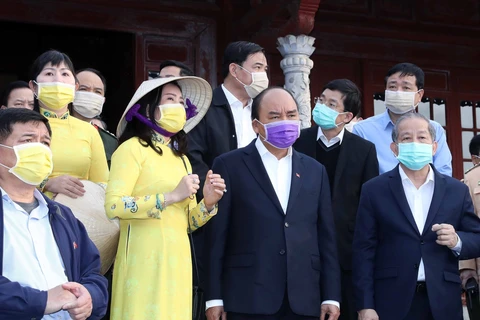
Prime Minister Nguyen Xuan Phuc on February 7 checked the fight against the acute respiratory disease caused by coronavirus (nCoV) in the central province of Thua Thien-Hue.
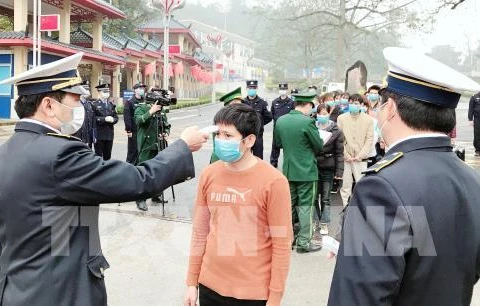
The exchange between Vietnamese and Chinese border residents, initially scheduled on February 10, is set to take place later this month due to impact of the novel coronavirus (nCoV).
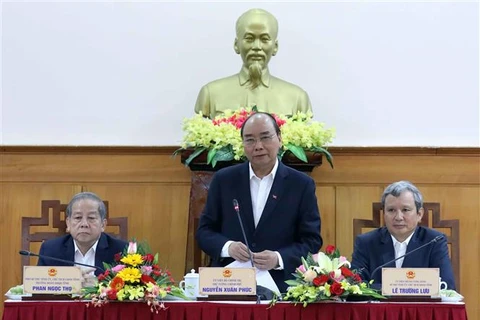
Thua Thien-Hue must push up production and business activities so as to quickly overcome the impact of the acute respiratory disease caused by the novel coronavirus (nCoV), Prime Minister Nguyen Xuan Phuc said on February 8.
Deputy Prime Minister Vu Duc Dam has stressed the importance of the community-based isolation as a measure to fight the acute respiratory disease caused by the novel coronavirus (nCoV) that is threatening to spread further.
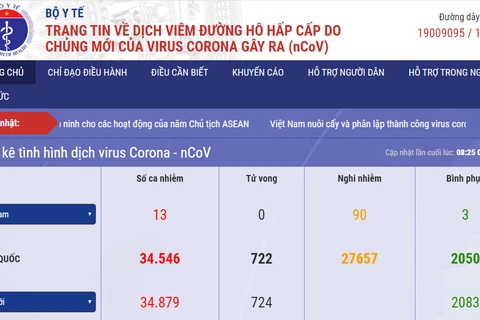
The Ministry of Health (MoH) on February 8 launched a subweb on its news portal and a mobile app on the acute respiratory disease caused by the novel coronavirus (nCoV) to support the prevention and control of the disease.
Deputy Prime Minister Vu Duc Dam, head of the steering committee on 2019-nCoV prevention and control, has signed Decision No. 80/QD-BCDQG on the establishment of four sub-committees.
Medical specialists and professors from Germany, Italy, Austria, and Spain conducted screenings for 80 children with cleft lips and palates and other congenital deformities. Following medical assessments, nearly 40 cases were selected for reconstructive surgery.
FV Hospital aims to develop into a leading robotic surgery hub in Southeast Asia, with the long-term goal of making the world’s most advanced treatment technologies more accessible to patients across Vietnam.
Under the programme, the southern largest economic hub has set several key health targets to be achieved by 2030. The average height of children and adolescents under 18 is expected to increase by at least 1.5cm, while the average life expectancy of residents is projected to reach around 77 years, including at least 68 years of healthy living.
In Vietnam, dengue fever consistently records cyclical increases, especially during the rainy season. In recent years many localities have recorded high numbers of cases, putting significant pressure on the healthcare system and directly impacting the health, daily lives and economy of the people.
In Vietnam, an estimated 6 million people live with rare diseases, about 58% of whom are children, while nearly 30% of affected children die before the age of five due to delayed diagnosis or limited access to appropriate treatment.
Commending the Hanoi – Vientiane General Hospital’s 13-year development, Ambassador Nguyen Minh Tam noted that prioritising conscience and virtue has helped it build a strong reputation among Lao citizens, the Vietnamese community and international friends in Laos.
Human resources remain decisive, as no matter how advanced equipment becomes, it is doctors who directly deliver care and sustain patients’ confidence, said Party General Secretary To Lam.
When patients pull through from the brink of death, when their vital signs stabilise and transplanted hearts begin beating strongly in new bodies, the joy shared by the entire medical team is overwhelming. And when the country welcomes the New Year, saving lives takes on an even more profound significance — offering patients and their families a new spring of hope.
The under-five mortality rate in Vietnam in 2025 was estimated at below 16 per 1,000 live births, more than three times lower than the 1990 level. The infant mortality rate (under one year) declined fourfold to below 11 per 1,000, while the neonatal mortality rate dropped fivefold, from 44 per 1,000 in 1990 to 8.8 per 1,000 in 2025.
The schemes focus primarily on cancer, rare diseases and severe chronic conditions, areas where treatment costs are high and often require expensive biological and originator drugs.
From demanding cross-country transplants to highly specialised procedures nearing regional and international standards, the sector has created new chances of survival for thousands of patients. However, persistent bottlenecks in organ donation and the legal framework highlight the urgent need to further perfect the national donation–transplantation system. In the era of advanced medicine, progress is measured not only by surgical mastery, but also by the ability to turn loss into hope and sustain life.
The surgery was carried out in the early morning of February 23 (the seventh day of the Lunar New Year), marking the hospital’s ninth heart transplant from a brain-dead donor.
Accordingly, provincial and municipal health departments are required to direct hospitals, centres for disease control and health care facilities to urgently develop plans and carry out medicine procurement to ensure sufficient supply, absolutely avoiding shortages. Medicines must meet quality standards and be sold at reasonable prices, with no sudden price increases allowed.
At around 16:20 the same day, the lane was activated at Bac Luan II Bridge area to allow an ambulance bearing license plate 15N-049.80 to transfer 63-year-old Chinese man Zhang Huizhong, who had suffered a cerebral infarction, to China for immediate treatment.
To build a resilient healthcare system capable of meeting the challenges of ageing, emerging diseases and rising expectations for quality care, Vietnam must continue to strengthen primary and preventive care, invest in human resources, accelerate digitalisation and big data development, and refine healthcare financing mechanisms.
An airport representative said Noi Bai has tightened health controls around the clock, with close coordination between the International Health Quarantine unit and the airport’s emergency medical team helping detect abnormal signs early and ensuring the aviation gateway remains safe and smooth.
Local authorities have been instructed to strengthen disease prevention and control measures at border gates, medical facilities and in the community, stay updated with global disease information, and closely monitor inbound travellers.
Nipah virus infection is designated a Group A infectious disease, with reported fatality rates of between 40 and 75%. At present, no vaccine or specific antiviral treatment is available. The virus is mainly transmitted from animals to humans or through contact with contaminated food and objects, and can also spread between people via direct contact with bodily fluids and secretions of infected patients.
Vietnam has recorded no cases of Nipah virus infection as of January 26, according to the Ministry of Health (MoH), which has instructed localities to step up surveillance and preventive measures and remain ready to respond to any potential outbreak.
Member of the Party Central Committee and Minister of Health Dao Hong Lan said the Politburo's Resolution No. 72 provides a breakthrough orientation for the protection, care and improvement of the people’s health. It places the people’s health at the centre of all healthcare policies and services, while aiming to address long-standing bottlenecks in the health sector that have yet to be fundamentally resolved.