Vietnam detects no mystery hepatitis, urged to monitor disease

Vietnam has not reported any cases of acute hepatitis of unknown origin in children, but health authorities and facilities must closely monitor the disease, strengthen testing of suspected cases of acute hepatitis and immediately report unusual cases, the Ministry of Health has announced.
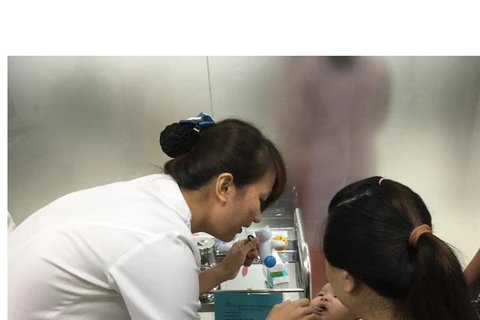
Vietnam detects no mystery hepatitis, urged to monitor disease ảnh 1A doctor gives a health check-up for a child at Thanh Nhan Hospital in Hanoi (Photo: VNA)
Hanoi (VNS/VNA) – Vietnam has not reported any cases of acute hepatitis ofunknown origin in children, but health authorities and facilities mustclosely monitor the disease, strengthen testing of suspected cases of acutehepatitis and immediately report unusual cases, the Ministry of Health hasannounced.

The ministry made the warning on May 8 after mysterious acute hepatitiscases were recently detected in several Southeast Asian countries.

The ministry has asked health facilities to keep updated and analyse theepidemiology of the acute hepatitis, which has been reported in 20 countries.

It has also asked local authorities and health facilities to assess infectionrisks of the new disease and propose action plans to bring it undercontrol.

Parents whose children are aged between one month to 16 years old must payextra attention to their children and take them to hospitals for furtherexamination if they show symptoms of the disease, such as nausea, vomiting,belly pain, dark urine, and yellow discolouration of the skin.

Previously,the ministry’s Department of Preventive Medicine had asked the CentralInstitute of Hygiene and Epidemiology, Nha Trang Pasteur Institute, HCM City’sPasteur Institute, and the Central Highlands Institute of Hygiene andEpidemiology to strengthen vaccination against hepatitis B ininfants, children under one-year-old and high-risk children.

The HCM City’s Department of Health has requested medical facilities,especially pediatric hospitals, to strengthen the detection of acutehepatitis in children.

Hospitals needed to consult with the Hospital for Tropical Diseases and theOxford University Clinical Research Unit (OUCRU) to collect information andsamples and conduct PCR testing to find infectious agents.

According to the World Health Organization, acute hepatitis of unknown originhas occurred in children aged 1-month-old to 16 years old, who have shownsymptoms including jaundice, nausea, abdominal pain, and fatigue.

Most cases do not register fever or a common virus that causes acute viralhepatitis, but nearly 10 per cent of severe cases require liver transplantation.

The cause of the disease in children remains unknown, according to the WorldHealth Organization. However, scientists are exploring the possibility that anadenovirus may be responsible.

The WHO and ECDC are supporting countries with ongoing investigations andcollecting information from the countries reporting cases. 

Among 169 cases of suspected acute child hepatitis found by April 21, a totalof 74 have been detected with adenovirus.

As of May 7, there are 278 suspected cases detected in 20 nations, includingfive deaths.

Tran Minh Dien, director of the National Children's Hospital, said the hospitalhad recorded a number of cases of liver damage, but it was related to childrenwith the multi-system inflammatory syndrome following COVID-19 infection.

No cases of isolated liver damage or adenovirus-associated liver damage hadbeen reported so far.

Nguyen Nguyen Huyen, head of the Kim Chung facility of the National Hospitalfor Tropical Diseases Medical Examination Department, said doctors were tryingto detect early signs and symptoms of suspected hepatitis in children amongthose who come for a health examination.

Huyen said adenovirus was not new in Vietnam and there were many medicalunits that could test for this virus.

The National Hospital for Tropical Diseases had equipped a standard test systemand the test results had been recognised in more than 130 countries.

However, the doctor said, if the mysterious disease was caused by a mutantstrain, it would be difficult to test the virus based on conventionaltechniques.

“We still need to wait for more information from world experts to find outwhether a mutation occurs. Based on that, there is a specific gene segment totest to find the exact cause of the mysterious hepatitis,” she said.

“There is no scientific evidence for the suspicion that adenovirus is relatedto SARS-CoV-2.” 

According to Huyen, based on the description of symptoms of the disease,children suffer from abdominal pain, vomiting or diarrhoea initially, followedby loss of appetite, yellow eyes, jaundice, yellow urine and liverfailure.

There is a high possibility that the mysterious hepatitis agent is transmittedthrough the blood and the gastrointestinal tract.

She recommended that children have proper nutrition and be fullyvaccinated according to the national immunisation programme andincrease outdoor physical activities.

Parents should send children to hospital for examination when theyshow suspicious signs./.
VNA

See more

An ambulance from the pre-hospital emergency care service in Phu Quoc special zone in An Giang province. (Photo: VNA)

Pre-hospital emergency care system to be launched nationwide

From 2027, the national pre-hospital emergency management platform will be put into operation, connecting data with the 113, 114 and 115 emergency call systems to facilitate rapid emergency dispatch and improve public access to emergency services.

Foreign patients travel to Vietnam for robotic cancer surgery at one-tenth of US costs

Foreign patients travel to Vietnam for robotic cancer surgery at one-tenth of US costs

With robot-assisted surgery costing tens of thousands of dollars in the US and Singapore, a growing number of international patients are traveling to Vietnam for robotic cancer surgery, including procedures for prostate, gynecological and gastrointestinal cancers, using the US made da Vinci Xi system at costs starting from just 3,000 USD.

Under a phased rollout beginning in 2026, every resident in Ho Chi Minh City will receive at least one annual health check-up or health screening. (Photo: VNA)

Ho Chi Minh City develops integrated multi-tier healthcare system

Under the new model, healthcare is organised into interconnected levels based on people's needs rather than administrative boundaries. Patients can move seamlessly between levels while their electronic health records and treatment information remain connected through digital platforms, referral systems, telemedicine, electronic medical records, and integrated health databases.

Doctors conduct heart and lung examinations for workers. (Photo: VNA)

Draft policy encourages people to prepare for old age from middle age

A draft circular guiding the implementation of the National Target Programme on Health Care, Population and Development (2026-2035) marks a shift from focusing solely on elderly care to encouraging healthy and independent ageing through early preparation. It covers healthy lifestyles, regular health check-ups, financial planning, suitable employment and home-based elderly care skills.

The meeting between the Vietnam Military Medical University delegation and leaders of the Lao Ministry of National Defence in Vientiane (Photo: VNA)

Vietnam, Laos deepen military medical cooperation

Since 1954, Vietnam Military Medical University has trained 687 Lao military medical personnel, including 322 doctors, 67 master's degree holders, 10 doctorate holders, and dozens of specialist physicians, alongside hundreds of pharmacists and medical technicians.

Vietnam's first penis transplant from a brain-dead donor is successfully performed at Viet Duc University Hospital. (Photo published by VNA)

Vietnam reaches new milestone in reconstructive transplant surgery

As the first operation of its kind in Vietnam, the hospital spent months developing treatment protocols, studying international experience and assembling a multidisciplinary team that included experts in transplantation, andrology, microsurgery, anaesthesia, immunology and pathology.

Dr. Nguyen Thanh Xuan is performing brain surgery on a patient (Photo published by VNA)

National strategy aims to build advanced medical ecosystem

Vietnam's adjusted healthcare network master plan for 2021–2030, with a vision to 2050, also outlines a regional structure covering the country's six socio-economic regions. It envisages 17 provincial general hospitals serving regional functions, at least one highly specialised hospital in each region, and at least one advanced medical facility in every province and city.

Vietnamese Ambassador to Bulgaria Nguyen Thi Minh Nguyet and Prof. Dr. Nguyen Huu Tu, President of Hanoi Medical University, meet with Prof. Boycho Landjov, President of Sofia Medical University. (Photo: VNA)

Vietnam, Bulgaria forge closer medical ties

The visit's highlight was the signing of a memorandum of understanding (MoU) between Hanoi Medical University and Sofia Medical University, creating a long-term framework for academic exchanges, scientific research and institutional cooperation between the two countries' leading medical schools.