Vietnam embraces opportunities from economic integration: experts

Vietnam will benefit from plenty of opportunities through economic integration and reform, however they can only be realised with suitable policies, experts said.
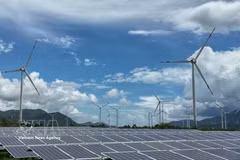
Vietnam embraces opportunities from economic integration: experts ảnh 1Illustrative photo (Source: VNA)

Hanoi (VNA) – Vietnam will benefit from plenty of opportunities through economic integration and reform, however they can only be realised with suitable policies, said Director of the Central Institute for Economic Management (CIEM) Nguyen Dinh Cung.

According to a report on macro-economy in 2015 and prospects for 2016, Vietnam’s economy is shifting from recovery to development and integration. Vietnam has also paid more attention to microeconomic reform and the conditions for the business community to take-off.

The international economic integration process has opened significant opportunities for enterprises, while highlighting motivations for reforms geared towards a market economy in the country.

Vietnam’s economy sees optimistic signs in 2016 as economic growth continues to enjoy a strong recovery, with investors and the business community believing it is currently very robust, the director stated.

Cung said the international economic integration process has progressed remarkably with several free trade agreements signed in 2015, including the Republic of Korea and the Eurasia Economic Union. 

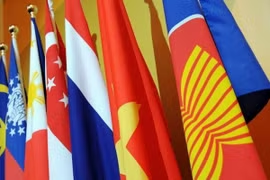
He added the formation of the ASEAN Economic Community (AEC) and conclusions of negotiations on the Trans-Pacific Partnership agreement and the FTA with the European Union will be important turning points in the country’s reform.

He went on to say that despite considerable improvement in macroeconomic indexes, motivation for growth is only slightly changed, together with underperforming factors such as public debt management, exchange rate monitoring and competitiveness, which is hindering economic progress.

Economic experts have said that many challenges come along with reform processes and economic integration; those might include insufficient awareness of reform and integration procedures, as well as the State and the government’s roles in economic management.

Regarding the State budget, Cung suggested some measures to ensure financial security in the short-to-medium term, such as capping overspending at 4 percent and reducing regular public spending.

He concluded by saying a suitable policy environment should meet international commitments and the country’s development targets, as well as nurturing the growth of the business community.-VNA

VNA

See more

National Brand products are on display at the Vietnam National Brand International Forum. (Photo: VNA)

Vietnam's national brand value jumps 45% to over 462 bln USD

Deputy Minister of Industry and Trade Luong Hoang Thai outlined Vietnam's National Brand Programme 's achievements, the role of business community and plans for brand development in a press interview ahead of the 10th Vietnam National Brand Product recognition ceremony on October 16.

Khanh Hoa province possesses significant advantages for renewable energy projects and new energy sectors. (Photo: VNA)

New value chains from two industrial – renewable energy centres

To implement the revised Power Development Plan VIII, the Ministry of Industry and Trade has proposed establishing two inter-regional renewable energy industrial and service centres in the northern and southern regions to develop the renewable energy sector and a complete value chain.

WB Senior Environmental Specialist and Task Team Leader Stephen Ling speaks at the working session (Photo; VNA)

Ca Mau, WB cooperate in sustainable fisheries development

Scheduled to run from 2026 to 2029, the project aims to develop the local fisheries sector and deepen global integration, while adapting to climate change and protecting the environment through infrastructure upgrades, technological innovation, and better management and production capacity.

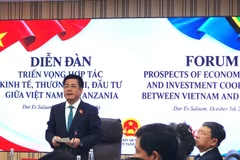
Vice President of the Vietnamese National Assembly Nguyen Hong Dien speaks at the forum. (Photo: Vietnam Trade Promotion Agency)

Tanzanian businesses seek greater cooperation, investment opportunities with Vietnam

Attending the forum during his working visit to Tanzania, Vice President of the National Assembly Nguyen Hong Dien said the two economies were highly complementary. Tanzania has strengths in natural resources, agriculture, energy, its domestic market and its strategic position in East Africa, while Vietnam has advantages in manufacturing and processing, high-tech agriculture, electronics, telecommunications and international trade.

The automatic ticketing system that uses electronic identification, authentication, biometric recognition and cashless payment for passengers on the Cat Linh-Ha Dong railway line in Hanoi. (Photo: VNA)

Cashless payments open gateway to financial inclusion

Cashless payments continued to grow rapidly in the first eight months of 2026. The number and value of cashless transactions rose 34.56% and 13.26% year-on-year, respectively, while online transactions increased 46.57% in number and 21.77% in value.

Ho Chi Minh City attracts more than 17.8 billion USD in FDI in the first nine months of 2026 (Illustrative image. Photo: VNA)

Ho Chi Minh City offers new destinations for FDI flows

The merger of Ho Chi Minh City with Binh Duong and Ba Ria-Vung Tau has opened up a larger development space, enabling the city to reshape its approach to attracting foreign investment. In particular, Resolution No. 10-NQ/TW of the Politburo sets out clear orientations for developing the foreign-invested economic sector, providing a basis for shifting the focus from the amount of investment capital to the quality of investment.

Vietnam exports about 1.4 million tonnes of coffee worth 6.54 billion USD in the first nine months of 2026. (Photo: VNA)

Vietnam seeks to boost value, expand markets for coffee sector

Acording to VICOFA, Vietnam needs to focus on exporting green coffee beans that meet EUDR criteria, particularly as compliance levels among some other producing countries remain low. At the same time, it should develop specialty and organic coffee lines as well as deeply processed products to serve the premium segment in Europe.