Israeli Minister of Economy and Industry Nir Barkat (middle) at the press conference. (Photo: VNA)
 Speaking at a press conference in Hanoi, the official further said the two countries “have many things in common” 30 years after the establishment of their diplomatic ties (July 12, 1993).
Notably, both countries are seeking global collaboration through FTAs around the world, and their governments have been aware of big cooperation opportunities, he elaborated.
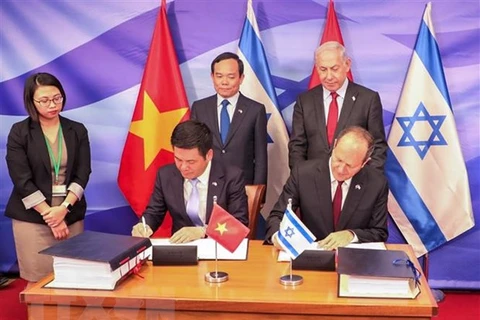
Barkat described the FTA inked in Tel Aviv on July 25 as a testimony for the good bilateral relationship over the past three decades, and called the FTA "one of the fastest deals ever done" that will open up many opportunities and benefit both economies.
“And today, Vietnamese Minister of Industry and Trade Nguyen Hong Dien told us that we are going to have direct flights between Vietnam and Israel,” Barkat said, describing it “a huge milestone” in the relationship.
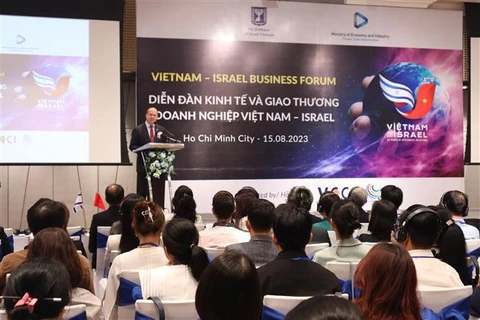
At the Vietnam-Israel Business Forum in Ho Chi Minh City on August 15, the Israel minister also suggested launching a direct air route between the southern metropolis and Israel.
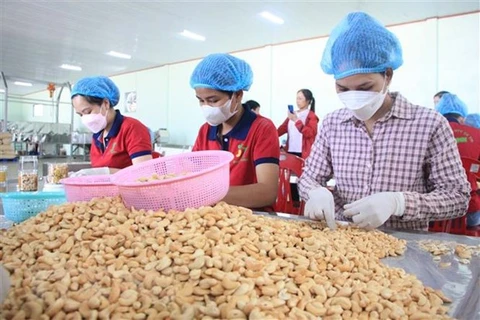
He stressed once e-visas and direct flights are launched, the two countries will see growth in cooperation in tourism and trade and other spheres, adding more Vietnamese products will be shipped to Israel while more technologies will come to Vietnam from Israel.
Barkat highlighted the seven business clusters on which Israel is focusing that are high-tech, homeland security, Industry 4.0, health care, life sciences, agrifood tech, and tourism, and suggested the two countries expand collaboration in these sectors.
He also suggested the two countries establish joint ventures in Vietnam, where Israel brings technologies while the Vietnamese side is in charge of marketing and development, and create a collaboration fund.
Vietnam is not just a country of some 100 million people and one of the fastest growing economies, Barkat said, adding it is actually a gateway to the Association of Southeast Asian Nations (ASEAN) and South Asia, which is a “big opportunity" for Israel.
Moreover, the Vietnamese government is really open to listen and to partner, he commented.
The minister noted his belief that the smart strategy that the Vietnamese government is taking to position itself will create big opportunities for both Vietnam and Israel.
Regarding challenges to the bilateral trade, he stressed both Vietnamese and Israeli businesses have expressed their happiness and optimism for the future and said: “Where there's a will, there's a way"./.
| Vietnamese Minister of Industry and Trade Nguyen Hong Dien and Israeli Minister of Economy and Industry Nir Barkat on July 25 signed the Vietnam - Israel Free Trade Agreement (VIFTA) in Tel Aviv in the presence of Vietnamese Deputy Prime Minister Tran Luu Quang and Israeli Prime Minister Benjamin Netanyahu. The two countries started negotiations on the agreement seven years ago and held 12 sessions. Israel is the first country in West Asia with which Vietnam has signed a free trade agreement (FTA) and Vietnam is also the first country in Southeast Asia that Israel has signed an FTA with. The agreement consists of 15 chapters and several appendices about trade in goods, services - investment, rules of origin, technical barriers to trade (TBT), sanitary and phytosanitary measures (SPS), customs, trade remedies, government procurement, and legal – institutional framework. With the agreed commitments, the two sides expect that two-way trade will reach 3 billion USD and more soon from 2.2 billion USD last year. The agreement will ultimately remove duties on at least 86% of Vietnamese products and 93% of Israeli products, according to the Vietnamese Ministry of Industry and Trade./. |
VNA