Vietnam enters 41st day without COVID-19 community transmission

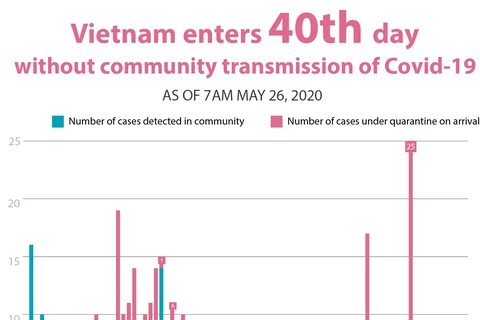
Vietnam reported no new COVID-19 cases in the last 12 hours from 18:00 on May 26 to 6:00 on May 27, entering the 41st consecutive day with no transmission in the community, announced the National Steering Committee on COVID-19 Prevention and Control.
Vietnam enters 41st day without COVID-19 community transmission ảnh 1Patient 19 is receiving treatment at Hanoi's Hospital for Tropical Diseases (Photo: VNA)
 Hanoi (VNA) - Vietnam reported no new COVID-19 cases in the last 12 hours from 18:00 on May 26 to 6:00 on May 27, entering the 41st consecutive day with no transmission in the community, announced the National Steering Committee on COVID-19 Prevention and Control.

Of the country’s total 327 infections, 187 imported cases were quarantined upon their arrivals, posing no risk of community transmission.

Meanwhile, 272 patients have been given the all-clear, accounting for 83 percent. No death has been reported.

As of May 25 evening, among those who are receiving treatment, six patients had tested negative for SARS-CoV-2 once, while five others at least twice.

On May 27, three patients are set to be declared to be free from the coronavirus. They include Patient 19, who used to be in critical condition and suffered three cardiac arrests. After 81 days of treatment, she has tested negative for the virus seven times and is now in stable health.

Two other expected recoveries are Patients 52 and 324. They will continue to be quarantined for the next 14 days.

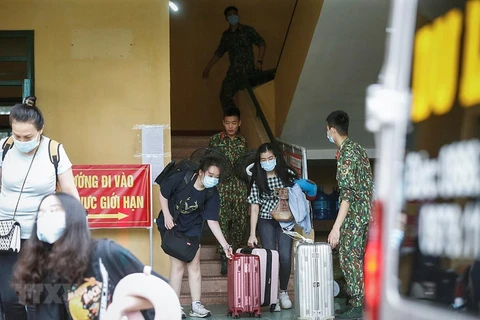
Right now there are 9,797 people in quarantine across the country, including 55 at hospitals, 7,535 at other quarantine establishments and 2,150 at home./.
VNA

See more

A doctor provides dental checkup for a student. (Photo: VNA)

Free health checkups for children ahead of new school year

According to the Hanoi Department of Health, the city has 4,776 educational institutions with more than 2.2 million preschool and school students. The health campaign will run from August 18 to September 4, targeting 100% coverage before the new school year begins.

Spraying insecticide to prevent dengue fever in Dan Hoa commune, Hanoi. (Photo: VNA)

Hanoi steps up dengue prevention as cases rise

According to the Hanoi Centre for Disease Control (CDC), 316 dengue cases were recorded across 74 communes and wards in the city from August 7-14, up 81 from the previous week. Eleven new outbreaks were also reported, bringing the total number since the beginning of 2026 to 63, with 24 still active.

Screening and early cancer detection using advanced medical equipment at a healthcare facility (Photo: VNA)

Vietnam targets Southeast Asia’s leading medical tourism position by 2030

Medical tourists to Vietnam currently mainly comprise overseas Vietnamese and visitors from Cambodia, Laos, the Republic of Korea, Japan, Australia and several European countries. Popular services include cosmetic dentistry, assisted reproduction, aesthetic medicine, general health check-ups and some advanced medical specialties.

An ambulance from the pre-hospital emergency care service in Phu Quoc special zone in An Giang province. (Photo: VNA)

Pre-hospital emergency care system to be launched nationwide

From 2027, the national pre-hospital emergency management platform will be put into operation, connecting data with the 113, 114 and 115 emergency call systems to facilitate rapid emergency dispatch and improve public access to emergency services.

Foreign patients travel to Vietnam for robotic cancer surgery at one-tenth of US costs

Foreign patients travel to Vietnam for robotic cancer surgery at one-tenth of US costs

With robot-assisted surgery costing tens of thousands of dollars in the US and Singapore, a growing number of international patients are traveling to Vietnam for robotic cancer surgery, including procedures for prostate, gynecological and gastrointestinal cancers, using the US made da Vinci Xi system at costs starting from just 3,000 USD.

Under a phased rollout beginning in 2026, every resident in Ho Chi Minh City will receive at least one annual health check-up or health screening. (Photo: VNA)

Ho Chi Minh City develops integrated multi-tier healthcare system

Under the new model, healthcare is organised into interconnected levels based on people's needs rather than administrative boundaries. Patients can move seamlessly between levels while their electronic health records and treatment information remain connected through digital platforms, referral systems, telemedicine, electronic medical records, and integrated health databases.