Vietnam-Germany Hospital launches two modern operating rooms

Two high-quality operating rooms were launched on February 27 by the Viet Duc (Vietnam-Germany) Friendship Hospital.
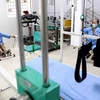
Vietnam-Germany Hospital launches two modern operating rooms ảnh 1Professor Tran Binh Giang (Four, right), director of the Vietnam-Germany Friendship Hospital, introduces modern equipment in the new operating room to representatives.(Photo:VNA)

Hanoi (VNA) - Two high-quality operating rooms were launched on February27 by the Viet Duc (Vietnam-Germany) Friendship Hospital.

They are named the BodyTom and Karl Storz Or1 operating rooms.

Professor Tran Binh Giang, director of the hospital, said that the mobilecomputerised tomography system in the BodyTom Operating Room has manyadvantages, such as wide vision, one-second rotation speed, 200-centimetre widescanning area, good-quality images and fast operation process.

The important point is the high-quality images. When integrated with roboticsystem, they increase the accuracy of surgery, especially in difficultoperations, he said.

The machine is movable during surgery and suitable for all patients. TheBodyTom Operating Room is used in surgery for cranial nerve, spine, combinedsurgeries with robots, image diagnosis, vascular intervention and hunchbackcorrection.

Experts said the Karl Storz Or1 Operating Room offers many practical benefits,such as standardising the surgical process, improving work efficiency, betterinformation exchange, reducing operation time and treatment.

The Karl Storz Or1 Operating Room has modern image and sound technology whichcan pass image signals of different camera systems such as laparoscopic surgerycameras or operating camera lights. It also allows establishing links toexternal websites around the world.

Online training and instruction is one of the strong points of the Vietnam-GermanyFriendship Hospital. The remote medical system will help in the hospital’sonline work./.
VNA
See more

The DAV asks pharmacy producers and distributors to increase medicine supply capacity during Tet to meet increasing demand (Photo: VNA)

Measures rolled out to ensure adequate medicine supply during Tet

Accordingly, provincial and municipal health departments are required to direct hospitals, centres for disease control and health care facilities to urgently develop plans and carry out medicine procurement to ensure sufficient supply, absolutely avoiding shortages. Medicines must meet quality standards and be sold at reasonable prices, with no sudden price increases allowed.

Military doctors conduct ultrasound examinations for residents in Dong Dang town, Cao Loc district, Lang Son province. (Photo: VNA)

Resolution 72 opens path to a modern, sustainable healthcare system

To build a resilient healthcare system capable of meeting the challenges of ageing, emerging diseases and rising expectations for quality care, Vietnam must continue to strengthen primary and preventive care, invest in human resources, accelerate digitalisation and big data development, and refine healthcare financing mechanisms.

Vietnam steps up Nipah virus prevention at border gates (Photo: suckhoedoisong.vn)

Vietnam tightens Nipah virus prevention at border gates

Local authorities have been instructed to strengthen disease prevention and control measures at border gates, medical facilities and in the community, stay updated with global disease information, and closely monitor inbound travellers.

Nipah virus infection is designated a Group A infectious disease, with reported fatality rates of between 40 and 75%. (Photo: moh.gov.vn)

Health sector steps up preparedness against Nipah virus disease

Nipah virus infection is designated a Group A infectious disease, with reported fatality rates of between 40 and 75%. At present, no vaccine or specific antiviral treatment is available. The virus is mainly transmitted from animals to humans or through contact with contaminated food and objects, and can also spread between people via direct contact with bodily fluids and secretions of infected patients.

Member of the Party Central Committee and Minister of Health Dao Hong Lan (Photo: VNA)

Health minister highlights comprehensive, people-centred healthcare orientation

Member of the Party Central Committee and Minister of Health Dao Hong Lan said the Politburo's Resolution No. 72 provides a breakthrough orientation for the protection, care and improvement of the people’s health. It places the people’s health at the centre of all healthcare policies and services, while aiming to address long-standing bottlenecks in the health sector that have yet to be fundamentally resolved.

Elderly people do morning exercises in the Hoan Kiem Lake area in Hanoi. (Photo: VNA)

Strategic roadmap for healthier future

As Vietnam’s population ages rapidly, Dr Angela Pratt, WHO Representative in Vietnam, identified two strategic priorities: strengthening primary healthcare and developing a formal long-term care system. These measures are essential not only for healthy ageing, but also as long-term investments with wide-ranging socio-economic returns.

Professor Dr Tran Van Thuan, Deputy Minister of Health. (File photo: VNA)

More than 300 medical staff assigned to serve 14th National Party Congress

Deputy Minister of Health Tran Van Thuan called on experts and healthcare workers to uphold a strong sense of responsibility, professionalism and expertise to ensure that medical services for the 14th National Party Congress are delivered safely, effectively and with the highest level of care.

Health check-up offered to citizens in Gia Lai province. (Photo: VNA)

Health ministry maps out three phases for hospital fee exemption

Health insurance participants from near-poor households and those aged 75 and above who are receiving social pension allowances will be entitled to 100% coverage of medical examination and treatment costs within the scope of health insurance benefits.

A patient pays hospital fees using cashless transactions (Photo: qdnd.vn)

Hanoi aims for modern healthcare system

Hanoi's health sector will continue to expand the comprehensive use of digital technology in professional practices to improve management efficiency and service quality, aiming to develop a modern, transparent, and people-centred healthcare system.