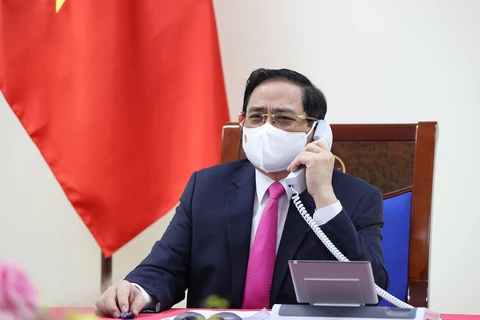
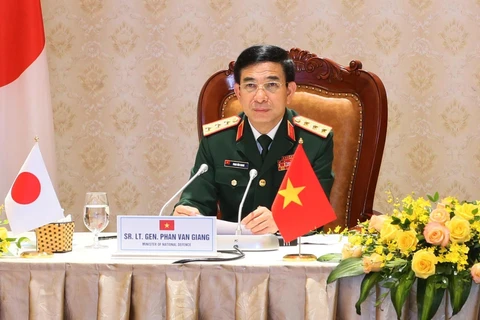
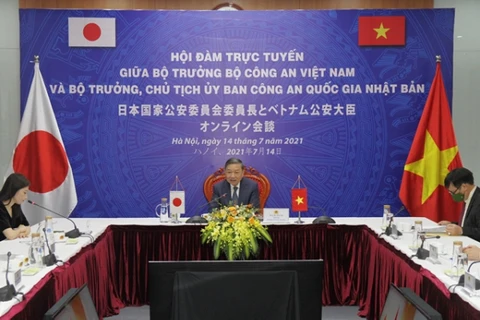
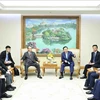
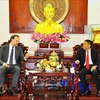
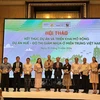
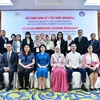
Signing ceremony of the MoU on low-carbon growth between Vietnam and Japan (Photo courtesy of Vietnam Ministry of Natural Resources and Environment)
 Hanoi (VNA) – Vietnam and Japan have signed a Memorandum of Understanding (MoU) on Joint Credit Mechanism – JCM, to bolster capacity in the implementation of activities in reducing greenhouse gas (GHG) emissions and climate crisis.
On October 14, on behalf of the Vietnamese and Japanese Governments, Minister of Natural Resources and Environment Tran Hong Ha and Japanese Ambassador to Vietnam Yamada Takio inked the agreement on cooperation in low-carbon growth between the two Governments for the 2021-30 period.
Japanese Minister of the Environment Yamaguchi Tsuyoshi Michael and Vietnamese Ambassador to Japan Vu Hong Nam witnessed the signing and exchange of the MoU from Tokyo.
The two ministers joined a virtual meeting prior to the ceremony.
JCM is a mechanism that Japan proposes to promote the transfer and application of low-carbon technologies towards green growth in developing countries and support the implementation of Japan's international commitments on mitigating greenhouse gas emissions. Fourteen countries have so far taken part in the JCM and Vietnam is the 6th country to sign an MoU towards implementing the mechanism.
At the meeting, the sides discussed the implementation of the JCM in the coming time, application of an evaluation model on climate change which facilitates a long-term strategy on GHG emission reduction and carbon neutrality.
They also exchanged views on the preparations for the seventh meeting of the Vietnam-Japan Environmental Policy Dialogue and a Vietnam-Japan environmental forum slated for December.
Speaking at the signing ceremony, Minister Ha said that the signing of an MoU to carry out the JCM until the end of 2030 has a great significance in the context that the world is moving together towards United Nations Climate Change Conference (COP26) with stronger commitments to repel the climate "crisis”.
The implementation of the mechanism during 2013-20 reaped important results and created a new investment channel for GHG reduction activities in the Southeast Asian nation.
Via the JCM, firms gain access to and apply low-carbon technologies, products, systems and services by Japan and receive assistance in raising capacity in rolling out GHG emission activities.
The document not only serves as a foundation for the two governments to implement cooperation activities but also demonstrates their sense of responsibility to deal with the above-mentioned challenges, Ha said.
The Vietnamese minister expressed his wish that this mechanism will become a model for cooperation between Vietnam and Japan in technology development and transfer, attracting a large number of Vietnamese and Japanese businesses.
Regarding Vietnam’s long-term strategy on carbon neutrality, Ha thanked the Ministry of the Environment of Japan for helping Vietnam calculate the peak emission level so as to build a national strategy on climate change from now until 2050, with the participation of leading experts in the field.
At the upcoming COP26, Vietnam is set to deliver a statement on stronger GHG emission reduction to 2030 and a time that the country has set for itself to achieve carbon neutrality.
Japanese Environment Minister Yamaguchi Tsuyoshi Michael appreciated Vietnam's contributions to the cooperation in solving urgent regional and international environmental issues in general as well as the implementation of the JCM in particular during the past time.
He said he was confident that the signed MoU will help the two countries promote cooperation in realising commitments on responding to climate change, mitigating greenhouse emissions, and actively contributing to Vietnam's goal of a carbon-neutral economy./.
| The first MoU on low-carbon growth between Vietnam and Japan was reached on July 2013 and extended in June 2017 until the end of last year. The JCM aims to bolster investment and development in low-carbon technologies, products, systems, services and infrastructure in Vietnam based on financial and technological assistance from Japan. |