Vietnam, Japan to hold training course for sappers

A visiting Japanese delegation visited Vietnam’s Sapper Brigade 249 on September 11 to review preparations for the two countries’ upcoming training course in operating heavy military machinery for sappers.
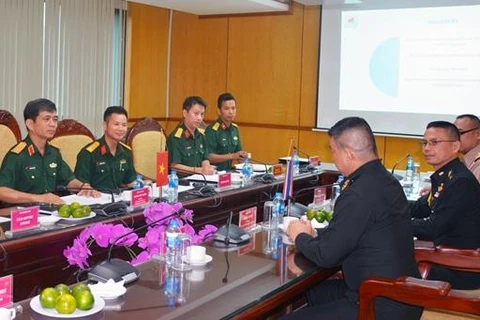
Vietnam, Japan to hold training course for sappers ảnh 1At the working session between the Japanese delegation and representatives of the Vietnam Department of Peacekeeping Operations. (Photo: qdnd.vn)

Hanoi (VNA) – A visiting Japanese delegationvisited Vietnam’s Sapper Brigade 249 on September 11 to review preparations forthe two countries’ upcoming training course in operating heavy militarymachinery for sappers.

The course, slated for later this year and the second of itskind, is part of a triangular partnership project among Vietnam, Japan and theUN to boost the peacekeeping capacity of Vietnam’s military engineering unitsfor its future peacekeeping mission.

At the visit, the delegation toured the brigade’s drillground, training locations, infrastructure, and equipment. The drill groundthat spans nearly 15 hectares is ready to serve the operation of heavy-duty equipmentduring the course.

Head of the delegation Lieutenant Colonel Akenko Shingo fromthe staff office of the Japan Ground Self-Defense Force said he is pleased withthe preparation made by Vietnam.

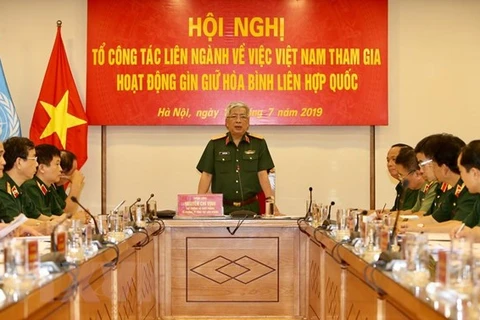
The same day, the Japanese guests had a working session atthe Vietnam Department of Peacekeeping Operations.

Director of the department Major General Hoang Kim Phungthanked Japan for supporting Vietnam within the framework of the triangularpartnership project.

He affirmed that the two countries’ cooperation related tothe UN peacekeeping mission plays an increasing important role and has become apillar in their defence ties. Such collaboration has been included in theagenda of the sides’ deputy ministerial-level defence dialogue.

Vietnam hopes to learn from Japan’s and international lecturers’peacekeeping experience in meeting UN’s standards and procedures, particularlywhen the country plans to send a large number of sappers, at around 290, tocarry out the mission.

For his part, Akenko Shingo stated Japan is ready to assistVietnam in deploying it engineer unit for UN peacekeeping mission via experiencesharing and training support./.
VNA
See more

General Secretary of the 14th Central Committee of the Communist Party of Vietnam To Lam (Photo: VNA)

Foreign leaders extend congratulations to Party General Secretary To Lam

First Secretary of the Communist Party of Cuba Central Committee and President of Cuba Miguel Diaz-Canel Bermudez expressed his belief that under the General Secretary’s clear-sighted leadership, the Party and people of Vietnam will continue advancing firmly on the path towards socialism and usher in a new phase of more prosperous, inclusive, and sustainable development.

Prof. George Toloraya, Director of the Centre for Russian Strategy in Asia at the Institute of Economics of the Russian Academy of Sciences. (Photo published by VNA)

Vietnam enters new development era: Russian scholar

Prof. George Toloraya noted that the 14th Party Congress represents a pivotal shift from Vietnam’s role as a “factory of the world” toward its ambition to become a high-tech powerhouse, with development quality reaching a higher level.

Participants pose for a group photo at the ceremony to mark the 76th founding anniversary of the diplomatic relations between Vietnam and China in Chongqing. (Photo: VNA)

Chongqing ceremony marks 76th anniversary of Vietnam – China ties

Consul General Bui Nguyen Long noted that the fruitful bilateral ties over the past 76 years have clearly demonstrated that the unceasing enhancement and development of Vietnam – China relations is fully consistent with the shared aspirations and long-term fundamental interests of the two peoples.

Delegates at the 14th National Party Congress vote on the list of candidates to the 14th Party Central Committee. (Photo: VNA)

14th National Party Congress: Enduring strength of people-centred path

Kyril Whittaker, a UK-based Vietnam specialist, that Vietnam’s 40-year Renewal (Doi Moi) process has succeeded thanks to three closely intertwined factors - a scientific and practical approach to reform, the Communist Party of Vietnam’s leadership role, and the principle of placing the people at the heart of all policies.

Party General Secretary To Lam speaks at an international press conference announcing the results of the 14th National Party Congress on the afternoon of January 23. (Photo: VNA)

Renewing mindset, setting development vision through 2045: Party General Secretary To Lam

The political report integrates three previously separate documents - the political report, the socio-economic report and the review of Party building - into a single, unified and comprehensive one, with clearer priorities. Designed to be concise, easy to understand, remember and implement, this integration stands out as a key hallmark of the Congress.

Communist Party of Vietnam General Secretary To Lam (right) and General Secretary of the Central Committee of the Lao People’s Revolutionary Party and President of Laos Thongloun Sisoulith during his visit to Vietnam on September 10, 2024 (Photo: VNA)

Top Lao leader to pay state visit to Vietnam

General Secretary of the Central Committee of the Lao People’s Revolutionary Party and President of Laos Thongloun Sisoulith and his spouse will pay a state visit to Vietnam from January 26 to 27.

The article titled “The 14th National Congress of the Communist Party of Vietnam and the Advance toward a New Era,” published on aladaainternacional.com, the website of the Latin American Center for Studies on Asia and Africa. (Photo: VNA)

14th National Party Congress: Vietnam’s strategic shift in new era

Vietnam now stands at the threshold of a new development era, driven by strong aspirations and substantial potential. The 14th Party Congress is, therefore, of decisive importance for the country’s future transformations, particularly amid an international environment marked by uncertainty and volatility. While this phase may be among the most complex of the renewal process, it also presents a critical opportunity for Vietnam to break through and evolve from an “Asian tiger” into a regional “dragon.”