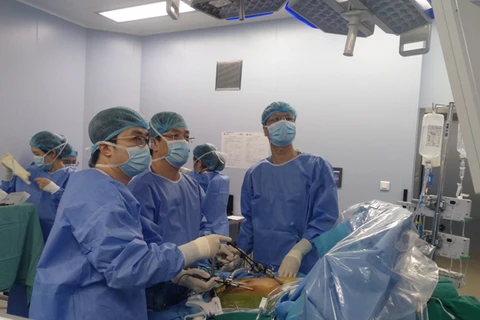
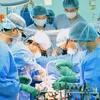
Doctors perform a life-saving surgery on a person with esophageal cancer. (Photo: VietnamPlus)
Hanoi (VNA) – Vietnam has made many advances in endoscopic surgery for patients with esophageal cancer. Up to 90 percent of esophageal cancer patients live for at least five years more, if the disease is detected and treated early.
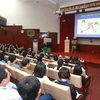
Participants heard the information at a scientific conference on the application of medical advances in endoscopic surgery for esophageal cancer patients in Hanoi on January 8.
The two-day event, entitled “Advances in endoscopic surgery treatment of esophageal cancer patients in Vietnam”, was organised by the Vinmec Times City International Hospital to mark the 10th anniversary of the establishment of Vinmec Health System.
At the event, Associate Professor Pham Duc Huan, Director of the Centre for Gastroenterology-Hepatology at the Vinmec Times City International Hospital, said that esophageal cancer is the fifth most common cancer among digestive cancers, after stomach, colon and rectal and liver cancers. Vietnam currently has tens of thousands of people living with esophageal cancer, who are mainly smokers and drinkers.
“In the past, people with esophageal cancer often had a poor prognosis and the survival rate after five years was only about 30 percent. With the current scientific and technological advances, now 90 percent of patients who are diagnosed and treated at an early stage live for at least five years more. Some of my patients lived over 20 years,” said Huan.
Experts said that previously, esophageal cancer surgery was open surgery and was one of the most difficult digestive surgeries, due to long operating time and the risk of many serious complications. Endoscopic surgery is considered a revolution and is gradually replacing open surgery in the treatment of esophageal cancer.
This is a minimally invasive technique, with only small incisions of 5-10mm, but has outstanding advantages for patients, including less pain, faster recovery, aesthetics and fewer complications.
However, endoscopic surgery does require highly qualified doctors, skilled laparoscopic surgery techniques and modern equipment, to ensure accuracy, radicality and the highest efficiency in treatment.
According to Assoc. Prof. Dr Nguyen Anh Tuan, head of the Gastroenterology Department of Central Military Hospital 108, esophageal cancer arises from the esophagus – the digestive tube between the throat and stomach. Patients often present symptoms of dysphagia and weight loss. The disease is quite common in Vietnam and is more common in the elderly.
Patients often come to doctors when they are at a late stage when the tumour is large, causing esophageal lumen obstruction or distant metastases. Patients only go to doctors when there are signs such as choking or pain, which means the esophageal cancer is at a later stage.
“Esophageal cancer is very difficult to treat and requires a multimodal combination of surgery, chemotherapy and radiation, in which surgery is the most important treatment,” said Doctor Tuan.
To detect esophageal cancer at an earlier stage, Tuan recommends that people pay attention to changes in the body, especially when feeling tired, losing weight and not eating well, and coming to the hospital for examination and treatment.
The conference was a professional forum for health experts and surgeons in the field of esophageal cancer treatment across the country to exchange knowledge and experience in many very comprehensive research works, in the fields of adjunctive techniques for endoscopic surgery, preoperative chemo-radiotherapy and issues relating to recovery of postoperative patients. Scientific reports at the conference show that with the application of the latest advances in the world, cancer treatment in Vietnam is now closer to that of developed countries.
During the event, participants also witnessed leading experts demonstrate endoscopic techniques to cut esophageal tumours with robotic surgery technology, the most modern and advanced technology available today./.