Vietnam needs strong financial sector to decarbonise economy: UN official

Vietnam needs to develop a strong domestic banking and financial sector that can provide a guaranteed funding base for decarbonising the oil economy, Kanni Wignaraja, UN Assistant Secretary-General and UNDP Regional Director for Asia and the Pacific, told the Vietnam News Agency (VNA) on July 29.
Vietnam needs strong financial sector to decarbonise economy: UN official ảnh 1Kanni Wignaraja, UN Assistant Secretary-General and UNDP Regional Director for Asia and the Pacific (Photo courtesy of UNDP Vietnam)

Hanoi (VNA) – Vietnam needs to develop a strongdomestic banking and financial sector that can provide a guaranteed fundingbase for decarbonising the oil economy, Kanni Wignaraja, UN Assistant Secretary-Generaland UNDP Regional Director for Asia and the Pacific, told the Vietnam News Agency (VNA) on July 29.

Vietnam can leverage green bonds to finance the developmentof renewables, she said, referring to one of a few things Vietnam could do to acceleratethe Just Energy Transition.

Secondly, she said, Vietnam should focus on enhancing the regulatoryframework since “money is not going to come in unless there are very strong,transparent, attractive regulations that govern the energy sector in the country.”

Thirdly, Wignaraja suggested Vietnam consider establishing a nationalenergy bank, a model that has been tested by some countries. “That way, youhave a domestic source of funding, or guarantee commercial banks that they cantake the risk to finance energy projects.”

That energy bank could take an equity stake in theselong-term projects and provide a safe space and way to invest in them, she explained.

But the most important thing of all is people have to beinvolved, she continued. “People's voice, their agency, their engagement has tobe not just allowed, it has to be encouraged.”

People must be able to speak and share their opinions, and to engage in this new development pathway that Vietnam needs to follow, she emphasised.

The UN official expected Vietnam can show that there’s a different way to do development and that amidst the uncertain global economic outlook, Vietnam can prove itself as an attractive place for investment by doing a greener, more inclusive development.

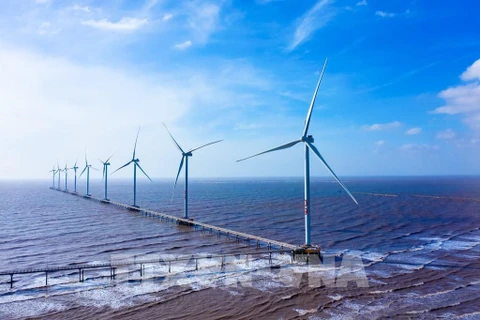
Vietnam needs strong financial sector to decarbonise economy: UN official ảnh 2A wind power farm in the Mekong Delta province of Bac Lieu. (Photo: VNA)
In regard to how Vietnam can successfully pursue an inclusive and green economic rebound in the post-COVID-19 period, she recommended the country to focus on energy security and energy access for everyone.

Wignaraja also urged Vietnam to promote a "standing social protection system," able to support the most vulnerable people, and to foster the use of technology. Technology does not only create new jobs but also enables more efficient public services, private sector services, and a more transparent and accountable state, she noted.

The UN official then spoke highly of how Vietnam has changed in the past 45 years since it joined the UN, describing it as “amazing.” A country coming out of war and dependent on aid is now playing the other role of being a “stable and secured power centre,” she said.

“The world needs Vietnam and Vietnam needs Vietnam,” she affirmed, “it is an active player now on the global stage."

“It's not just Asia and the Pacific that will rely on Vietnam. I think the world is going to rely a lot more on Vietnam."

“I have been here 20 years ago,” she shared, “back now again, I put my vote that this country is going to be good for the world, and it will show the world a different way of ensuring progress not just for a few people, but for all.”

Wignaraja is on an official visit to Vietnam from July 27-31 to follow up a meeting between Prime Minister Pham Minh Chinh and UNDP Administrator Achim Steiner in New York last May, with priority given to the UNDP's support for Vietnam in the context of post-pandemic recovery and financing a sustainable climate and energy transition.

Last year, PM Chinh pledged that Vietnam would strive to achieve net zero emissions by 2050 at the 26th UN Climate Change Conference of the Parties (COP26). Vietnam is now among more than 70 countries having committed to doing so, which requires a transition from fossil fuels to renewable energy sources./.
VNA

See more

Vietnamese Ambassador to Brazil Bui Van Nghi speaks at the seminar. (Photo: VNA)

Vietnam, Brazil seek ways to promote trade, investment cooperation

Vietnamese Ambassador to Brazil Bui Van Nghi informed that two-way trade reached 4.22 billion USD in the first six months of 2026, up 16.8% year-on-year. Brazil's exports to Vietnam exceeded 2 billion USD, rising 16.6%, while its imports from Vietnam totalled about 2.11 billion USD, an increase of 17%.

Wave Alpha, Honda Vietnam’s best-selling manual motorcycle model each month. (Photo: Bnews/VNA)

Honda Vietnam posts strong car sales growth, leads motorcycle market

The company sold 172,299 motorcycles in June, up 4.7% from the same month last year, highlighting steady consumer demand even as the market gradually shifts towards greener transport options. For the first six months of 2026, motorcycle sales reached 515,743 units, up 0.6% year-on-year.

Rice harvest in Xuan Giang commune, Ninh Binh province. (Photo: VNA)

Plan issued to develop agricultural logistics system

A key target is that by 2030, all concentrated agricultural, forestry and fisheries production areas will have access to essential services, including product traceability, quarantine, testing, quality certification, processing and market development. The move reflects growing international demand for stricter food safety, quality and traceability standards, which have become increasingly important for agricultural exports.

Delegates at the signing ceremony (Photo: VNA)

Vietnam, RoK boost micro-business cooperation

Vietnam's young population, dynamic market, and big growth potential are a perfect fit for the strengths that Korean micro-businesses bring in K-brands, technology, and service expertise, said KFME President Song Chi Young.

Cars at a public parking lot in Hai Phong city. (Photo: VNA)

Vietnam's auto sales rise 15%, hybrid, imported vehicles continue to outperform

With auto loan interest rates remaining competitive, stable vehicle supply, and an increasingly diverse product range, Vietnam's automotive market is expected to maintain its growth momentum through the remainder of 2026. SUVs, MPVs, and hybrid vehicles are likely to remain the main drivers of overall market sales.

The MoU signing ceremony between Becamex VSIP Binh Dinh and PV Gas CNG in Gia Lai province on June 26, 2026 (Photo: nhandan.vn)

Gia Lai positions itself as magnet for sustainable investment

Vice Chairman of the provincial People's Committee Nguyen Huu Que said ESG is no longer a communications message or a cost burden, but an essential requirement for accessing global capital. Gia Lai has chosen ESG as a pillar for building new competitive advantages and achieving sustainable development.

Chairman of the Tay Ninh provincial People's Committee Le Van Han delivers remarks at the inauguration ceremony. (Photo: VNA)

Suntory PepsiCo inaugurates 300-million-USD plant in southern Tay Ninh province

Built on nearly 20 hectares at Huu Thanh Industrial Park, the facility is the company's largest and most advanced plant in Vietnam and the biggest production site in Suntory PepsiCo's Asian manufacturing network. The factory has a designed annual production capacity of over 1.24 billion litres and is equipped with highly automated production, filling and warehousing systems.

Ho Chi Minh City inaugurates a UAV postal route linking Can Gio commune and Vung Tau ward on February 12, 2026. (Photo: VNA)

Ho Chi Minh City promotes UAV applications to develop low-altitude economy

With its enlarged development space, Ho Chi Minh City now combines strengths in urban development, industry and services with high-tech agriculture, the marine economy, logistics and diverse ecological areas. These conditions provide an ideal testing ground for UAV applications in urban management, land administration, environmental monitoring, disaster prevention and response, agriculture, logistics and public services.