Vietnam needs to promote livestock value chain development

Vietnam should enhance cooperation between State management agencies and commodity associations to jointly build a value chain for Vietnam's livestock industry.
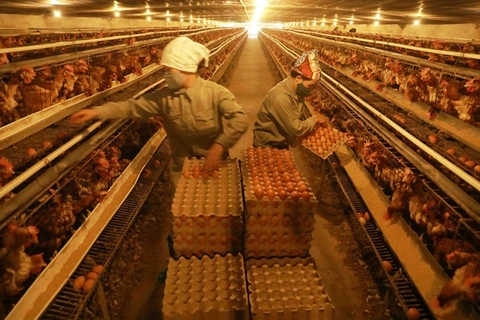
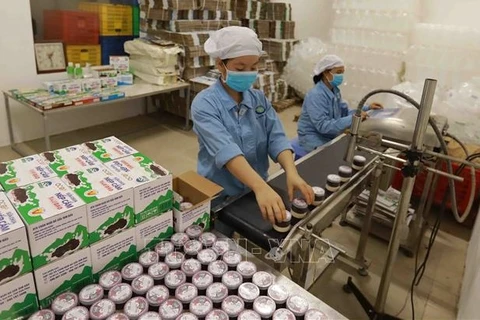
Vietnam needs to promote livestock value chain development ảnh 1The livestock industry accounted for 25.2% of the agricultural sector's GDP with a steady growth of 4-6% each year over the past 10 years. (Photo: nongnghiep.vn)
Hanoi (VNS/VNA) - Vietnam should enhance cooperation between Statemanagement agencies and commodity associations to jointly build a value chainfor Vietnam's livestock industry.

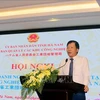
Deputy Minister of Agriculture and Rural Development Phung Duc Tien made thestatement at a conference on building the livestock value chain held in Hanoion October 27.

Tien proposed enterprises producing the same product as well as operating inthe same value chain strengthen their cooperation in production and business.That would help the agriculture sector reach targets set out in the sector'sdevelopment strategy.

"It needs to set up strategies and create a close connection between Statemanagement agencies and the commodity associations. This will improve the positionand role of the associations and also exploit all potential of theindustry," Tien said.

Duong Tat Thang, director of the ministry's Department of Livestock Production,said that the domestic livestock industry still has a lot of room for developmentbecause it has a large consumer market at home with nearly 100 million people,and the neighbouring China market. However, the industry still has manylimitations, so not yet reaching requirements in the region and the world.

The livestock industry is requested to focus on improving quality and value formeeting the demand for delicious and clean food. This requires the industry tobuild a value chain of livestock products, ensuring quality, food safety andhygiene.

Nguyen Xuan Duong, deputy chairman of the Vietnam Livestock Association, saidthe livestock industry now has a strategic orientation, specific plans,solutions and a relatively complete legal framework.

The livestock sector has key products, such as pork, poultry meat and eggs;beef and milk; birds nests; and bees. It must have a chain-based developmentstrategy for each product line, he said.

Nguyen Thanh Son, chairman of the Poultry Breeding Association, said theindustry needs to determine key products in the next 10-20 years, productionand consumption scale, and the role of parts in the chain, includingenterprises, farmers, and cooperatives.

At present, foreign-invested enterprises are gradually occupying both domesticand export market share of the livestock sector.

Sơn has suggested that the Ministry of Agriculture and Rural Development createa favourable mechanism for commodity associations and enterprises to developthe livestock industry.

Vietnam has no law on associations, so the ministry is requested to issueregulations and mechanisms for the operation of associations in agriculture.

Tien said the livestock industry has a relatively complete institutionalframework, including the Law on Livestock, three decrees, five circulars, onedevelopment strategy of the livestock industry, and one sustainable developmentstrategy on agriculture and rural areas.

From 2010 to 2021, the industry saw an increase of 1.7 times in meatproduction, 2.7 times for eggs, four times for fresh milk, and about two timesin animal feed. The output of meat, eggs and dairy basically met the needs ofnearly 100 million people and 17 million tourists each year.

"The livestock accounted for 25.2 per cent of the agricultural sector'sGDP with a steady growth of 4-6% each year over the past 10 years," saidTien.

However, Vietnam's livestock production still faces challenges in terms ofdiseases, climate change and natural disasters, as well as fluctuations in themarket for raw materials for animal feed.

Meanwhile, Nguyen Van Trong, deputy chairman of the Vietnam Farms Association,said domestic enterprises have not yet seen the benefits of joining theassociation, causing the number of members to fall.

Trong said the associations should promote cooperation with cooperatives andfarmers. They also need to coordinate with the Department of LivestockProduction to build a traceability system./.
VNA
See more

The Government’s issuance of Decree No. 72/2026/ND-CP revising preferential import tariffs on several petrol products and raw materials is a timely move to diversify supply sources. (Photo: VNA)

Fuel import tariff cuts strengthen Vietnam’s energy resilience: experts

Economic expert Dinh Trong Thinh said revising fuel import tariffs helps diversify supply sources and reduce reliance on traditional markets, thereby strengthening Vietnam’s ability to cope with potential global supply shocks. Ensuring access to multiple energy sources is also vital for safeguarding national energy security, he added.

Leaders of Dak Lak province inspect IUU fishing prevention and control efforts at Phu Lac fishing port, Hoa Hiep ward. (Photo: daklak.gov.vn)

Dak Lak readies for EC mission on anti-IUU fishing efforts

Dak Lak province is completing preparations for an upcoming European Commission (EC) inspection on efforts to combat illegal, unreported and unregulated (IUU) fishing, with a view to having the fisheries “yellow card” removed.

Vietnamese Ambassador to Argentina Ngo Minh Nguyet speaks at the event. (Photo: VNA)

Vietnam, Argentina promote trade, investment cooperation

On relations with South America, Nguyet noted that in December 2025, Vietnam and the Southern Common Market (MERCOSUR) announced the launch of negotiations for a Preferential Trade Agreement (PTA). She expressed her hope that the agreement will be signed soon, thereby further boosting trade and investment between Vietnam and MERCOSUR member states, including Argentina.

Customers buy petrol at a Petrolimex petrol station in Tran Hung Dao ward, Hung Yen province. (Photo: VNA)

PM orders stronger measures to ensure stable petrol supply

The MoIT was instructed to direct key petrol producers and traders to proactively develop supply plans to guarantee adequate fuel provision for distribution systems, maintain regular sale operations, and sell products at listed prices. It must also closely monitor developments in global and domestic petrol markets and adopt appropriate management measures when necessary.

Farmers in Ca Mau province use combine harvesters to harvest rice. (Photo: VNA)

PM orders coordinated measures to stabilise rice production and markets

The Minister of Agriculture and Environment is tasked with instructing local authorities to closely monitor production developments, improve forecasting capacity, strengthen pest control measures, and proactively respond to adverse weather conditions to protect crops, maintain planned yields and output, and reduce production costs.

A worker refuels a vehicle at a petrol station in Hung Yen province. (Photo: VNA)

Fuel prices slashed as stabilisation fund used

According to a joint decision by the Ministry of Industry and Trade and the Ministry of Finance, the price of RON95-III petrol – the most widely used grade – fell by 3,880 VND to 25,240 VND (0.95 USD) per litre.

Customers purchase petrol at Station No. 03 (Petrolimex Hung Yen) on Quang Trung Street, Tran Hung Dao ward, Hung Yen province. (Photo: VNA)

Hung Yen takes measures to curb speculation, stabilise fuel market

Petrolimex Hung Yen maintains regular reserves of about 5,500 cubic metres at directly managed outlets and roughly 2,000 cubic metres at franchised stations. The provincial Department of Industry and Trade has ordered closer monitoring of supply and demand and retail prices to detect shortages or unjustified price hikes.

The automobile assembly line of the Honda Phuc Yen factory in Phu Tho province (Photo: VNA)

Honda Vietnam sees decline in motorcycle, car sales

Sales of both motorcycles and automobiles by Honda Vietnam declined in February, dropping 19.6% and 41.8% year-on-year, respectively, according to the company’s latest business results released on March 11.

Team 2 of the Hanoi Market Surveillance Sub-department inspects operations of a Petrolimex petrol station on Tran Quang Khai street (Photo: VNA)

Hanoi maintains stable supply of petrol, LPG

The Hanoi Market Surveillance Sub-department said petrol and LPG trading activities across the city remain stable, with supply largely meeting demand despite volatility in global energy prices.

A Qatar Airways aircraft is seen at Noi Bai International Airport in Hanoi. (Photo: VNA)

Qatar Airways cancels 13 more flights amid Middle East conflicts

Statistics show that airspace across the Middle East has yet to return to normal operations, with multiple FIRs still imposing restrictions or partial closures. As a result, international flight operations through the region continue to face disruptions and route adjustments.

New FDI registrations remained robust in the first two months of 2026, with 620 newly licensed projects worth 3.54 billion USD, up 20.2% in the project number and 61.5% in registered capital compared to the same period last year. (Photo: VNA)

FDI attraction in 2026: Vietnam adapts to new global investment standards

To further enhance FDI attraction amid rising global and regional competition, Deputy Minister of Finance Tran Quoc Phuong said the ministry is drafting new strategies on foreign-invested economic development and next-generation FDI attraction, focusing on more open, transparent and competitive institutional frameworks.

Prime Minister Pham Minh Chinh speaks at the conference. (Photo: VNA)

PM highlights 'silver economy' as sustainable growth driver

The PM stressed that population ageing is an inevitable part of development, and the key challenge is not to avoid it but to respond proactively with sound policies and decisive action to turn the "silver economy" into a new driver of growth, innovation and sustainable development.

The first EU – Vietnam Global Gateway Business and Investment Forum is scheduled to take place in Hanoi on March 24, 2026. (Photo: vneconomy.vn)

EU – Vietnam Global Gateway business forum to be held in Hanoi

Key discussions will centre on sectors viewed as catalysts for Vietnam’s sustainable growth such as sustainable transport, energy transition, infrastructure connectivity, green and digital transformation, and the adoption of ESG standards in investment and business practices.