Vietnam News Agency correspondents active in pandemic's charity work

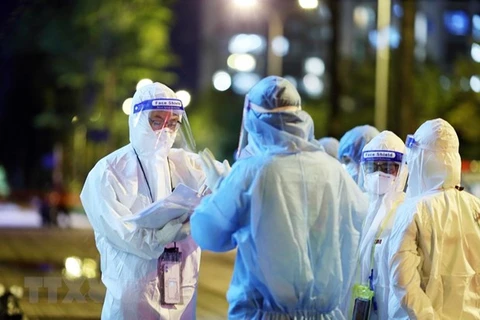
The Vietnam News Agency (VNA) correspondents are not only frontline reporters in COVID-19 hotspots but are also lending a helping hand to those in need.
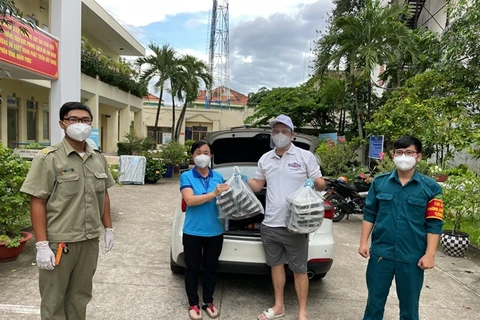
Vietnam News Agency correspondents active in pandemic's charity work ảnh 1Reporter Hoang Tuyet of VNA’s Tin Tuc (News) newspaper in HCM City prepares food aid packages for people in need (Photo: VNA)
Hanoi (VNS/VNA) – The Vietnam News Agency (VNA) correspondentsare not only frontline reporters in COVID-19 hotspots but are also lending ahelping hand to those in need.

My Phuong, a VNA economic correspondent in Ho Chi Minh City, has called forfood donations from local enterprises to support quarantine sites andresidential areas in lockdown.

So far, she has helped collect four tonnes of food and donated it to localfield hospitals.

Because Phuong is in charge of covering news on the economic sector, she hasclose relations with local organisations and businesses. A lot of businessesthat want to offer assistance to residents and frontline forces have contactedjournalists to offer their services.

While working on the sites or through relatives, Phuong happened to know thosein need of help and shared the information with businesses.

During the fourth wave of COVID-19, farmers in localities close to HCM City arestruggling to share their produce, while HCM City residents are lacking food.

Phuong has contacted farmers in those localities to transport food to HCM Cityand deliver to residents living in her neighbourhood.

She said VNA correspondents in HCM City often share information about those inneed on a report group and ask businesses for help.

One day she knew through the group that a new field hospital in District 2 waslacking food. Immediately, she contacted High Quality Vietnamese GoodsAssociation for help.

Essential goods were transported to the hospital.

"In the most urgent times, acting as a bridge to help the community,helping people in need, contributing a small part to the fight against thepandemic, I feel very happy," she said.

Reporter Hoang Tuyet of the VNA’s Tin Tuc (News) newspaper in HCM City, hasjoined a lot of charity activities but she is the most impressed with thememories she has from Field Hospital No 6.

Tuyet’s friend, a doctor at the hospital, sent her a photo of a lunch box. Themeal was delivered on time to doctors but they had no time to eat.

When doctors finished their shift, the food could no longer be eaten.

“I cried seeing the lunch box," Tuyet said.

"I thought I thought that if I didn't do anything, I would feel guilty. Iasked a female chef I know who is working at a five-star hotel if there is anyway to preserve the food longer. After thinking about the solution, the cookmade 200 pieces of bread and sent them to the doctors.

“I have connected many units and businesses to present gifts to field hospitalsand disadvantaged households in lockdown areas. Today, I just connected with acompany to send 150 gifts to residents who have been in lockdown for two monthsand can't go out to buy food.”

In Hanoi, during the COVID outbreak earlier this year, VNA reporters of theDomestic News Department, VNA Television, youth unions of VNA news outletsdonated essential goods to local hospitals, COVID-19 patients and frontlineforces.

Not only in big cities, VNA correspondents in small localities have been activein voluntary work during the pandemic.

Reporter Dau Tat Thanh in southern Binh Phuoc province called for help toinstall a water purifying station which provides free water for quarantinesites and medical centres which have a lot of residents coming for testing in DongXoai city.

Thanh also called for donations to set up a food freezer for frontline forceson duty around the clock at a COVID checkpoint.

Reporter Dang Cong Mao in southern An Giang Province and his friends presentedfive tonnes of rice and 500 food packages to local residents in need.

He also helped to raise more than 100 million VND to build two houses for thepoor in Long Xuyen city.

Nguyen Van Hieu, head of the VNA office in southern Soc Trang province, usedhis own money to buy a tonne of rice to support people in need.

Most of the reporters who have done charity work said that’s what they shoulddo in the time of the pandemic. All of them feel happy to help disadvantagedpeople./.
VNA

See more

Adrien Jean (right) introduces his photos at the exhibition (Photo: VNA)

Vietnam - France friendship captured through photographs

The “Lyon – Ho Chi Minh City” exhibition showcases 14 large-format photographs by Adrien Jean, a French photographer living in Ho Chi Minh City, and Tony Noel, a French-Vietnamese photographer based in Lyon. The works are displayed along the exterior wall of the French Residence at 6 Le Duan street, making art accessible to a wide public - from passers-by to photography enthusiasts.

VNA General Director Vu Viet Trang (second from right) and Permanent Vice Chairman of the Vietnam Journalists Association Nguyen Duc Loi (fourth from right) present the A Prize to the winners. (Photo: VNA)

VNA Press Awards 2025 inspire professional commitment, innovation in digital era

A notable feature of this edition is the significant rise in both the number and diversity of entries across all categories. These figures reflect not only growing engagement but also a more coordinated and professional approach among editorial departments and domestic and overseas bureaus, forming a consistent and multi-dimensional flow of information.

Glenn Mathews and his wife hand over the diary of Vietnamese martyr Vo Van Cong to Minister Counsellor Nghiem Xuan Hoa, representing the Embassy of Vietnam in Australia. (Photo: VNA)

Australian veteran’s son returns diary of Vietnamese martyr

Entries in the diary show that Vo Van Cong was born in 1944 in the former Phuoc Tho commune, Nhon Trach district, Bien Hoa province, now Dong Nai province. He joined the revolutionary movement in April 1961 and was admitted to the Communist Party of Vietnam in May 1962.

A number of youth union members at the Vietnam Academy of Social Sciences visit the exhibition space showcasing books and materials on culture. (Photo: VNA)

Book week underscores role of knowledge in policymaking

The highlight is a series of activities on April 21, including a book and document exhibition on culture, the launch of a special publication titled “Special scientific information for leadership” and initiatives promoting reading culture, including a book donation programme and a book review contest.

Hanoi has over 1,100 libraries and numerous cultural and educational spaces in the community. (Photo: VNA)

Spreading value of books, building foundations of learning society

Each weekend in Hanoi, the “Reading with Children” Club brings together students to practise reading, explore language, and express ideas creatively. According to founder of the club Nguyen Thuy Anh, the club encourages children to reflect, retell stories, and connect books with personal experiences, making reading more vivid and meaningful.

Automated ticketing system is used on the urban railway Cat Linh-Ha Dong line in Hanoi. (Photo: VNA)

Digital transformation powers Hanoi metro expansion

Beyond convenience, stable fares and the elimination of fuel, parking and maintenance costs have made urban rail increasingly attractive. The growing preference for metro travel is also contributing to a greener, more modern urban lifestyle.

Delegates cut the ribbon to inaugurate the operation of electric bus route No. 43. (Photo: VNA)

Hanoi accelerates shift to green buses, targets 100% by 2030

In the 2027–2030 period, the city will accelerate the transition towards the complete phase-out of fossil fuel-powered buses. The share of electric and green energy-fueled buses is projected to reach 79–89% by 2029 and 100% by 2030.

At the second session of the Ho Chi Minh City People’s Council (Photo: VNA)

Ho Chi Minh City greenlights central square, administrative centre in Thu Thiem

The new central city square and administrative centre will create a modern, centralised political-administrative complex for Ho Chi Minh City, designed to house around 8,000 officials, civil servants, and employees. It will also handle daily traffic of 1,500- 2,000 citizens and business representatives through a unified one-stop-shop administrative service system.