Vietnam potential market for digitalisation, e-commerce

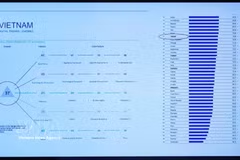
Vietnam has become an attractive destination for foreign firms and a potential market for digitalisation and electronic commerce, said Dato Lim Jock Hoi, Secretary General of the ASEAN.
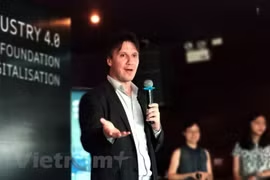
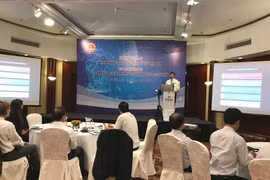
Vietnam potential market for digitalisation, e-commerce ảnh 1Vietnam has become an attractive destination for foreign firms and a potential market for digitalisation and electronic commerce, said Dato Lim Jock Hoi, Secretary General of the ASEAN (Illustrative photo: VNA)

HCM City (VNA) – Vietnam has become an attractive destination for foreign firmsand a potential market for digitalisation and electronic commerce, said DatoLim Jock Hoi, Secretary General of the ASEAN.

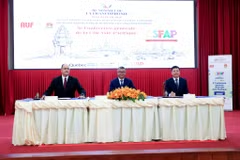
Theofficial made the statement at a press conference announcing the results of adialogue between the Federation of the Japanese Chamber of Commerce andIndustry in ASEAN (FJCCIA) and the ASEAN Secretary General, which was held inHo Chi Minh City on July 23.

Vietnamhas proved its position in the global economy. Notably, the country’s economymaintains an impressive growth rate with an open business climate, he added.

Vietnamis now a member of many bilateral and multilateral free trade agreements,including those with great influence such as the Comprehensive and ProgressiveAgreement for Trans-Pacific Partnership (CPTPP) and the European Union-VietnamFree Trade Agreement (EVFTA).

Inaddition, with a population of nearly 100 million, a low median age, and a highrate of Internet users, Vietnam is a strong potential market that foreigninvestors in the fields of digitalisation and e-commerce are keeping an eye on,the ASEAN Secretary General noted.

Accordingto Hiroyuki Ishige, Chairman of the Japan External Trade Organisation (JETRO),Vietnam and Japan have inked 36 memoranda of understanding totalling 21 billionUSD.

Recentreforms on administrative and customs procedures have helped address troublesfor firms in goods transport and foster foreign investment activities in the tradeand service sectors, he said, adding that Japan’s investment in Vietnam hasbeen on the rise.

In2017, Japan topped the list of countries and territories investing in Vietnamwith 9.11 billion USD, accounting for 25.4 percent of total capital.

Inthe first six months of this year, Japan also overcame 86 countries andterritories to become the largest foreign investor in Vietnam, with 6.47billion USD, or 31.8 percent of the total registered capital. –VNA 
VNA

See more

Karnataka Chief Minister D.K. Shivakumar speaks positively about cooperation prospects and expresses hope that more Vietnamese businesses will invest in the Indian state. (Photo: VNA)

Vietnam, India's Karnataka boost science, technology cooperation

The ambassador highlighted the complementary strengths of Vietnam and the Indian state, home to the country's Silicon Valley, and significant potential for cooperation in artificial intelligence (AI), semiconductors, digital technology, and research and development.

Delegates pose for a group photo at the Bengaluru Tech Summit 2026 in Karnataka, India (Photo: VNA)

Vietnam attends annual int’l tech summit in India

Vietnam's growing focus on science and technology, digital transformation and innovation as new drivers of development made India a natural partner in achieving its development and digital transformation goals. Cooperation potential between the two countries remains substantial, spanning both hardware and software.

Vietnamese Deputy Minister of Science and Technology Tran Trung Tinh speaks at the event. (Photo: Published by VNA)

Vietnam, RoK seek to expand cooperation in AI and semiconductor sectors

Vietnamese Deputy Minister of Science and Technology Tran Trung Tinh stressed that the Politburo's Resolution No. 57-NQ/TW identifies science and technology, innovation and digital transformation as leading breakthroughs and key drivers of rapid and sustainable development. Semiconductors and artificial intelligence (AI) are among the strategic technologies prioritised for development.

Representatives of Cambodia’s Ministry of Education, Youth and Sport (MoEYS), the Agence Universitaire de la Francophonie (AUF) and Viettel Cambodia (Metfone) sign a tripartite agreement to strengthen cooperation and accelerate digital transformation in Cambodia’s higher education sector. (Photo: khmertimeskh.com)

Vietnamese company joins Cambodia’s digital transformation efforts

The agreement establishes a cooperation framework to modernise higher education through digital governance, digital learning, artificial intelligence (AI) applications, and capacity building through training and knowledge sharing. It also aims to expand internship, employment and scholarship opportunities for students.

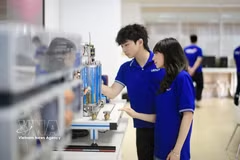
USTH students access modern equipment (Photo: VNA)

Vietnam’s AI ambition runs into talent wall

AI is becoming a foundational technology, cutting across industrial production, healthcare, education, finance, governance and public service delivery. But turning technological potential into practical value requires a workforce able to study, master and apply AI to Vietnam’s real-world problems.

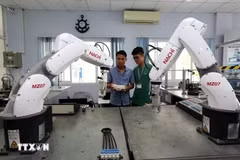
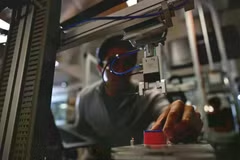
Trainees practise programming and operating robots at the Ho Chi Minh City High-Tech Park Training Centre. (Photo: VNA)

Vietnam, Malaysia hold potential for cooperation in robotics industry

Businesses from both countries should lead joint research and field-testing projects in areas such as electronic component inspection, warehouse transport, agricultural monitoring and medical logistics, said Samirul Ariff Othman, a policy, economic and business analyst at Global Asia Consulting and visiting lecturer at Universiti Teknologi PETRONAS.

Illustrative image (Photo: SGGP)

Ericsson establishes R&D capability in Vietnam

This initiative builds on Ericsson’s growing software engineering and testing capabilities in the country, and will further strengthen Vietnam’s contribution to Ericsson’s global technology development.

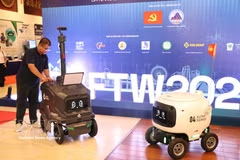
An AI-powered robot at the 2026 Seoul AI Conference. (Photo: VNA)

RoK’s AI robotics drive opens cooperation opportunities with Vietnam

Dao Tuan Hung, President of the Business Association of Vietnamese in Korea (BAVIK), said Vietnam should adopt a practical approach by prioritising specialised robots, including autonomous mobile robots (AMR/AGV), collaborative robots and machine vision systems, in sectors such as agro-fishery processing, textiles and garments, electronics and logistics.

Russian survey vessel Akademik M.A. Lavrentyev (Photo: VNA)

Russian survey vessel docks in Hai Phong

This is the third joint marine scientific survey in Vietnamese waters, running from November 4 - December 12, and one of the opening field activities under the Vietnam–Russia roadmap for marine scientific research cooperation for 2026-2035.

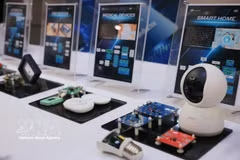
Smart products, chips and semiconductor materials are displayed at the launch ceremony of the national semiconductor chip prototyping support centre in Hanoi on June 26, 2026. (Photo: VNA)

Vietnam-Japan semiconductor cooperation paves the way for high-tech investment

The two countries are implementing five semiconductor research projects involving leading universities, with funding agreements signed in July. The projects cover three-dimensional integrated circuits, advanced semiconductor materials, secure artificial intelligence (AI) chips and power electronic components.

An exhibition space at the “Da Nang Semiconductors and High-Tech 2026” conference, organised by the Da Nang People’s Committee. (Illustrative photo: VNA)

Mobilising international resources to drive Vietnam’s technology development

Vietnam previously focused mainly on attracting overseas experts and intellectuals to work in the country over the long term, but this approach encountered certain difficulties. Cooperation methods are now shifting towards greater flexibility, allowing experts to take part in conferences and scientific seminars, contribute to addressing major national challenges, or participate in short-term training and research programmes.