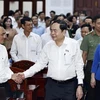
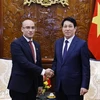
Politburo member and Permanent member of the Communist Party of Vietnam (CPV) Central Committee’s Secretariat Tran Cam Tu and Vice President of the Cambodian People’s Party (CPP) and Chairman of Standing Board of the CPP Central Committee Say Chhum witnessed the exchange of cooperation documents between the two countries' localities in Phnom Penh on April 10.
The two sides agreed to further strengthen cooperation mechanisms, particularly information sharing, to enable timely prevention and response to emerging threats, while providing strategic advice to their respective ministries. They also pledged to enhance coordination in addressing security challenges that could affect bilateral ties.
According to the scholar, the visit carries great significance as both sides seek to respond to rising unilateralism and hegemonism by jointly promoting multilateralism and globalisation, thereby contributing to global stability.
In his message, the leader commended the force’s 80-year development, highlighting its steadfast loyalty, strong sense of responsibility and consistent fulfilment of all assigned tasks.
Vietnamese Ambassador to Italy Nguyen Phuong Anh underscored the special diplomatic significance of the upcoming official visit to Italy by National Assembly (NA) Chairman Tran Thanh Man, noting that it will be the top legislator’s first overseas trip in his new tenure and the first official visit to Italy by a Vietnamese NA Chairman in more than a decade.
Since its adoption in 2016, the Law on Belief and Religion has helped safeguard the freedom of belief and religion and support activities of religious organisations. However, after eight years, the lack of provisions governing online activities has become a notable shortcoming.
The Vietnamese NA has consistently played a proactive and leading role in IPU cooperation. It has actively put forward and championed multiple initiatives, delivering substantive contributions to IPU activities. It stands ready to collaborate with fellow member parliaments and the IPU to follow resolutions and initiatves aimed at preserving peace and promoting sustainable development for the benefit of all nations, said Deputy Minister of Foreign Affairs Dang Hoang Giang.
During the visit, the two sides are expected to review and discuss the implementation of agreements reached at at recent high-level meetings, with a focus on practical and people-centred cooperation in areas such as connectivity infrastructure, border trade, education, and digital transformation.
Bounleua Phandanouvong, head of the External Relations Commission of the Lao People’s Revolutionary Party (LPRP) Central Committee, affirmed that the April 9 visit to Laos by Politburo member and Permanent member of the Party Central Committee’s Secretariat Tran Cam Tu and related activities were conducted successfully and fulfilled all set objectives.
The visit to Cambodia by Politburo member and Permanent member of the Communist Party of Vietnam (CPV) Central Committee’s Secretariat Tran Cam Tu is expected to help advance the implementation of high-level agreements, maintain the continuity and efficiency of cooperation mechanisms, and enhance economic connectivity, particularly in transport infrastructure, energy and digital transformation.
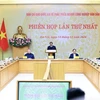
Presenting the Government’s proposal, Minister of Finance Ngo Van Tuan stressed that escalating tensions in the Middle East have triggered sharp fluctuations in global energy prices, particularly oil and gas, disrupting supply chains and pushing up crude oil prices. These developments have significantly impacted Vietnam’s fuel market, driving up retail prices in a short period and affecting business activities as well as daily life and income of people.
A draft resolution on some regulations regarding environmental protection tax, value-added tax, and excise tax on petrol, oil, and aviation fuel is among those high on the agenda on April 10.
This is the first official visit to Cambodia by Tu in his capacity as Politburo member and Permanent member of the CPV Central Committee's Secretariat. The visit takes place at a time of significant political and cultural importance, as Cambodia is preparing to celebrate its traditional New Year festival, Chol Chhnam Thmey. It also follows Vietnam’s successful organisation of the 14th National Party Congress and the election of deputies to the 16th National Assembly and People’s Councils at all levels, as well as the consolidation of its leadership apparatus and rollout of new strategic orientations.
The following is a list of selected news summaries reported last night by the Vietnam News Agency.
Leaders of Russia, Brunei, Japan, Venezuela, South Africa, Kazakhstan, Angola, Sweden and Switzerland and political parties have sent congratulatory messages and letters to Vietnam's Party, State, Government, and National Assembly leaders.
Vietnam–Cambodia relations have seen strong progress in recent years, with political trust further consolidated on the basis of high-level agreements. Economically, Vietnam is Cambodia’s third-largest trading partner globally and its largest within the Association of Southeast Asian Nations (ASEAN).
The event combined Vietnamese musical works with international repertoire in a ceremonial showcase spotlighting national unity, public confidence in the national development path, and the People’s Public Security’s absolute loyalty to the Party, State, and people.
Chairman Man, who is also the committee’s head, underscored Party General Secretary and State President To Lam’s strong push for fundamental lawmaking reform and his vision for a modern, unified, stable and development-oriented legal system.
Politburo member and Permanent member of the Communist Party of Vietnam (CPV) Central Committee’s Secretariat Tran Cam Tu emphasised that the Vietnam–Laos relationship is not only an invaluable asset but also a sacred legacy that must be preserved and passed on to future generations.
According to Indian observers, a stable political foundation enables Vietnam to engage more proactively in shaping regional norms, rules and initiatives, gradually enhancing its influence in both regional and global governance.