Vietnam, Russia issue joint statement on deepening comprehensive strategic partnership

Vietnam and Russia have issued a Joint Statement on deepening their comprehensive strategic partnership, building on the achievements of the three-decade implementation of their Treaty on Principles of Friendly Relations.

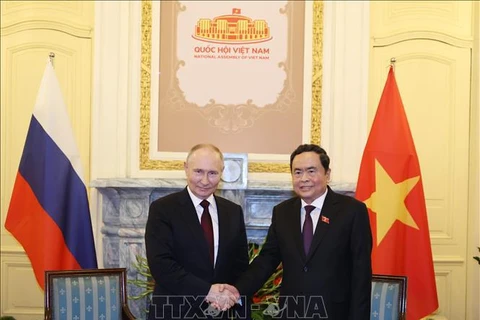
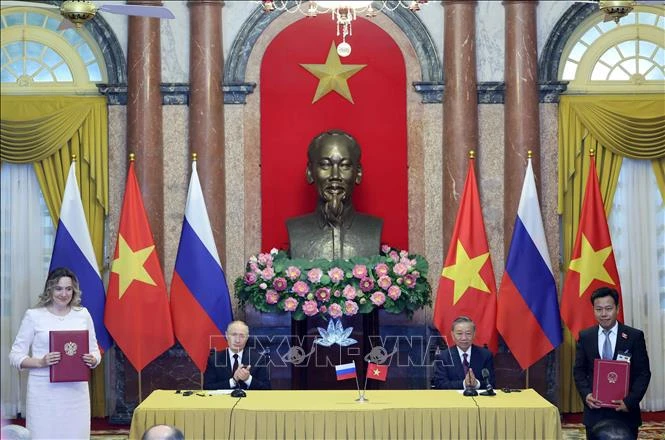
Vietnamese President To Lam (sitting, right) and Russian President Vladimir Putin witness the exchange of signed bilateral agreements between the two nations. (Photo: VNA)

Hanoi (VNA) - Vietnam and Russia have issued a Joint Statement on deepening their comprehensive strategic partnership, building on the achievements of the three-decade implementation of their Treaty on Principles of Friendly Relations.

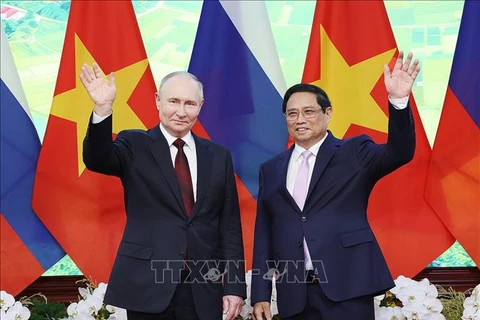
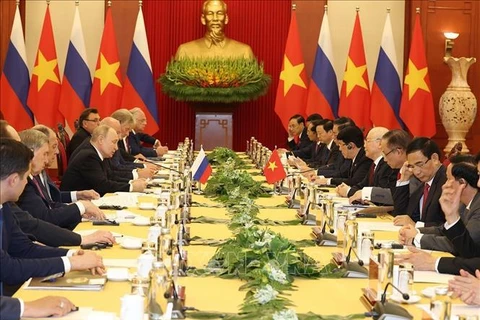
Released as part of Russian President Vladimir Putin's state visit to Vietnam on June 19 and 20, the joint statement wrote that the two countries will continuously strengthen their comprehensive strategic partnership based on friendship and mutual support amidst a complex international landscape. In 2025, they will celebrate 75 years of diplomatic relations, marking a long journey of overcoming challenges together.

According to the document, both sides affirmed that consolidating and enhancing the effectiveness of the comprehensive strategic partnership is a top foreign policy priority for both, serving long-term interests, contributing to each country's development, and enhancing their roles regionally and globally.

Vietnam and Russia build their relationship on mutual trust, principles of sovereign equality, territorial integrity, the right to self-determination, non-interference in each other's internal affairs, no use or threat to use force, peaceful settlement of disputes, and in accordance with the UN Charter and international law. They are determined to continue close cooperation in both bilateral and multilateral frameworks.

Vietnam and Russia do not align or enter into agreements with a third party to take actions that are harmful to each other's independence, sovereignty, territorial integrity, and fundamental interests. The development of their bilateral relations is not aimed against any third party.

Vietnam and Russia also agreed to continue regular and substantive high-level political dialogue, striving to effectively implement agreements reached between their leaders. They aim to enhance the efficiency of existing cooperation mechanisms, establish new ones, and strengthen contacts through party and parliamentary channels.

Both sides emphasised the special role of defence and security cooperation in their overall relationship and agreed to strengthen comprehensive collaboration in international information security in line with international law and bilateral agreements.

The two sides recognised the need to enhance joint work in emergency response, further develop economic cooperation, and support the early agreement and implementation of the master plan for Vietnam-Russia cooperation development until 2030.

They affirmed the importance of increasing Vietnamese investment in Russia and Russian investment in Vietnam in such areas as mineral extraction and processing, industry, agriculture, machinery manufacturing, and energy.

Both sides concurred to continue cooperating in existing and new oil and gas projects in accordance with each country's law, meeting the strategic interests of both parties. They also saw potential in cooperation on the construction and modernisation of power facilities.

They supported facilitating the operation expansion of Vietnamese oil and gas enterprises in Russia as well as of Russian oil and gas enterprises on the Vietnamese continental shelf, in line with Vietnamese, Russian and international laws, including the 1982 United Nations Convention on the Law of the Sea.

The joint statement also highlighted the potential for nuclear energy collaboration, the strategic nature of joint work in education, training, science, technology, and innovation, and the promotion of the study and teaching of Vietnamese in Russia and Russian in Vietnam.

The areas for expanded cooperation also included humanities, media, health, sports, and tourism. Both sides agreed to continue discussions on immigration issues and facilitate the living, working, and studying conditions for Vietnamese citizens in Russia and Russian citizens in Vietnam.

Both sides vowed to accelerate the objective process of establishing a fair and sustainable multipolar world order, in line with the fundamental principles of the United Nations Charter and international law, including respecting sovereignty, territorial integrity, the right to self-determination of peoples, non-interference in the internal affairs of countries, and refraining from the threat or use of force, and peaceful settlement of disputes.

They emphasised that effective cooperation and coordinated actions at global and regional forums will strengthen and enhance the bilateral relationship, deepening the traditional friendship and comprehensive strategic partnership between the two countries. This will serve the long-term interests of their people, contributing to peace, security, and sustainable development in the Asia-Pacific and the world.

President Putin invited Party General Secretary Nguyen Phu Trong and other high-ranking Vietnamese leaders to visit Russia at a convenient time. The Vietnamese side accepted the invitation with pleasure./.
VNA

See more

Prime Minister Pham Minh Chinh speaks at the meeting with the Policy Advisory Council in Hanoi on March 7, 2026. Photo: VNA

PM requests flexible, prompt, effective response to all situations

Prime Minister Pham Minh Chinh called for measures to ensure stable supplies of fuel, electricity and energy, while also viewing current challenges as an opportunity to accelerate the green energy transition and better harness the country’s potential and competitive advantages.

National Assembly Vice Chairman Tran Quang Phuong speaks at the March 7 inspection on An Giang's preparations for the election of deputies to the 16th legislature and People’s Councils at all levels for the 2026-2031 tenure. (Photo: VNA)

NA Vice Chairman inspects election preparations in An Giang

National Assembly (NA) Vice Chairman Tran Quang Phuong on March 7 led a working delegation to meet with the Election Committee of An Giang to inspect and supervise preparations for the election of deputies to the 16th legislature and People’s Councils at all levels for the 2026-2031 tenure.

Bru–Van Kieu ethnic minority villagers in Quang Tri province's remote commune of Truong Son are eagerly preparing for early voting. (Photo: VNA)

Bru–Van Kieu community in Quang Tri gear up for early voting

According to the provincial Election Committee, three polling stations in Truong Son commune – located in Hoi Ray, Nuoc Dang and Doc May villages – will organise voting on March 8, seven days before the nationwide election of deputies to the 16th National Assembly and People’s Councils at all levels for the 2026–2031 tenure, to make it easier for residents in remote areas where travel remains difficult to cast their ballots.

Politburo member, Secretary of the Party Central Committee, Secretary of the Party Committee of the Vietnam Fatherland Front (VFF) and central mass organisations, and President of the VFF Central Committee Bui Thi Minh Hoai speaks at the event in Phu Tho province on March 6. (Photo: chinhphu.vn)

Front leader meets voters in Phu Tho

Voters in Phu Tho province's Hoa Binh and Luong Son expressed their hope that if elected, the candidates would continue to uphold their roles and responsibilities as people’s representatives, remain close to the grassroots level, and understand the legitimate aspirations of the people.

Party General Secretary To Lam speaks at the event in Hanoi on March 6. (Photo: VNA)

2026 inspection-supervision decision for NA Party Committee's Standing Board announced

The NA Party Committee is ready to cooperate closely, promptly provide relevant documents and materials, and work in accordance with the delegation’s requests. During the inspection and supervision process, its Standing Board hopes members of the inspection delegation will offer frank comments and clearly point out both its achievements and shortcomings.

Prime Minister Pham Minh Chinh presents the 2025 Kovalevskaia Award to Prof. Dr. Tran Thi Viet Nga, Director of the Vietnam–Japan Institute of Advanced Technology and senior lecturer at Hanoi University of Civil Engineering (Photo: VNA)

PM proposes “Talented, creative and dedicated women” award

This year’s award went to a group of female scientists from Hanoi University of Science and Technology for their research cluster on applying biocatalysis to enhance the value of Vietnamese agricultural products. The individual award was presented to Prof. Dr. Tran Thi Viet Nga, Director of the Vietnam–Japan Institute of Advanced Technology and senior lecturer at Hanoi University of Civil Engineering, for research linked to environmental protection, energy security and climate change adaptation.

Delegates attend the 5th meeting of the ASEAN–UK Joint Cooperation Committee. (Photo: VNA)

Vietnam co-chairs 5th ASEAN–UK joint cooperation committee meeting

Ambassador Ton Thi Ngoc Huong, Head of Vietnam’s Mission to ASEAN, affirmed that Vietnam will work closely with ASEAN member states to achieve the objectives set for the fifth anniversary year. These include developing a substantive new ASEAN–UK Plan of Action for 2027–2031 and finalising the ASEAN–UK Joint Declaration on cooperation within the framework of the ASEAN Outlook on the Indo-Pacific.

Prime Minister Pham Minh Chinh meets with 20 Ambassadors and Chargé d'affaires of the European Union (EU) and EU member states in Hanoi on March 5. (Photo: VNA)

PM receives EU Ambassadors, Chargé d'affaires in Vietnam

PM Chinh affirmed that the EU and its member states are top priority partners in Vietnam's foreign policy, and the establishment of a new framework reflects the increasingly high level of political trust and creates momentum for expanding cooperation in all fields.