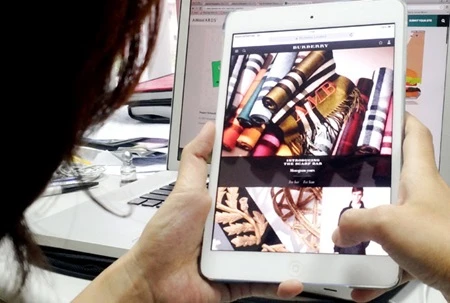
Illustrative photo (Source:Internet)
 Hanoi (VNA) - Vietnam hopes to see 3G and 4G networks covering 95 percent of residential homes by 2020, according to Deputy Minister of Information and Communications Phan Tam.
Speaking at the Vietnam–Republic of Korea LTE Vision Workshop 2016 held in Hanoi on April 1, Tam said that under the national broadband plan, the most advanced broadband technology, such as long-term evolution (LTE), has received attention from both management agencies and telecom providers.
The ministry has allowed businesses to carry out pilot 4G LTE programmes since 2010. Based upon market demands, together with technologies, equipment and other conditions, Vietnam has granted licenses for the pilot LTE and LTE-Adv networks for some telecom companies affiliated with Viettel and Vinaphone in various localities.
LTE is one of the latest mobile telecom technologies, called 4th Generation (4G), providing end-users with mobile data service that is 10 times faster than 3G’s maximum speed. This is equivalent to downloading a multimedia file, such as a 100 megabyte music video, to a user’s LTE smartphone in three seconds in optimal conditions.
Telecom providers are expected to complete their investment and business plans for 4G networks this year. The ministry is also expected to complete management policies to ensure healthy competition and sustainable development in the broadband market.
“I believe that this year will be a good start for LTE, and the technology will be strongly developed by next year,” he said.
Doo Soo Park, global marketing and sales general director of Samsung Networks, said by the end of 2015 there were 480 LTE networks in 157 countries and territories with over one billion users.
In Asia, LTE has been one of the most popular technologies, with the Republic of Korea, China, Singapore, Malaysia, Indonesia, the Philippines and Thailand offering commercial LTE services.
Park said that Vietnam is a potential target for LTE development, as telecom providers have considerable experience from operating pilot 4G LTE networks.
He noted that the most important factor was to build high speed LTE networks to catch up with the development of LTE-Advanced Pro, which provides continuous broadband, high quality calls and quick data transfers to end-users.
“We recommend the building of LTE overlays, which are separated from 2G and 3G networks, to help implementation move along more quickly and conveniently,” he said, adding that Samsung has striven to jointly participate in the pilot 4G LTE program in Vietnam. “We want to become a long-term strategic partner when the 4G LTE network is introduced into Vietnam,” he noted.
Meanwhile, Choi Yang-hee, Minister of Science, ICT and Future Planning, said Korean businesses are ready to share their experience in 4G LTE development, as well as strengthen relationships between the two countries to support Vietnam in becoming a strong ICT country.
One of the key challenges put forward by the Korean delegation was managing the revolutionary growth of mobile data traffic. For example, about 75 percent of total mobile network traffic was generated by voice in 2009, but just three years after the LTE launch, mobile data traffic has increased to take up to 99 percent of total network traffic in 2014.
A key driver of this remarkable shift was ‘mobile video’ services. By the end of 2015, one LTE user on average consumed 4.3 Gigabytes (GB) per month, whereas a 3G customer used 0.7 Gigabytes, and 57 per cent of total data traffic was for downloading mobile videos.
To speed the commercial readiness of LTE and to accommodate the exponentially growing market demand, operators have built LTE networks that are separate from legacy networks, while the government has designed frequency assignment policies based upon future needs.
At this workshop, industry experts from the government, operators and solution providers discussed the vision for LTE, policies, deployment experiences, market needs and challenges, killer app trends and technology evolution, along with how to expedite LTE readiness throughout Vietnam.-VNA