Vietnam sets good example of technological innovation: GII report

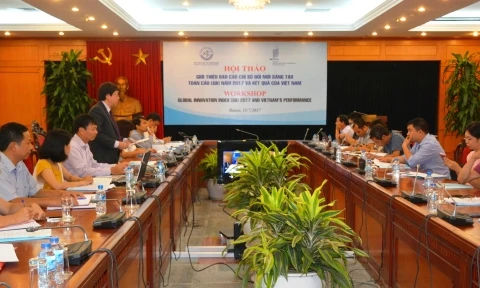
Vietnam is an outstanding economy in turning its investment for innovation into concrete results, according to the Global Innovation Index (GII) Report 2018 released by the World Intellectual Property Organisation (WIPO) on July 10.
Vietnam sets good example of technological innovation: GII report ảnh 1Sacha Wunsch-Vincent, a senior expert in the WIPO’s GII research group (Source: VNA)

Hanoi (VNA)
- Vietnam is anoutstanding economy in turning its investment for innovation into concreteresults, according to the Global InnovationIndex (GII) Report 2018 released by the World Intellectual PropertyOrganisation (WIPO) on July 10.

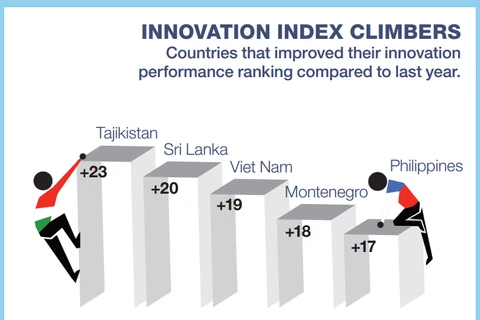
Vietnam improved its position in the GII, ranking 45th among 126economies in the world, climbing two places compared to last year.

Among 30 low middle-income countries, Vietnam ranked second after Ukraine,according to the report.

In an interview with US-based Vietnam News Agency’s correspondents on thesidelines of the announcing ceremony of the report, Sacha Wunsch-Vincent, asenior expert in the WIPO’s GII research group, said in the most recent editionof the GII, Vietnam emerged as a country with a special effect on innovation.

It became a model of technologicalinnovation for the group of low middle-income countries, he noted.

According to Wunsch-Vincent, Vietnam is the only country that has directionsfrom the prime minister level with a resolution on setting up a special group tobring together ministries and sectors to improve the country’s position in the globalinnovation rankings.

He noted some economies are making a serious mistake if they don’t pursue acontinual innovation agenda and recommended Vietnam to avoid this blunder and pursuepolicies and plans set forth by Prime Minister Nguyen Xuan Phuc to promoteinnovation.

Vietnam should not make another mistake in many countries to set goals as greatas building Silicon Valley, he added.

The country should focus on its existing internal strengths, such as in foodproduction and processing and information technology, considering ways toincrease the country’s own innovation capacity along with accessing new externaltechnologies, he said.

Le Thanh Binh, Science and Technology Counsellor of the VietnamPermanent Mission to the United Nations, highlighted the improvement of Vietnam’sposition in the GII 2018, noting that the country climbed 14 places comparedwith 2016, and recorded higher scores in all seven pillars of the GII.

The effectiveness of Vietnam's reform efforts were reflected in both input andoutput indicators and Vietnam's position in the GII rankings has improved inevery aspect in the last five years, he added.

This year, Switzerland is the world’s most innovative nation, followed by Netherlands,Sweden, the UK, Singapore, the US, Denmark, Germany and Ireland.

In the top 20 of the GII 2018, Israel and China recorded leaps. Israel climbedseven places to rank 11th and China jumped five places to the 17th position.

This is the 11th consecutive year the GII Report has been released. Itaims to capture the multi-dimensional facets of innovation by providing adatabase of metrics for economies worldwide.

The GII2018 is divided into seven pillars. Of which, the first five pillars are in thegroup of innovation input sub-indices, including institutions, human capitaland research, infrastructure, market sophistication and business sophistication.The last two pillars are the group of innovation output sub-indices, including knowledgeand technology outputs and creative outputs.

Themed “Energizing the World withInnovation”, the GII 2018 is the result of collaboration between CornellUniversity, INSEAD and the WIPO as co-publishers.

The GII Report 2018 analyses the energyinnovation landscape of the next decade and identifies possible breakthroughsin fields such as energy production, storage, distribution and consumption. Italso looks at how breakthrough innovation occurs at the grassroots level anddescribes how small-scale renewable systems are on the rise.

The report concludes that by 2040, the world’senergy demand is expected to grow substantially by 30 percent, whileconventional approaches to expand energy supplies are no longer feasible in thecontext of climate change.-VNA
VNA

See more

Visitors tour an exhibition showcasing technology and cultural products. (Photo: VNA)

VIPC Summit 2026 highlights Vietnam’s ambitions in strategic technologies

Through the VIPC Summit 2026, Vietnam aims to reaffirm its commitment to building a transparent, competitive and internationally integrated investment environment, while promoting new financial mechanisms and institutions to make science, technology, innovation and digital transformation strategic growth motivation in the coming years.

At the “Digital Trust in Finance 2026” forum (Photo: VNA)

Forum discusses digital trust in finance during AI era

Deputy Minister of Public Security Sen. Lieut. Gen Pham The Tung told the forum that Vietnam’s financial and banking industry is racing through a digital overhaul, creating major opportunities as the country aims for double-digit growth in 2026 and beyond.

Citizens obtain queue numbers for administrative procedures at the Public Service Center of Hanoi's Hoan Kiem ward (Photo: VNA)

All citizen-government transactions to go fully digital by 2035

Looking ahead to 2035, Vietnam envisions becoming a comprehensive and sustainable digital nation where all transactions between citizens and government agencies are conducted online. National databases, with population data at the core, will be interconnected and efficiently utilised to support smart governance and real-time decision-making.

The EV models are manufactured at VinFast's factory in India. (Photo: VNA)

Experts hope for expanded Vietnam-India innovation cooperation

Indian experts voiced confidence that the state visit by Party General Secretary and State President To Lam would create fresh momentum for Vietnam-India cooperation in innovation, digital technology and startups, contributing to the more substantive and effective development of the two countries’ Enhanced Comprehensive Strategic Partnership.

Vietnamese and Australian experts at the meeting (Photo: VNA)

Vietnam, Austria promote cooperation in AI, cybersecurity

The NCA proposed strengthening its strategic partnership with the AIT through several key orientations, including the protection of critical digital infrastructure, data security and trusted digital ecosystems, the application of AI and data analytics in cybersecurity, high-quality human resources training, expert exchanges, and the co-organisation of annual international forums and conferences.

Illustrative image (Photo: congly.vn)

SMEs urged to strengthen cybersecurity amid digital transformation

In the digital era, the line between opportunity and risk is becoming increasingly blurred. For SMEs, digital transformation is an inevitable path, but building a strong “digital shield” will be essential for sustainable growth and stronger contributions to the national digital economy.

The Vietnamese delegation attends the SAHA 2026 International Defence & Aerospace Exhibition in Istanbul. (Photo: qdnd.vn)

Vietnam attends SAHA 2026 defence, aerospace exhibition in Türkiye

Vietnam’s participation in SAHA 2026 International Defence & Aerospace Exhibition in Istanbul reflects the country’s consistent policy of enhancing international defence integration and promoting defence industry cooperation towards self-reliance, self-strengthening, modernisation and dual-use development.

Vietnam, Austria seek deeper cooperation in cybersecurity

Vietnam, Austria seek deeper cooperation in cybersecurity

The Austria-Vietnam Cybersecurity Forum was held in a hybrid format in Vienna on May 5, bringing together policymakers, businesses, and experts to explore opportunities for bilateral cooperation while advancing policy dialogue on cybersecurity.

Students engage in hands-on learning through the application of digital technology software. (Illustrative photo: VNA)

Resolution 57 delivers tangible gains in digital life of citizens

The resolution has generated not only strategic momentum but also practical impact, as digital technologies are increasingly embedded in daily activities, driving socio-economic development and laying a solid foundation for rapid and sustainable growth in the new phase.