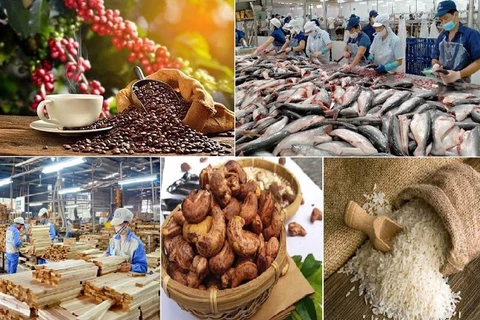
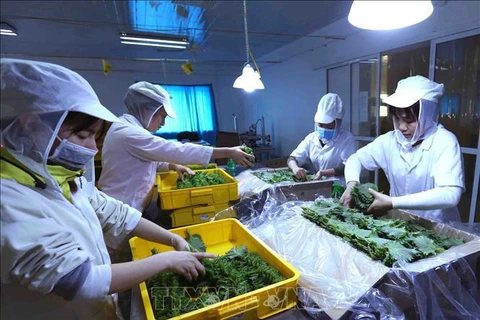
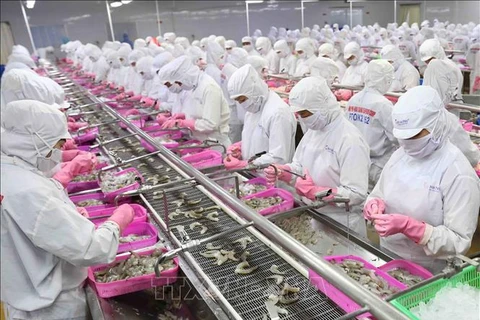
Hanoi (VNA) Vietnam currently exports a broad range of agricultural products all over the world. Its key exports are rice, coffee, cashew nuts and fruits and vegetables, according to HSBC. Shining admist global agriculture Contributing roughly 12 percent to Vietnam’s GDP, agriculture has long been the backbone of the country’s economy for a number of comparative advantages like cultivation land, forest coverage, sea territories, tropical climate, available and cost effective labour. In 2023, Vietnam’s agricultural sector experienced its highest growth in the past 10 years, reaching 3.83 percent, with rice production going up by 1.7 percent, meat production increasing 3.5 percent whereas fishery products was up 2.9 percent. The high yields boosted the agriculture sector’s export turnover to over 53 billion USD, while the trade surplus was more than 12 billion USD, accounting for 42.5 percent of the counrty’s total trade surplus. Rakshit said Vietnam currently exports a broad range of agricultural products all over the world. Its key exports are rice, coffee, cashew nuts and fruits and vegetables, accounting for more than 16 billion USD of agricultural exports. Among them, many have successfully gained access to new markets. Since the beginning of the year, Vietnam’s durian, coffee and rice prices have increased by 20 percent, 9 percent, and 6 percent respectively. The total export turnover of agro-forestry-fishery products is estimated at 54-55 billion USD in 2024. Rakshit added that thanks to the rapid growth, Vietnam is becoming a key player in global agriculture. Last year the World Economic Forum (WEF) selected the country as one of the first three countries to pilot the Food Innovation Hub, a flagship initiative of the Food Action Alliance designed to improve sustainability in food production. Besides, Vietnam’s government has put a lot of effort in promoting agriculture, placing it under the global spotlight. One of them was Ministry of Agriculture and Rural Development’s decision in December 2023 to approve the establishment of the scheme on Food Innovation Hub Vietnam (FIHV), aiming to foster more innovation.  Taking the EU-Vietnam Free Trade Agreement (EVFTA) as an example, this FTA has helped Vietnam eliminate up to 94 percent of tax lines for fruits and vegetables, creating a competitive advantage over Thailand and China. Specifically, for rice, the preferential tariffs from EVFTA has benefitted Vietnam compared to countries like Cambodia, Thailand and India. Vietnam has now become one of the largest sources of cashew nuts and coffee for the EU. Tackling climate change is a key focus area for the goverment to help agriculture sector to thrive sustainably, he said. Due to the country's geographic exposure, it is particularly susceptible to climate change with a serious effect on agriculture. Following Vietnam’s bold net zero commitment at COP26, the government approved the National Green Growth Strategy 2021-2030 with vision to 2050, which is an important policy document for the country’s economic growth and sustainable development, with specific goals related to greenhouse gas emission reductions. Last year, the Vietnamese Government also approved the National Electricity Development Plan for 2021 – 2030, with a vision to 2050. Known more commonly as the Power Development Plan 8 (PDP8), after almost three years in the making, this masterplan highlights the significant investment required to develop Việt Nam’s energy sector and presents potential opportunities for foreign energy firms.  |
VNA