Vietnam shows strong political commitment to maximising green energy transition

Green transition in the energy sector is a key trend in the world and is one of Vietnam’s current top priorities. Vietnam is among countries with great potential to invest in new renewable energy sources such as solar, wind and ocean wave power, and biogas.
Vietnam shows strong political commitment to maximising green energy transition ảnh 1Installing rooftop solar power at Duong river surface water plant JSC (Photo:nhandan.vn)

Hanoi (VNA) - Green transition in the energy sector is a key trend in the world and is one of Vietnam’s current top priorities. Vietnam is among countries with great potential to invest in new renewable energy sources such as solar, wind and ocean wave power, and biogas.

According to experts, to take advantage of its inherent potential, Vietnam needs to have incentive policies to expand the renewable energy market, promote and deploy new technologies, provide appropriate opportunities as well as encouraging the use of renewable energy in all important areas.

The world today still depends mainly on traditional energy such as oil, coal, and natural gas. However, these sources are gradually running out. According to scientists' calculations, they can only last 70 to 100 years.

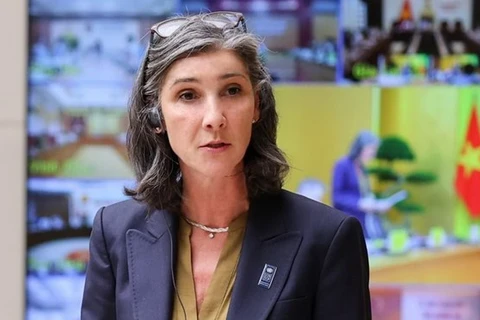
Dr. Chu Duc Hoang, Chief of the Office of the National Technology Innovation Fund under the Ministry of Science and Technology, said traditional energy not only causes serious environmental pollution from greenhouses emissions that produce harmful effects to water and soil, but are also gradually depleting, posing a threat to stable energy supply in the future.

Vietnam’s energy industry has developed strongly in recent years, in all stages of exploration, exploitation, production, transmission, distribution and import and export of energy. However, the scale and efficiency of the energy industry are still low.

In particular, Vietnam's energy demand is also increasing rapidly with about 10% a year during 2001-2010, about 7% a year in the period from 2011 to present. Electricity demand climbed by 13% a year during the 2001-2010 and nearly 10% a year from 2011 to present.

Greenhouse gas emissions from the energy sector accounted for about 63% of Vietnam's total greenhouse gas emissions in 2010 and about 67.7% in 2020. Emissions are forecast to make up about 73.1% and 79.7% in 2030 and 2050 respectively according to the normal scenario.

The 26th Conference of the Parties participating in the United Nations Framework Convention on Climate Change (COP26) with strong political commitments of many countries, including Vietnam, to reduce greenhouse gases shows the trend. Green energy production and consumption as well as energy transition are becoming an urgent and important issue in sustainable development strategies, associated with environmental protection of countries around the world.

Committing to achieving the goal of complete decarbonisation by mid-century makes Vietnam an even more attractive destination for foreign corporations to invest in renewable energy infrastructure, including offshore wind power projects. With a coastline of more than 3,200 km, shallow water depth and high, stable wind speed, Vietnam fully meets the important prerequisites necessary to develop reliable offshore wind power projects.

Dr. Chu Duc Hoang said that facing the challenge of climate change and the risk of energy depletion, the transition to green energy is not just an option but an urgent need. In this transition, technology plays a key role. Tech will create efficient solutions for capturing and storing energy to optimising its use in both production and daily consumption. Therefore, technological innovation is an inevitable trend for countries, corporations, and businesses to successfully convert from traditional energy to clean energy./.
VNA

See more

A display area for unmanned aerial vehicles (UAVs) at a workshop in Da Nang city on June 12, 2026. (Photo: VNA)

Vietnam eyes UAV industry as key driver of low-altitude economy

For Vietnam, the opportunity presented by unmanned aerial vehicles (UAVs) lies not only in expanding their applications but, more importantly, in gradually building industrial capacity, mastering technologies and engaging more deeply in global value chains.

A semiconductor chip by TSMC (Photo: VCG)

Vietnam seeks deeper integration into global semiconductor value chains

Nguyen Anh Tuan, Director of the National Centre for Pilot Semiconductor Chip Manufacturing Support under the Ministry of Science and Technology, said that amid increasingly intense global technological competition, the semiconductor industry is not only a high-value-added economic sector but also a foundation for technological self-reliance, national security and economic competitiveness.

Demonstration of an autonomous electric street sweeper. (Photo: VNA)

Hanoi approves controlled pilot of two technology projects

The two projects involve an intelligent autonomous transportation system developed by Phenikaa-X JSC and a technology for producing mixed rare-earth oxides with a purity of over 95% on a semi-industrial scale developed by the Mining Technology and Construction Consultancy JSC.

Prof. Dr. Tran Hong Thai, President of the Vietnam Academy of Science and Technology (VAST), has a working session with leaders of Russia’s State Atomic Energy Corporation Rosatom. (Photo: VNA)

Vietnam, Russia develop quantum technology cooperation roadmap

Quantum technology is an emerging field undergoing rapid breakthroughs and requiring enormous investment resources. Learning from the experience of pioneering countries such as Russia will enable Vietnam to significantly shorten the time needed to build its workforce and develop endogenous capabilities.

Senior Vice-President of Latin America and Asia at Thales Group Guy Bonassi (L) at a meeting with Vietnamese Ambassador to France Trinh Duc Hai (Photo published by VNA)

Vietnam, France should expand cooperation in strategic fields: business leader

General Secretary of the Communist Party of Vietnam Central Committee and President To Lam’s visit to France, Guy Bonassi, Senior Vice-President of Latin America and Asia at Thales Group, said the upgrade of bilateral ties to a Comprehensive Strategic Partnership reflects their shared desire to deepen and broaden cooperation, with technological autonomy, resilience and human resources development assuming increasingly important roles.

The Vietnamese delegation led by Deputy Prime Minister Ho Quoc Dung visits the Korea Institute of Science and Technology (KIST). (Photo: VNA)

Vietnam, RoK promote strategic technological cooperation

Deputy Prime Minister Ho Quoc Dung proposed expanding joint research programmes, particularly in strategic areas where Vietnam has development needs, and KIST has strengths, including semiconductor integrated circuits, AI, batteries and energy storage, and biotechnology.

Digital transformation brings economic benefits closer to businesses

Digital transformation brings economic benefits closer to businesses

In addition to streamlining processes and reducing the time required to complete administrative procedures, digital models are creating more opportunities for businesses, household enterprises and small traders to access information, adopt new payment methods, connect with partners and expand their markets.

Images are collected and processed at a satellite image receiving station. (Photo: VNA)

Vietnam, France explore new space technology cooperation opportunities

Building on the effectiveness of VNREDSat-1, Vietnam and France are continuing to promote cooperation in the next phase, including a proposal for VNREDSat-2. The two sides have discussed technological options, resources and an implementation roadmap, with a view not only to developing a new-generation satellite but also to increasing Vietnam’s level of participation and technological capabilities.