Vietnam successfully eliminates trachoma: WHO

The World Health Organisation (WHO) confirmed on October 21 that Vietnam has eliminated trachoma, a contagious, bacterial disease that may eventually lead to blindness.

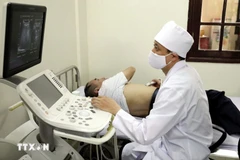
Deputy Minister of Health of Assoc. Prof. Nguyen Thi Lien Huong (2nd from left) receives a certificate and a plaque honouring Vietnam's elimination of trachoma. (Photo: nhandan.vn)

Hanoi (VNA) - The World Health Organisation (WHO) confirmed on October 21 that Vietnam has eliminated trachoma, a contagious, bacterial disease that may eventually lead to blindness.

This remarkable achievement was validated by the WHO and a plaque was presented to Deputy Minister of Health of Assoc. Prof. Nguyen Thi Lien Huong at the 75th session of the WHO Regional Committee for the Western Pacific, which opened on October 21 in Manila, the Philippines.

Trachoma remains the world’s leading infectious cause of blindness, even though it is a preventable eye disease caused by the bacterium Chlamydia trachomatis.

The disease spreads through flies or direct contact with eye or nasal discharge from an infected individual.

Repeated infections can cause the eyelashes to turn inward, leading to pain and damage to the cornea. In severe cases, surgery is required to prevent blindness.

Historical surveys revealed that trachoma posed a public health threat in four provinces in Vietnam. Thirty years ago, 1.7% of people in these high-risk areas needed surgery to avoid blindness from the disease. However, by 2023, this rate had dropped to below 0.2%, meeting the WHO’s threshold for eliminating trachoma as a public health issue.

This achievement is attributed to ongoing surveillance and the implementation of the SAFE (short for 'surgery, antibiotics, facial cleanliness and environmental improvement') strategy, which began in 1999.

The landmark outcome follows decades of dedication by healthcare workers, communities, different sectors of society and the Government, supported by WHO and partners including the Australian Department of Foreign and Trade (DFAT), the Fred Hollows Foundation, the International Trachoma Initiative, RTI International, UNICEF and USAID.

USAID Vietnam has provided financial and technical assistance since 2011 towards the efforts./.

VNA
See more

An ambulance from the pre-hospital emergency care service in Phu Quoc special zone in An Giang province. (Photo: VNA)

Pre-hospital emergency care system to be launched nationwide

From 2027, the national pre-hospital emergency management platform will be put into operation, connecting data with the 113, 114 and 115 emergency call systems to facilitate rapid emergency dispatch and improve public access to emergency services.

Foreign patients travel to Vietnam for robotic cancer surgery at one-tenth of US costs

Foreign patients travel to Vietnam for robotic cancer surgery at one-tenth of US costs

With robot-assisted surgery costing tens of thousands of dollars in the US and Singapore, a growing number of international patients are traveling to Vietnam for robotic cancer surgery, including procedures for prostate, gynecological and gastrointestinal cancers, using the US made da Vinci Xi system at costs starting from just 3,000 USD.

Under a phased rollout beginning in 2026, every resident in Ho Chi Minh City will receive at least one annual health check-up or health screening. (Photo: VNA)

Ho Chi Minh City develops integrated multi-tier healthcare system

Under the new model, healthcare is organised into interconnected levels based on people's needs rather than administrative boundaries. Patients can move seamlessly between levels while their electronic health records and treatment information remain connected through digital platforms, referral systems, telemedicine, electronic medical records, and integrated health databases.

Doctors conduct heart and lung examinations for workers. (Photo: VNA)

Draft policy encourages people to prepare for old age from middle age

A draft circular guiding the implementation of the National Target Programme on Health Care, Population and Development (2026-2035) marks a shift from focusing solely on elderly care to encouraging healthy and independent ageing through early preparation. It covers healthy lifestyles, regular health check-ups, financial planning, suitable employment and home-based elderly care skills.

The meeting between the Vietnam Military Medical University delegation and leaders of the Lao Ministry of National Defence in Vientiane (Photo: VNA)

Vietnam, Laos deepen military medical cooperation

Since 1954, Vietnam Military Medical University has trained 687 Lao military medical personnel, including 322 doctors, 67 master's degree holders, 10 doctorate holders, and dozens of specialist physicians, alongside hundreds of pharmacists and medical technicians.

Vietnam's first penis transplant from a brain-dead donor is successfully performed at Viet Duc University Hospital. (Photo published by VNA)

Vietnam reaches new milestone in reconstructive transplant surgery

As the first operation of its kind in Vietnam, the hospital spent months developing treatment protocols, studying international experience and assembling a multidisciplinary team that included experts in transplantation, andrology, microsurgery, anaesthesia, immunology and pathology.

Dr. Nguyen Thanh Xuan is performing brain surgery on a patient (Photo published by VNA)

National strategy aims to build advanced medical ecosystem

Vietnam's adjusted healthcare network master plan for 2021–2030, with a vision to 2050, also outlines a regional structure covering the country's six socio-economic regions. It envisages 17 provincial general hospitals serving regional functions, at least one highly specialised hospital in each region, and at least one advanced medical facility in every province and city.