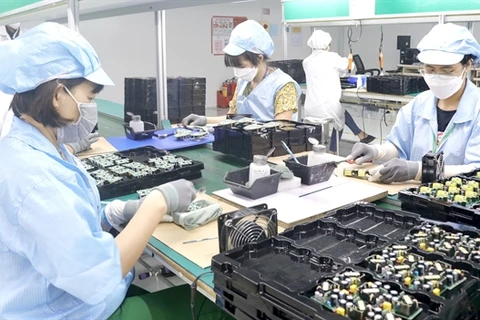
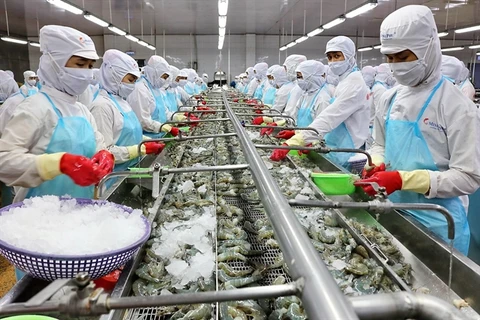
Panasonic Life Solutions Vietnam in Vietnam - Singapore Industrial Park, Binh Duong province. (Photo: VNA)
 The move comes amid concerns that this measure might undermine the competitive advantage of developing countries in attracting foreign investment through offering tax incentives.
The global minimum tax was Pillar Two of the Organisation for Economic Co-operation Development (OECD)’s base erosion and profit-shifting (BEPS) framework.
To date, the solution drew the participation of over 140 countries and jurisdictions, including Vietnam, which aimed to reform international taxation rules and ensure that multinational enterprises pay a fair share of tax wherever they operate through the establishment of a global minimum effective corporate tax rate of 15% for those with annual revenue of 750 million euros, starting from 2024.
Do Van Su, Deputy Director of the Ministry of Planning and Investment’s Foreign Investment Agency, said the global situation was changing rapidly with unpredictable and complicated developments, negatively affecting the economic prospects and budget revenues of most countries.
In addition, the rapid development of information and technology and the emergence of new economic models allowed multinational companies to take advantage of policy loopholes to avoid tax obligations through transferring profits from countries with a high tax rate to counties with lower rates, or transfer pricing. In addition, the competition in attracting investment among capital-importing countries was in a race to the bottom, he said.
In Vietnam, tax incentives were being used as a financial leverage tool to influence investment trends. Vietnam’s corporate income tax incentives were considered attractive compared to other countries in the region.
Specifically, the common corporate income tax was 20%, higher than the global minimum tax rate. The preferential rates of 10%, 15% and 17% were applied depending on the industries, sizes and locations of the investment. Notably, some investors were given special rates of just 5%, 7% and 9%. Other incentives included tax exemption and a 50% reduction.
When the global minimum tax came into force, tax incentives would no longer give Vietnam a competitive advantage in attracting investment, Su said. This rule, moreover, affected the management of existing foreign-invested enterprises.
This fact required Vietnam to raise solutions to adapt to the global minimum tax and develop new investment promotion policies.
According to Takeo Nakajima, Chief Representative of the Japan External Trade Organisation (JETRO) Hanoi, when investing in a country, an investor would consider a number of factors, especially tax incentives.
The implementation of the global minimum tax rate would have a direct impact on the business operation, thus, it was important for Vietnam to early raise policies to maintain the attractiveness and adapt to the global minimum tax.
Besides, the investment environment and market growth potential were among other factors.
He cited findings of a survey by JETRO that 24% of participant enterprises found Vietnam’s investment environment attractive in terms of tax but around 60% said, like some countries in ASEAN, the implementation of tax policies in Vietnam was not really effective.
Predicting that the capital flow from small and medium-sized enterprises would increase, he said Vietnam should maintain the tax incentives for those who were not subject to the global minimum tax.
While corporate income tax incentives were no longer an advantage, Vietnam could not delay the formulation of other policies to attract foreign investment.
Yasuhisa Taninaka, from the Japanese Chamber of Commerce and Industry in Vietnam, said that enterprises would see the total cost when investing in Vietnam, not only corporate income tax.
He proposed reductions in personal income tax rates would be put into consideration as the rates remained high in Vietnam.
A representative from the European Chamber of Commerce in Vietnam (Eurocham) said that enterprises were aware that the global minimum tax was a global game, but enterprises wanted to know how countries, including Vietnam, changed their policies so that they could distribute their tax payable.
He cited Eurocham’s 2022-23 Whitebook that 70% said Vietnam could increase foreign investment by reducing roadblocks in terms of administrative procedures, 53% suggested improving infrastructure, 35% suggested improving human resources and 47% suggested easing visa barriers for foreign experts.
Deputy Minister of Planning and Investment Nguyen Thi Bich Ngoc said that Vietnam would amend the investment attraction policies to ensure the compatibility to the global minimum tax and minimise the impacts on enterprises, pledging a harmonisation of benefits and a favourable environment to encourage investment in Vietnam in line with the country’s socio-economic development.
At the Vietnam Business Forum on last weekend, Prime Minister Pham Minh Chinh said that the Vietnamese Government was consulting other countries to develop an appropriate policy on the global minimum tax and striving to issue it this year to create opportunities for foreign companies to operate and contribute more in Vietnam without affecting interests of investors.
Previously, the Government asked relevant ministries to submit a comprehensive report about the global minimum tax within March.
A working group in charge of studying the tax was established in August 2022./.
VNA