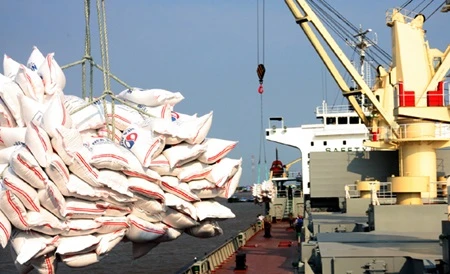
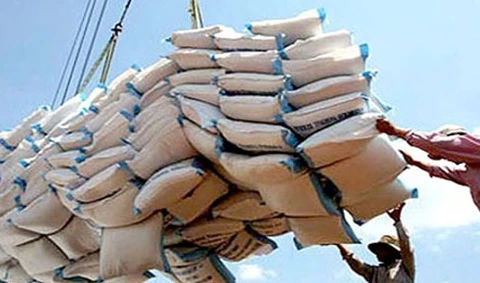
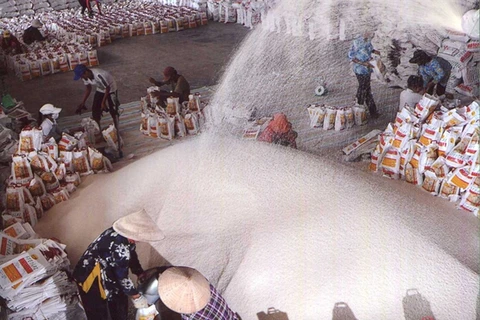
Rice is packaged at Co May Co in Dong Thap province’s Chau Thanh district. (Photo: VNA)
HCM City (VNA) - The rice output of the winter-spring rice crop fell significantly because of drought and salination, but with an additional 200,000ha to be planted in the Mekong Delta region, there will be enough rice for exports, according to the Mekong Delta Rice Research Institute.
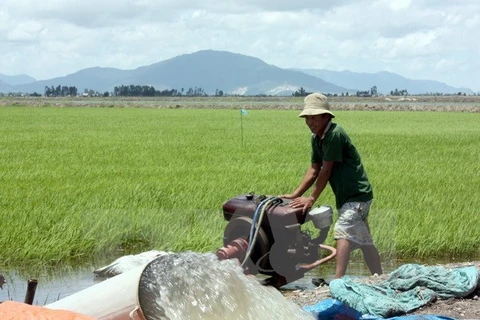
As many as 180,000 hectares of the winter-spring rice crop in the Mekong Delta region have been damaged by drought and saltwater.
The region is expected to yield 10.94 million tonnes of paddy from the crop, down by 186,144 tonnes over the same period last year.
Professor Nguyen Hong Son, director of the rice research institute, said that rice output from the winter-spring crop fell by 10-15 percent, but localities plan to increase the cultivation area for the autumn-winter crop by 200,000ha. Thus, there will be no shortage of rice exports.
With drought and saltwater intrusion expected to continue, Kien Giang province in collaboration with agencies has taken urgent measures, including building dams made of Larsen steel to prevent saltwater intrusion into fields and to save thousands of hectares of rice to be harvested soon. This will also help protect upcoming rice crops.
Nguyen Van Tam, director of Kien Giang province’s Department of Agriculture and Rural Development, said the provincial authority set a target of 4.7 million tonnes of rice this year. Due to drought and saltwater, its rice output had fallen by over 200,000 tonnes compared to its plan.
To compensate for the fallen output, the provincial agricultural sector would increase the cultivation area for the autumn-winter rice crop by 30,000ha to 120,000ha, he said.
At a recent meeting to review the winter-spring rice crop and set tasks for the next crop organised by the Ministry of Agriculture and Rural Development, delegates agreed that with localities increasing rice cultivation areas, the damage level of the winter-spring crop would not have a great impact on rice supply sources for export.
A fall in output has increased rice prices in the region. In Can Tho City, for example, farmers have harvested all cultivation areas of the winter-spring crop of 87,000ha.
Currently, a kilo of dried IR50404 paddy costs 5,800-5,900 VND (26.3-26.8 US cents), while jasmine rice is priced 6,700-6,800 VND, up 500-700 VND compared to the beginning of the crop.
Despite higher rice prices, most farmers do not have rice to sell since they harvested and sold their fresh paddy right at the field.
Many of them had even received deposits from traders to sell their rice at the beginning of the crop at much lower prices.
Nguyen Thanh Son, a farmer in Hậu Giang province’s Phung Hiep district, said rice prices were unstable in previous years, with farmers even unable to sell their rice.
At the beginning of this winter-spring crop, Son and other farmers received deposits from traders to sell rice. Because the price increased strongly at the end of the crop, now the farmers have regrets.
With current price of 5,400 VND per kilo of fresh paddy in the field, 1,000 VND higher than in the beginning of the crop, Son’s family lost 5 million VND (227 USD) of profit from one-ha rice field.
Le Cong Ly, a rice trader in Dong Thap province’s Cao Lanh district, said rice prices in Can Tho and Vinh Long had also increased.
Many traders came to newly cultivated paddy fields for the summer-autumn crop in Hau Giang, Dong Thap and An Giang provinces to place orders to buy rice, he said.
Professor Vo Tong Xuan said the agricultural sector should quickly apply measures to cut production costs to benefit farmers and improve the competitiveness of Vietnamese rice in the world market.
The Government had set the average production cost for a kilo of rice at 3,800 VND, but farmers had been spending 3,500-4,000 VND to produce each kilo of rice, he said.-VNA