Vietnam-UK trade deal to officially take effect from May

Vietnam will announce to the UK side its ratification of the UK-Vietnam Free Trade Agreement (UKVFTA) this month, so the deal can officially come into force from May 1.
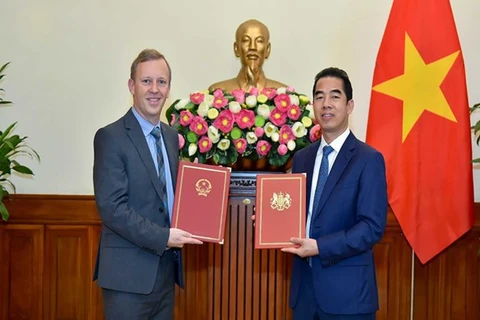
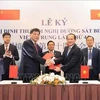
Vietnam-UK trade deal to officially take effect from May ảnh 1Representatives of Vietnam and the UK hand over notes confirming the date when the UKVFTA comes into force. (Photo: VNA)

Hanoi (VNA)
- Vietnam will announce to the UK side its ratification of the UK-VietnamFree Trade Agreement (UKVFTA) this month, so the deal can officially come intoforce from May 1.

According to theEuropean-American Market Department under the Ministry of Industry and Trade(MoIT), the ministry has promptly and closely coordinated with the UK in thesigning and completion of necessary procedures in order to put the pact in placeas soon as possible.

The VietnameseGovernment’s recent adoption of a resolution ratifying the UKVFTA will see thedeal, which temporarily took effect from January 1, become officially effective.

Figures releasedby the General Department of Vietnam Customs show that in the first two monthsof this year, trade between Vietnam and the UK reached over 1.02 billion USD,up 20.05 percent year-on-year.

The figurereflects the momentum created by the UKVFTA to recover bilateral trade.

Economic and tradecooperation will continue to be a bright spot in the relationship between thetwo sides, given the UK has rolled out mass COVID-19 vaccinations and has a positiveeconomic outlook according to international institutions.

After Vietnam andthe UK signed the UKVFTA in London on December 29, 2020, the two sides completeddomestic procedures to temporarily put the pact in place from January 1(Vietnamese time).

The MoIT willcontinue to coordinate with other relevant ministries and agencies to complete animplementation plan to bring into full play the opportunities generated by theagreement./.
VNA

See more

Tran Ngoc Quan, Trade Counsellor and head of the Vietnam Trade Office in Belgium and the EU (Photo: VNA)

Belgian firms suggested to expand presence in Vietnamese market

Entering 2026 – the first year of implementing the Vietnam – EU Comprehensive Strategic Partnership, the Vietnam Trade Office in Belgium and the EU views this as a pivotal time to inject new momentum into trade ties, said Trade Counsellor Tran Ngoc Quan.

Saigon Marina IFC, an emerging landmark, reflects Ho Chi Minh City’s pioneering spirit.

Saigon Marina IFC – The light of Ho Chi Minh City’s new icon

Saigon Marina IFC, an emerging landmark, reflects Ho Chi Minh City’s pioneering spirit. Designed to become an International Financial Centre, this new architectural icon along the Saigon River is envisioned not only as a premium commercial complex, but as a central platform supporting financial institutions, international investors and cross-border capital flows in the years ahead.

Shoppers at a supermarket in Hung Yen (Photo: VNA)

Retailers see tax compliance, AI as key to survival in 2026 survey

The annual survey, conducted at the end of 2025 among retail and food and beverage (F&B) sellers nationwide, found that businesses are shifting their focus from rapid growth to operational efficiency, cost control and legal compliance amid increasingly stringent regulatory standards.

Visitors shop at Glorious Spring Fair 2026 (Photo: VNA)

Spring Fair 2026 opens broader prospects for Vietnam–UAE trade cooperation

For Vietnam, the UAE serves not only as a consumer market but also as a gateway to the Middle East and North Africa. Vietnamese agricultural products such as cashew nuts, pepper, cinnamon and rice have steadily gained market share, while aquatic products, including tra fish and tuna, are increasingly present in the UAE’s hospitality sector.

Bao Viet Bank's employee counts Vietnamese banknotes at a transaction counter in Hanoi. (Photo: VNA)

Credit quota reform, tighter capital rules may widen gap among banks

Yuanta Vietnam Securities estimates that to achieve GDP growth above 10%, credit growth would need to exceed 16%. This suggests bank credit is no longer expected to be the main growth driver, with greater reliance on fiscal policy, public investment and capital markets.