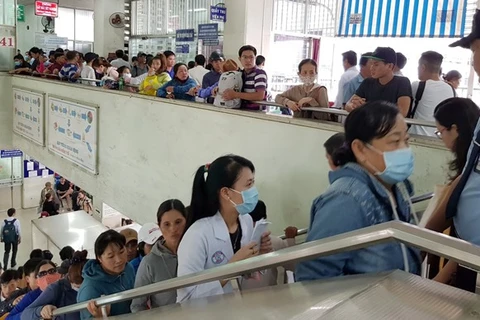
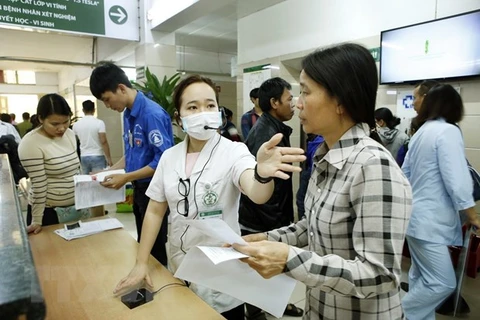
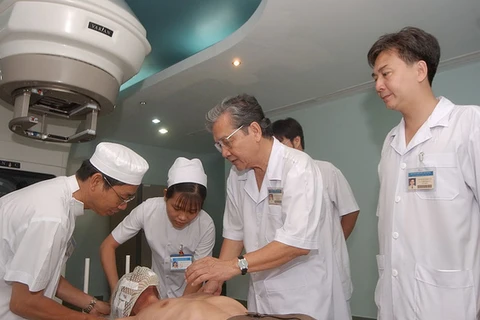
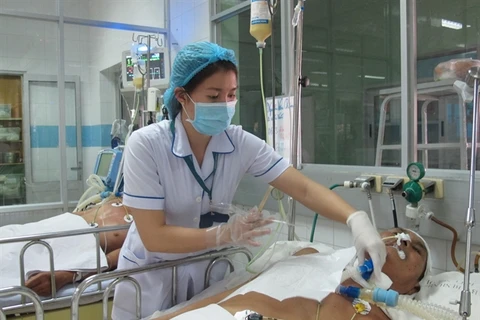
A Vietnamese trainee nurse during a training course in Japan (Photo: asia.nikkei.com)
 Hanoi (VNS/VNA) - As demand for nurses has been increasing in countries with ageing populations, Vietnam sees an opportunity to send workers abroad.
The job offers opportunities for candidates to gain skills, high salaries and opportunities to stay, work and receive social benefits like native workers.
Tran Van Anh, head of Communication Desk at the Department of Overseas Labour under the Ministry of Labour, Invalids and Social Affairs, said Vietnam has sent thousands of nurses to Taiwan, Japan and Germany.
According to the department, since 2012, about 1,200 candidates have joined Japanese language courses run by the department and Japanese partners. Until now, 673 Vietnamese nurses have worked in Japan. The Ministry of Labour, Invalids and Social Affairs granted permission for 13 companies to send nurses to Japan.
According to the German Development Cooperation Agency (GIZ), under a pilot project to attract workers from Vietnam to train as nurses in Germany, since 2016, more than 300 trainee nurses and geriatric nurses from Vietnam found employment in Germany. A total 195 participants have completed their training and are now working in Germany as fully fledged nurses and geriatric nurses, while a further 125 are in training.
While Japan and Germany require nurse candidates to be professionally trained in language and skills, Taiwanese employers usually consider nurses as domestic helpers who deal with household chores and take care of the elderly or children, Ha said.
Besides strict requirements, Japan and Germany usually offered assistance to candidates, for example, up to 30-35 million VND per month for accommodation and food during a training course in the host countries, Ha said.
After the training courses, candidates take an exam to earn certificates which helped them get jobs with monthly salary of 50-60 million VND, Ha said, adding that guest workers could then apply for residence status in the host countries.
“To get such benefits, Vietnamese workers must make efforts to meet the job requirements,” Ha said.
“Some Vietnamese nurses working in Japan and Germany said that what they did there was different from the job descriptions. They said they worked more,” Ha said, warning that workers should not expect easy jobs with high salaries.
“When Vietnamese workers finish training courses in the host countries but have not earned certificates to work as nurses, they have to do all the work assigned by official nurses. This means they might have to do more than the tasks was mentioned in their labour contracts,” Ha said.
Dang Sy Dung, deputy director of the Department of Overseas Labour, said candidates who wanted to become nurses should carefully learn about the job because of its complexity and difficulty.
“The job requires patience and hard work,” he said, adding that candidates should not merely look at the salary.
Dung said the department and the GIZ were implementing a programme to pick 230 candidates to attend nurse training courses in Germany.
The candidates would take a 13-month German language course in Vietnam and then, a 3-year course in Germany. During the training in Vietnam, they would be offered accommodation, food and about 900,000 VND in cash monthly. Each candidate must pay 1.8 million VND monthly in training fees.
When in Germany, they would receive monthly salary of 27-34 million VND.
Nguyen Luong Trao, Chairman of the Vietnam Labour Export Association, said demand for nurses in Japan, Germany and other European countries was high because of their aging populations.
“Without co-operation and assistance from the governments of Vietnam and host countries for training, both workers and labour exporting companies find it a struggle to afford these programmes,” Trao said.
The number of Vietnamese workers sent to work abroad last year hit 140,000, increasing nearly 7 percent over 2017, according to the department. This was the fifth consecutive year the number has increased and exceeded 100,000.-VNS/VNA
The job offers opportunities for candidates to gain skills, high salaries and opportunities to stay, work and receive social benefits like native workers.
Tran Van Anh, head of Communication Desk at the Department of Overseas Labour under the Ministry of Labour, Invalids and Social Affairs, said Vietnam has sent thousands of nurses to Taiwan, Japan and Germany.
According to the department, since 2012, about 1,200 candidates have joined Japanese language courses run by the department and Japanese partners. Until now, 673 Vietnamese nurses have worked in Japan. The Ministry of Labour, Invalids and Social Affairs granted permission for 13 companies to send nurses to Japan.
According to the German Development Cooperation Agency (GIZ), under a pilot project to attract workers from Vietnam to train as nurses in Germany, since 2016, more than 300 trainee nurses and geriatric nurses from Vietnam found employment in Germany. A total 195 participants have completed their training and are now working in Germany as fully fledged nurses and geriatric nurses, while a further 125 are in training.
While Japan and Germany require nurse candidates to be professionally trained in language and skills, Taiwanese employers usually consider nurses as domestic helpers who deal with household chores and take care of the elderly or children, Ha said.
Besides strict requirements, Japan and Germany usually offered assistance to candidates, for example, up to 30-35 million VND per month for accommodation and food during a training course in the host countries, Ha said.
After the training courses, candidates take an exam to earn certificates which helped them get jobs with monthly salary of 50-60 million VND, Ha said, adding that guest workers could then apply for residence status in the host countries.
“To get such benefits, Vietnamese workers must make efforts to meet the job requirements,” Ha said.
“Some Vietnamese nurses working in Japan and Germany said that what they did there was different from the job descriptions. They said they worked more,” Ha said, warning that workers should not expect easy jobs with high salaries.
“When Vietnamese workers finish training courses in the host countries but have not earned certificates to work as nurses, they have to do all the work assigned by official nurses. This means they might have to do more than the tasks was mentioned in their labour contracts,” Ha said.
Dang Sy Dung, deputy director of the Department of Overseas Labour, said candidates who wanted to become nurses should carefully learn about the job because of its complexity and difficulty.
“The job requires patience and hard work,” he said, adding that candidates should not merely look at the salary.
Dung said the department and the GIZ were implementing a programme to pick 230 candidates to attend nurse training courses in Germany.
The candidates would take a 13-month German language course in Vietnam and then, a 3-year course in Germany. During the training in Vietnam, they would be offered accommodation, food and about 900,000 VND in cash monthly. Each candidate must pay 1.8 million VND monthly in training fees.
When in Germany, they would receive monthly salary of 27-34 million VND.
Nguyen Luong Trao, Chairman of the Vietnam Labour Export Association, said demand for nurses in Japan, Germany and other European countries was high because of their aging populations.
“Without co-operation and assistance from the governments of Vietnam and host countries for training, both workers and labour exporting companies find it a struggle to afford these programmes,” Trao said.
The number of Vietnamese workers sent to work abroad last year hit 140,000, increasing nearly 7 percent over 2017, according to the department. This was the fifth consecutive year the number has increased and exceeded 100,000.-VNS/VNA
VNA