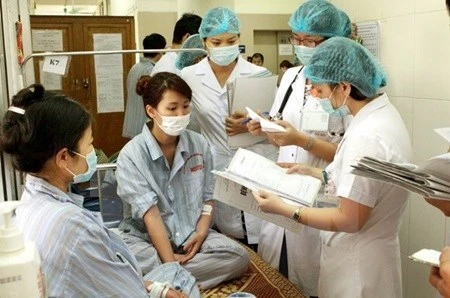
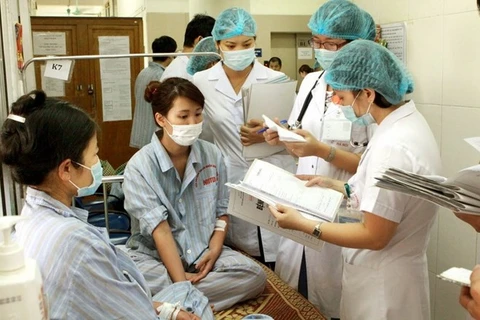
More talented and experienced doctors are leaving public hospitals to work in private facilities, raising concerns of a shortage of key doctors in the public sector (Photo thanhnien.vn)
 Dong Nai (VNS/VNA) – More talented and experienced doctors are leaving public hospitals to work in private facilities, raising concerns of a shortage of key doctors in the public sector.
Low salaries and poor working conditions were among reasons given by doctors leaving public hospitals.
Figures from the southern province of Dong Nai's Department of Health show that the number of doctors leaving public hospitals for private facilities has increased over the past few years.
In 2016, as many as 65 doctors quit their jobs in favour of the private sector. The number increased to 98 in 2017 and 102 in 2018.
Since early this year, 11 doctors from public hospitals resigned to move to private centres.
Dr Le Thi Phuong Tram, deputy head of the Dong Nai General Hospital told Thanh Nien (Young People) newspaper that 32 doctors decided to leave the hospital. Of that, three were deputy department heads and eight had post-graduate degrees.
Most were young doctors with 2 to 5 years of working experience, she said.
The health sector in HCM City is facing the same exodus. As many as 23 health workers, including six doctors and six nurses, have gone on to pursue employment at private hospitals.
Low salaries and poor working conditions were among reasons given by doctors leaving public hospitals.
Figures from the southern province of Dong Nai's Department of Health show that the number of doctors leaving public hospitals for private facilities has increased over the past few years.
In 2016, as many as 65 doctors quit their jobs in favour of the private sector. The number increased to 98 in 2017 and 102 in 2018.
Since early this year, 11 doctors from public hospitals resigned to move to private centres.
Dr Le Thi Phuong Tram, deputy head of the Dong Nai General Hospital told Thanh Nien (Young People) newspaper that 32 doctors decided to leave the hospital. Of that, three were deputy department heads and eight had post-graduate degrees.
Most were young doctors with 2 to 5 years of working experience, she said.
The health sector in HCM City is facing the same exodus. As many as 23 health workers, including six doctors and six nurses, have gone on to pursue employment at private hospitals.
PhD Tang Chi Thuong, Deputy Director of HCM City’s Department of Health said he was afraid the trend would continue.
The brain drain was alarming, affecting leading hospitals in the city, he said.
It was necessary to have an intervention otherwise the situation would lead to a domino effect, he said.
Dr Le Thi Phuong Tram said the Dong Nai General Hospital took a survey on the salary doctors wished to receive each month.
Most said they wanted between 20-25 million VND (864-1,080 USD) per month.
To meet the expectation, the hospital is planning to diversify medical examination and treatment to increase the income of the doctors, she said.
But many doctors said there’s more to it than money.
Director of the Thong Nhat General Hospital in Dong Nai Pham Van Dung said apart from low incomes, there were other reasons for doctors seeking private employment.
Nguyen Hoai Nam of HCM City’s Medical University said many left their jobs as they no longer felt happy and comfortable with the working environment.
The income was not the key factor for them leaving, he said.
Tang Chi Thuong said well-paid doctors still resigned as they had little chance of studying abroad or doing research to improve their professional skills.
Bui Thanh Chi, former deputy head of the Hanoi -based Bach Mai Hospital, said qualified doctors working at public hospitals like Vietnam-Germany or Bach Mai rarely wanted to switch jobs to get more money.
A professional working atmosphere with research and advancement opportunities would be the key factor helping doctors devote themselves to their work, he said.
Health experts have suggested that the health sector needed to change a number of policies and mechanisms to improve the income and professional skills of health staff. This would help retain talented and qualified doctors at public hospitals.-VNS/VNA
The brain drain was alarming, affecting leading hospitals in the city, he said.
It was necessary to have an intervention otherwise the situation would lead to a domino effect, he said.
Dr Le Thi Phuong Tram said the Dong Nai General Hospital took a survey on the salary doctors wished to receive each month.
Most said they wanted between 20-25 million VND (864-1,080 USD) per month.
To meet the expectation, the hospital is planning to diversify medical examination and treatment to increase the income of the doctors, she said.
But many doctors said there’s more to it than money.
Director of the Thong Nhat General Hospital in Dong Nai Pham Van Dung said apart from low incomes, there were other reasons for doctors seeking private employment.
Nguyen Hoai Nam of HCM City’s Medical University said many left their jobs as they no longer felt happy and comfortable with the working environment.
The income was not the key factor for them leaving, he said.
Tang Chi Thuong said well-paid doctors still resigned as they had little chance of studying abroad or doing research to improve their professional skills.
Bui Thanh Chi, former deputy head of the Hanoi -based Bach Mai Hospital, said qualified doctors working at public hospitals like Vietnam-Germany or Bach Mai rarely wanted to switch jobs to get more money.
A professional working atmosphere with research and advancement opportunities would be the key factor helping doctors devote themselves to their work, he said.
Health experts have suggested that the health sector needed to change a number of policies and mechanisms to improve the income and professional skills of health staff. This would help retain talented and qualified doctors at public hospitals.-VNS/VNA
VNA