Vietnam yet to sow seeds of low carbon rice

Investment in low carbon farming models can speed up rice industry reform, increase productivity, boost farmers’ incomes and ensure sustainable development, a senior official have said.
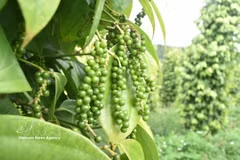
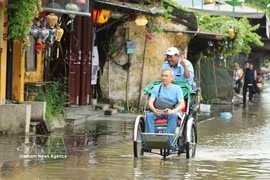
 Vietnam yet to sow seeds of low carbon rice ảnh 1In Vietnam, greenhouse gas (GHG) emissions from rice cultivation are estimated to account for more than half of emissions by agriculture production as a whole. (Photo: nongnghiep.vn)

Hanoi (VNA) - Investment in low carbon farming modelscan speed up rice industry reform, increase productivity, boost farmers’incomes and ensure sustainable development, a senior official have said.

It would also help the country access climate change funds forgreen growth, Deputy Minister of Agriculture and Rural Development Le QuocDoanh said at conference in Hanoi on December 1.

In Vietnam, greenhouse gas (GHG) emissions from rice cultivationare estimated to account for more than half of emissions by agricultureproduction as a whole.

Reducing GHG emissions in agriculture production in general andrice production in particular would be crucial to the nation’s climate changeresponse, Doanh said.

It would also contribute to fulfilling national commitments toreduce GHG emissions, he added.

According to the General Statistics Office, Vietnam grows rice on4.14 million hectares, using up 59.2 percent of agriculture production land forannual crops.

According to the Ministry of Natural Resources and Environment, in2014, rice cultivation generated 44.6 million tonnes of CO2 emissions or 50.5 percentof the agriculture production in total. Total GHG emissions that year reached225.6 million tonnes.


The deputy minister said that private firms were still notparticularly interested in low carbon rice projects because of common risksinvolved in agricultural investments as well as a lack of supporting policies.

The rice industry reform plan approved by the agriculture ministrylast year promotes public-private-partnership in agriculture projects, but manylocalities have failed to raise funds for their own part while calling on theprivate sector to invest, Doanh said.

Tran Xuan Dinh, deputy head of the Ministry of Agriculture andRural Development’s Cultivation Department, said that in rice production,greenhouse gas was mostly generated and emitted when the rice fields werecovered by water.

Underground chemical reactions in processing nutrients, the photosynthesisof rice, anaerobic micro-organisms’ activities produced greenhouse gases likedinitrogen monxide N2O or Methane NH4, he said.

In Mekong Delta provinces, farmers have been applying themid-season drainage method to reduce GHG emissions and save water.

Mid-season drainage involves the removal ofsurface flood water from the rice crop for about seven days towards the end oftilling. The duration of the dry period must be long enough for rice plant toexperience visible moisture stress.

According to climatetechwiki.org,mid-season drainage aerates the soil, interfering with anaerobic conditions andthereby interrupting CH4 production.

Mid-season drainage of a rice crop involveswithholding flood irrigation water for a period until the rice shows symptomsof stress. It involves ridge and furrow cultivation technology, where somemoisture still exists in the soil even after the toe furrow is drained.

It is essential to check when the crop has usedmost of the available water. The degree of soil cracking will depend on thesoil type and on the spatial distribution of the rice cultivars.

The cumulative evapo-transpiration of the cropvaries from 77-100mm during the time water is removed, depending on crop vigourand soil types. The field is then re-flooded as quickly as possible. It isnecessary to cover the soil surface with water so that the plants startrecovery. Water depth then can be gradually increased to that required forprotection of the developing plant canopy from damaging high temperaturesduring anthesis.

Mid-season drainage reduces methane emissionsfrom paddy fields.

Tran Van The, deputy head of the Institute for AgricultureEnvironment, said this method is feasible and can deliver great benefits.

In Mekong Delta provinces, if the right scheme is followed,farmers can save half the water used in a rice season. More sparse sowing helpsrice have better photosynthesis, fewer diseases, and therefore, require lessfertliser.

Mid-season drainage could help save one third of product costscompared with conventional rice production while productivity was the same orhigher, The said.

“Farming techniques and drainage systems are key to the success ofthe mid-season drainage method,” he said, calling on the Government and investorsto prepare a proper infrastructure for drainage works.

Other experts at the conference agreed that the Government andprivate investors should pay more attention to integrating low carbon farminginto the development of agriculture infrastructure.-VNA
VNA
See more

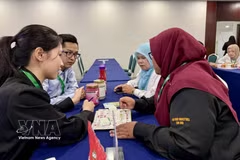
Vietnamese and Malaysian businesses connect at the event (Photo: VNA)

Vietnam, Malaysia connect businesses to boost bilateral trade cooperation

It centred on a business-to-business (B2B) matchmaking session, bringing Vietnamese and Malaysian companies together to discuss import-export needs, seek partners and explore cooperation. Vietnamese businesses aimed to connect with Malaysian importers, distributors and retailers, while expanding access for their products to Malaysia and other markets.

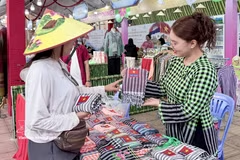
Visitors browse traditional Southern Vietnamese checked scarves on display at the Vietnam-Cambodia Trade Fair. (Photo: VNA)

Vietnam-Cambodia trade fair opens in An Giang

The fair features 150 booths representing 200 businesses, cooperatives, household businesses and production and trading establishments from both countries. The exhibition space is arranged into 10 zones showcasing products from Vietnamese localities and three zones featuring Cambodian products, creating opportunities for businesses from the two countries to promote their products, seek partners and expand markets.

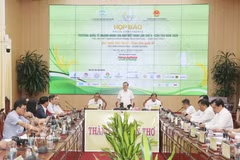
An overview of the press conference to announce the organisation of the second Vietnam International Rice Festival - Can Tho 2026. (Photo: VNA)

Festival to chart new course for rice industry

The second Vietnam International Rice Festival - Can Tho 2026 will take place from November 22 to 25, showcasing the achievements and potential of Vietnam’s rice industry while promoting Can Tho’s image, cultural identity and people, as well as the distinctive river culture of the Mekong Delta.

Japanese business representatives review Ho Chi Minh City’s investment project portfolio at the conference. (Photo: VNA)

Vietnam remains attractive destination for Japanese businesses

Fukai Akihiko, President and Representative Director at Gunma Bank and head of a business delegation from Japan’s Gunma prefecture, said cooperation between Gunma and Vietnam has continued to expand in recent years. Around 15,000 Vietnamese people currently live in Gunma, forming the largest foreign community in the prefecture.

A panoramic view of the site designated for the Ninh Thuan 1 nuclear power plant in Phuoc Dinh commune, Khanh Hoa province. (Photo published by VNA)

Vietnam to access MBIR reactor research capabilities, gradually master nuclear technology

As Vietnam develops its nuclear science and technology and prepares the necessary conditions in terms of human resources, research capacity, safety systems and technical infrastructure, participation in international research programmes and access to MBIR will enable the country to conduct experiments supporting its programme for the peaceful use of atomic energy.

Illustrative image (Photo: chinhphu.vn)

State secret list for financial sector issued

Top secret items include detailed submissions, reports, proposals, explanatory documents, and data concerning state financial and budgetary policies presented to the Party Central Committee, the Politburo, the National Assembly, the National Assembly Standing Committee, or the Government in the event of an emergency related to national defence, national security, social order and safety, or a war for the defence of the Fatherland.

At the 2026 Vietnam Food Forum (Photo: VNA)

Vietnamese food exporters see EU as major market amid stricter standards

The EU–Vietnam Free Trade Agreement (EVFTA) tariff cuts are opening doors. But the EU is also a market with a strict and frequently updated system of standards and regulations, especially in food safety, quarantine, traceability, environmental protection and sustainable development.

Laos accelerates 47 power projects for export to Vietnam

Laos accelerates 47 power projects for export to Vietnam

A notable project is the 600 MW Monsoon Wind Power Plant, located in Dakcheung district of Xekong province and Xanxay district of Attapeu province. Featuring 133 turbines, the project began commercial operations on August 22, 2025, and supplies electricity to Vietnam Electricity (EVN) under a 25-year power purchase agreement.

Minister of Industry and Trade Le Manh Hung holds working sessions with leaders of major Japanese corporations on November 10 to discuss investment cooperation opportunities in Vietnam’s mineral industry (Photo: Ministry of Industry and Trade)

Vietnam steps up cooperation with leading Japanese corporations

Minister of Industry and Trade Le Manh Hung spoke highly of economic, trade and investment ties between the two countries, highlighting the important role of Japanese businesses in developing production, transferring technology and strengthening supply chain linkages in Vietnam.