Vietnamese cashew sector seeks to increase export value

Although Vietnam is a leading exporter of cashew nut, the country’s export value remains modest as many enterprises are still dependent on imported materials.
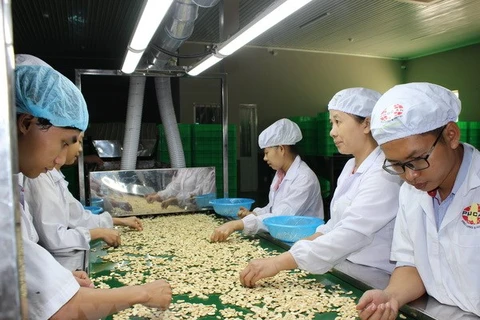
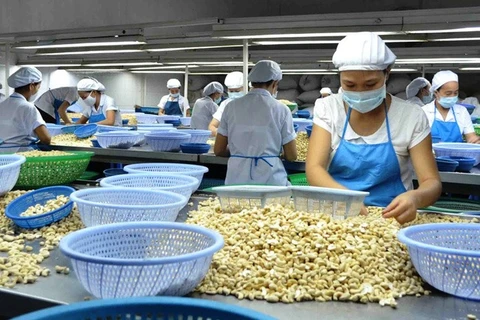
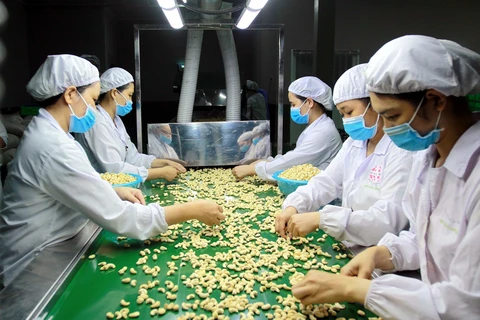
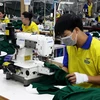
Vietnamese cashew sector seeks to increase export value ảnh 1Processing cashew for export (Source: VNA)

HCM City (VNA) – Although Vietnam is a leadingexporter of cashew nut, the country’s export value remains modest as manyenterprises are still dependent on imported materials.

In 2018, Vietnam’s cashew export revenue hit 3.52 billionUSD, but up to 70 percent of cashew materials for processing were imported,leading to high costs.

According to the Vietnam Cashew Association (Vinacas), in2019, Vietnam plans to ship abroad 350,000 tonnes of cashew nuts for about 4billion USD, a lower volume but higher value than the year previous.

By increasing sales of processed products instead of rawcashew, the ratio of processed cashew nuts of Vietnam is expected to rise 30percent, double that of two years ago.

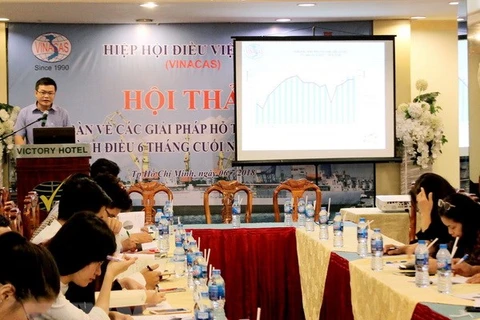
Vinacas General Secretary Dang Hoang Giang said that alongwith improving the quality of processed cashew nut, in June 2019, theassociation will survey the West Asian market, bringing about more choices for exportersin terms of market and product.

Vietnamese cashew is popular in choosy markets such as theUS and the EU, paving the way for domestic exporters to expand markets.

Along with seeking new markets, Vietnam aims to maintainmajor ones such as the Netherlands, China, and especially the US, whichconsumes up to 40 percent of the country’s cashew nuts, said Giang.

He added that the current market trend is products withclear origin, as customers prefer products with strictly controlled quality.

Vinacas Vice President Nguyen Minh Hoa said that to conquer newmarkets, Vietnamese firms should pay greater attention to studying requirementsof the markets to supply suitable products.

Hoa noted that with the acceptation of Vietnamese technologyover the years, African countries have started processing cashew and reducingtheir exports of material cashew. They will be Vietnam’s competitor in the nextfive years.

Amidst the dependence on materials from other countries, it iscrucial for the Vietnamese cashew sector to improve quality to enhancecompetitiveness, he said.

Pham Van Cong, Vinacas President said the association willask for support from the Ministry of Industry and Trade in implementing the“Cashew of Vietnam” promotion programme as well as other programmes to assistthe building of Vietnamese cashew trademark and providing information andtechnical support for exporters.

Vinacas will ask the Ministry of Finance to deploy measuresto encourage foreign-invested forms to focus on processing, contributing toincreasing the ratio of processed products.

Although Vietnamese cashew is defined by the InternationalNut and Dried Fruit Council as having higher quality than that of Africancountries and Cambodia, the price of material cashew is not much different thanin other countries.

Therefore, the building of a Vietnamese cashew trademarkshould start by building a trademark for materials.

Cong said Vinacas and the Ministry of Agriculture and RuralDevelopment have built a set of national criteria for material cashew nuts,which will be issued in 2019 and is expected to reduce problems in the qualityof materials.-VNA
VNA

See more

Farmers harvest the 2025 Winter–Spring rice crop in An Giang province. (Photo: VNA)

An Giang accelerates export shift to meet green consumption trends

To enhance competitiveness, authorities are assisting businesses in obtaining globally recognised certifications such as GlobalG.A.P., Organic and HACCP, enabling key exports including rice, seafood and clean agricultural products to strengthen their position in global markets, according to Quang Xuan Lua, Director of the An Giang Centre for Trade and Investment Promotion.

Motorcycle riders refill their vehicles at a petrol station in Hanoi (Photo: VNA)

E5 RON92 biofuel price falls in latest adjustment

Since the beginning of this year, domestic fuel prices have undergone 14 adjustments, including five decreases and nine increases for RON95 and six declines and eight hikes for E5 RON92. Meanwhile, diesel price has fallen three times and risen 11 times.

A French customer is tasting Vietnamese lychee. (Photo: VNA)

Vietnamese agricultural products boost global brand recognition

Vietnam aims to achieve about 74 billion USD in agro-forestry-fishery export turnover this year. Expanding value-added products, improving quality standards and strengthening brand building, especially through international supermarket systems, will be key to enhancing the competitiveness and global recognition of Vietnamese agricultural products.

An apartment building developed by BCONS in Binh Duong (Photo: VNA)

Resolution 68 boosts businesses entering market

By the end of 2025, Vietnam had more than one million active enterprises. In the first two months of 2026, about 64,500 enterprises entered or re-entered the market, up 29.4% year-on-year, averaging 32,200 newly established or returning businesses per month.

A Vinh Long official introduces signature local products to Korean guests. (Photo: VNA)

Vinh Long courts Korean investment in key sectors

Vice Chairman of the provincial People’s Committee Nguyen Truc Son vowed to accompany investors and provide them with optimal conditions, while building a transparent and stable business environment to secure long-term engagement from foreign enterprises, particularly those from Daejeon.

Delegates at the launching ceremony (Photo: VNA)

Digital platform on overseas market development launched

With Vietnam’s network of 64 trade offices overseas, Deputy PM Son noted that connecting them through a modern digital platform could help establish a unified national trade information system that operates efficiently, transparently and with strong forecasting capacity.

The Government’s issuance of Decree No. 72/2026/ND-CP revising preferential import tariffs on several petrol products and raw materials is a timely move to diversify supply sources. (Photo: VNA)

Fuel import tariff cuts strengthen Vietnam’s energy resilience: experts

Economic expert Dinh Trong Thinh said revising fuel import tariffs helps diversify supply sources and reduce reliance on traditional markets, thereby strengthening Vietnam’s ability to cope with potential global supply shocks. Ensuring access to multiple energy sources is also vital for safeguarding national energy security, he added.

Leaders of Dak Lak province inspect IUU fishing prevention and control efforts at Phu Lac fishing port, Hoa Hiep ward. (Photo: daklak.gov.vn)

Dak Lak readies for EC mission on anti-IUU fishing efforts

Dak Lak province is completing preparations for an upcoming European Commission (EC) inspection on efforts to combat illegal, unreported and unregulated (IUU) fishing, with a view to having the fisheries “yellow card” removed.

Vietnamese Ambassador to Argentina Ngo Minh Nguyet speaks at the event. (Photo: VNA)

Vietnam, Argentina promote trade, investment cooperation

On relations with South America, Nguyet noted that in December 2025, Vietnam and the Southern Common Market (MERCOSUR) announced the launch of negotiations for a Preferential Trade Agreement (PTA). She expressed her hope that the agreement will be signed soon, thereby further boosting trade and investment between Vietnam and MERCOSUR member states, including Argentina.

Customers buy petrol at a Petrolimex petrol station in Tran Hung Dao ward, Hung Yen province. (Photo: VNA)

PM orders stronger measures to ensure stable petrol supply

The MoIT was instructed to direct key petrol producers and traders to proactively develop supply plans to guarantee adequate fuel provision for distribution systems, maintain regular sale operations, and sell products at listed prices. It must also closely monitor developments in global and domestic petrol markets and adopt appropriate management measures when necessary.

Farmers in Ca Mau province use combine harvesters to harvest rice. (Photo: VNA)

PM orders coordinated measures to stabilise rice production and markets

The Minister of Agriculture and Environment is tasked with instructing local authorities to closely monitor production developments, improve forecasting capacity, strengthen pest control measures, and proactively respond to adverse weather conditions to protect crops, maintain planned yields and output, and reduce production costs.