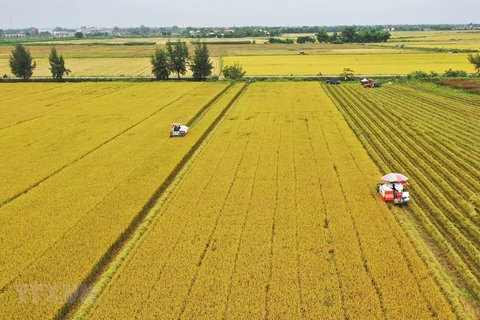
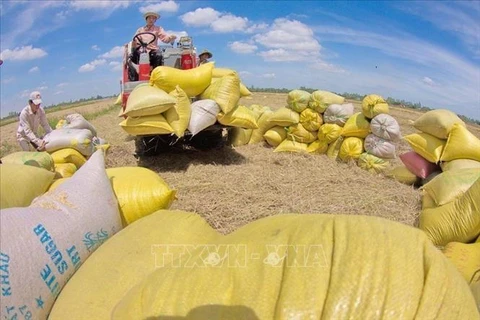
Packaging rice for export (Photo: VietnamPlus)
 Hanoi (VNA) - A delegation of the Ministry of Industry and Trade (MoIT) led by Deputy Director of the ministry’s Agency of Foreign Trade Tran Quoc Toan and representatives from 19 Vietnamese rice exporters paid a working visit to Beijing, China, to promote Vietnamese rice exports to this market.
During the visit, the Vietnamese delegation worked with representatives of the Ministry of Commerce of China, the China Animal Agriculture Association, and Xinfadi Group and visited the Vietnam Trade Office in China.
According to the MoIT, among the exports from Vietnam to China, rice shipments have seen good growth in recent years, accounting for nearly one-fifth of China's total rice imports. In 2022, Vietnam's rice exports to China reached 834,200 tonnes, worth 423.2 million USD.
In the first nine months of 2023, China imported nearly 869,000 tonnes of rice from Vietnam, an increase of 41.1% over the same period in 2022.
Notably, Vietnam can supply popular rice varieties in China such as sticky rice, jasmine rice, and ST rice. Vietnam has established long-term traditional partnerships with China.
Rice exporters see China as an important market as it has been Vietnam’s second largest rice buyer. They have made unceasing efforts to improve product quality and packaging to better meet the regulations, demands, and tastes of Chinese consumers.
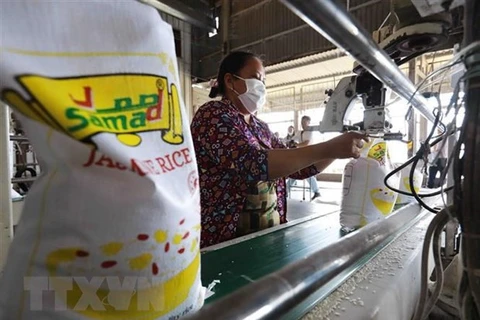
 Enterprises have invested big in advanced technology to increase the value of exported rice. (Photo: VietnamPlus)
 To consolidate trade relations between the two countries, especially with China’s northern region, the delegation reached agreements with Chinese agencies, associations, and agricultural and food businesses, especially Chinese rice businesses.
Specifically, the two sides will strengthen trade support and establish information exchange channels to jointly solve arising issues and promote Vietnam's rice exports to China.
They will consider signing memoranda of understanding to promote exports and trade between the two countries while supporting Vietnamese rice products to enter deeply into China's traditional retail and e-commerce channels.
According to statistics from the General Department of Vietnam Customs, Vietnam gained 4 billion USD from shipping more than 7.1 million tonnes of rice abroad during the January – October period, up 35% in value and 17% in volume as compared to the same time last year.
The Ministry of Agriculture and Rural Development said Vietnam is able to export 7.8 million tonnes of rice, and earn 4.2-4.5 billion USD in export revenue in 2023.
Meanwhile, the Vietnam Food Association (VFA) said the prices of Vietnamese export rice have soared to the highest level ever.
Vietnam’s 5% broken rice has been traded at 653 USD per tonne, up 10 USD per tonne, while the 25% broken rice has been sold at a record high of 638 USD per tonne.
They are much higher than those of Thailand and Pakistan. Specifically, 5% broken rice is valued at 560 USD per tonne in Thailand and 563 USD in Pakistan, and 25% broken rice at 520 USD in Thailand and 488 USD in Pakistan.
The VFA said there is ample room for Vietnamese rice exports as demand continues to climb across the globe. The Philippines wants to import an additional 1.1 million tonnes of rice, while the demand from Indonesia is 2.3 million tonnes. China’s rice import is expected to surge at the end of the year.
Vietnamese exporters said prices will continue to climb even in the fall-winter and winter-spring harvest seasons as global demand has increased over years while supply has tapered off due to climate change.
Boasting high-quality rice which has won the taste of foreign consumers, Vietnam could sell its rice at 640-650 USD per tonne at the end of 2023, they added.
Domestic rice prices have been on the rise as a result of increasing export demand, with the 5% broken grain sold at 15,343 VND (0.62 USD) per kilogramme, up 3,000 VND, while 25% broken one traded at 14,725 VND per kilogramme, up nearly 3,000 VND from July./.