Vietnamese language teaching promoted in Taiwan

The Vietnam Economic and Cultural Office in Taipei, in collaboration with relevant units, launched a week-long Vietnamese language training course for Vietnamese teachers and a Vietnamese bookshelf in Taoyuan, Taiwan (China) on July 4.

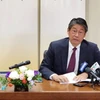
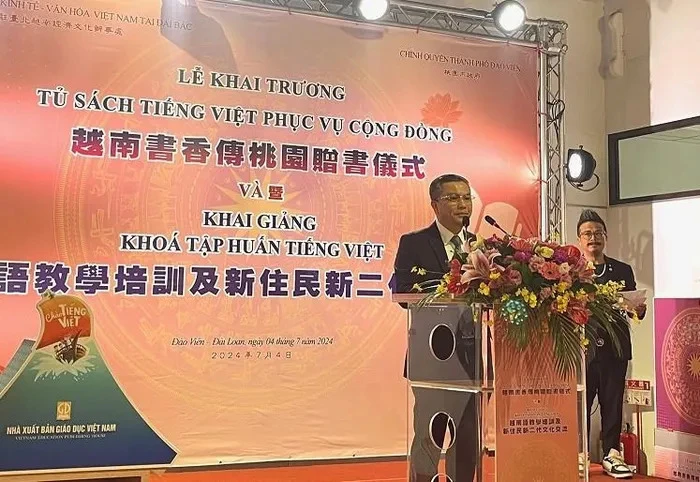
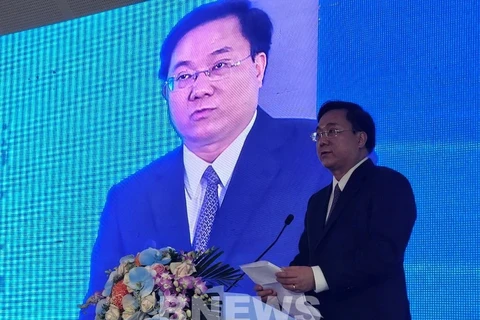
Head of the Vietnam Economic and Cultural Office in Taipei Vu Tien Dung speaks at the event. (Photo: VNA)

Hanoi (VNA) – The Vietnam Economic and Cultural Office in Taipei, in collaboration with relevant units, launched a week-long Vietnamese language training course for Vietnamese teachers and a Vietnamese bookshelf in Taoyuan, Taiwan (China) on July 4.

The training course, held from July 1-7, provided nearly 40 Vietnamese language teachers across various levels of the Taiwanese education system with valuable instructions by two lecturers from the Hanoi National University of Education.

Speaking at the ceremony, head of the office Vu Tien Dung said in recent years, the Vietnamese Government and relevant agencies have intensified efforts to promote Vietnamese language appreciation among overseas Vietnamese communities worldwide. This aims to deepen the understanding of the language and national culture among Vietnamese people abroad and international friends as well.

Dung expressed his hope that the training course and a donation of nearly 500 Vietnamese books from Vietnam will contribute to further motivating the Vietnamese teaching and learning movement within the Vietnamese community in Taiwan. This, in turn, will promote cultural exchanges between the people of Vietnam and Taiwan.

The launching of the Vietnamese bookshelf was preceded by a seminar held on July 3, which explored the current state of Vietnamese language education for Vietnamese children in Taiwan./.
VNA

See more

President Luong Cuong, his spouse, delegates and artists at the special Spring Homeland Art Programme 2026. (Photo: VNA)

Five major shifts chart overseas Vietnamese affairs in 2026 and beyond

In a world marked by intensifying strategic competition, emerging conflicts and intertwined economic, security and social challenges, nearly 6.5 million Vietnamese living in over 130 countries and territories have continued to look to the homeland as a firm spiritual anchor. The homeland remains a source of confidence, connection and aspiration for Vietnamese abroad.

Vietnamese Ambassador to Cuba Le Quang Long (right) symbolically hands over 250 tonnes of rice to Cuban Deputy Minister of Agriculture Telce Abdel González (Photo: VNA)

Vietnam supports Cuba in ensuring food security

Cuban Deputy Minister of Agriculture Telce Abdel González affirmed that Cuba will create all favourable conditions for AgriVMA’s rice production project in Los Palacios district, Pinar del Río province, with a view to expanding the model to other localities across the country.

The Binh Phuoc provincial Intelligent Operations Center (IOC), operational since September 2020, has played an important role in supporting the development of digital government. (Photo: VNA)

Breakthroughs under Resolution 57 drive local development

Following the Politburo’s Resolution No. 57-NQ/TW on advancing science, technology, innovation and national digital transformation, many localities across Vietnam are translating strategic guidelines into concrete action, laying the foundation for a new development model based on knowledge, technology and modern governance.

The spring flower market for the 2026 is brightly illuminated at night. (Photo: VNA)

Spring flower market opens in Ho Chi Minh City

The market features more than 500 booths selling a wide variety of flowers and ornamental plants. The space combines traditional and modern elements, recreating the distinctive river culture of southern Vietnam.

The Security Investigation Agency of Hung Yen province executes a search warrant. (Photo: congan.hungyen.gov.vn)

Man prosecuted for abusing democratic freedoms to infringe upon State interests

Anh, born in 1958, frequently filed complaints and denunciations with authorities at various levels. The contents mainly concerned the land management and use by officials of People’s Committee of Nghia Hiep commune over a long period. Many of the complaints and denunciations were found to be unfounded, lacking evidence, speculative, accusatory, defamatory, and prolonged.