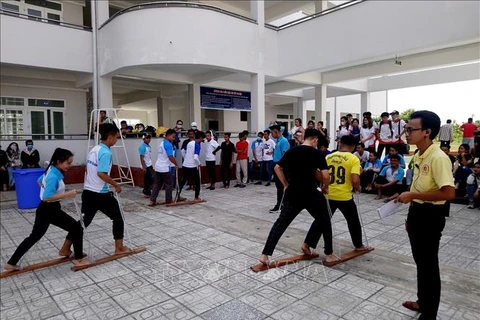
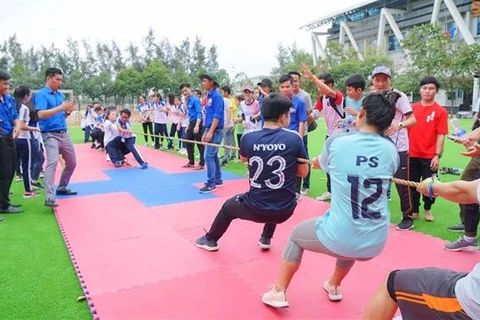
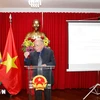
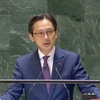
The overview of the Vietnam - Laos - Cambodia youth exchange programme. (Photo: VNA)
 Hanoi (VNA) – A Vietnam – Laos – Cambodia youth exchange programme took place virtually on October 22, sharing knowledge on the nations’ friendship and their young people’s experience in COVID-19 prevention and control and adaptation to digital transformation.
Delivering an opening speech, Nguyen Ngoc Luong, Secretary of the Ho Chi Minh Communist Youth Union Central Committee and President of the Vietnam Youth Federation (VYF), said given complicated developments of the pandemic, youth units of the three nations have came up with new initiatives to communicate, exchange information with and support one another.
Their high-level phone talks, support activities to ensure social welfare and fight the epidemic, and the youth exchange demonstrate their strong and close-knit friendship, he stressed.
He hoped the exchange will help improve young the Vietnamese, Lao, and Cambodian people’s adaptation capacity and comprehensive development and believed it would connect them and foster their countries’ traditional friendship and cooperation.
 Delegates post for a photo (Photo: VNA) Considering the event an opportunity for better solidarity and mutual understanding, President of the Union of Youth Federations of Cambodia (UYFC) Hun Many expressed his wish for more similar activities to take place in contribution to the development of the nations’ political, economic and diplomatic ties.
Vice Secretary of the Lao People’s Revolutionary Youth Union (LPRYU) Thoong Chan Phu Mu Phan hoped young people of the three nations will cultivate their solidarity, and boost exchanges, experience sharing, cooperation, and mutual support in socio-economic, investment, and tourism development./.
Delivering an opening speech, Nguyen Ngoc Luong, Secretary of the Ho Chi Minh Communist Youth Union Central Committee and President of the Vietnam Youth Federation (VYF), said given complicated developments of the pandemic, youth units of the three nations have came up with new initiatives to communicate, exchange information with and support one another.
Their high-level phone talks, support activities to ensure social welfare and fight the epidemic, and the youth exchange demonstrate their strong and close-knit friendship, he stressed.
He hoped the exchange will help improve young the Vietnamese, Lao, and Cambodian people’s adaptation capacity and comprehensive development and believed it would connect them and foster their countries’ traditional friendship and cooperation.
 Delegates post for a photo (Photo: VNA)
 Vice Secretary of the Lao People’s Revolutionary Youth Union (LPRYU) Thoong Chan Phu Mu Phan hoped young people of the three nations will cultivate their solidarity, and boost exchanges, experience sharing, cooperation, and mutual support in socio-economic, investment, and tourism development./.
VNA