Vietnamese sugar mills struggle to compete

Low consumption, high inventory and continuously plunging prices mean tough times for domestic sugar mills, said chairman of the Vietnam Sugarcane and Sugar Association (VSSA) Pham Quoc Doanh.
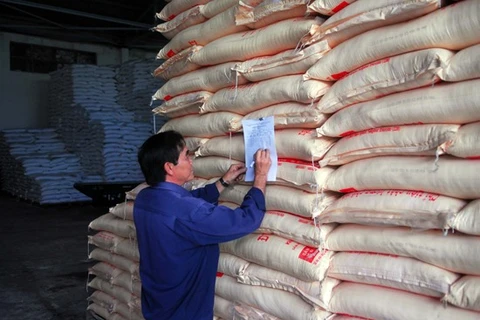
Vietnamese sugar mills struggle to compete ảnh 1Domestic producers are under pressure from smuggled sugar. (Photo: danviet.vv)

Hanoi (VNS/VNA) - Lowconsumption, high inventory and continuously plunging prices mean tough timesfor domestic sugar mills, said chairman of the Vietnam Sugarcane and SugarAssociation (VSSA) Pham Quoc Doanh.

The sugar industry is set to harvestits new crop next month, but it has suffered due to smuggled sugar from foreigncountries.

Doanh said during 23 years of theGovernment’s one-million-tonne sugar programme, this year’s crop has seen themost difficulties.

Low consumption means some sugarfactories are in debt after buying sugar cane from farmers but being unable tosell the refined product for the usual rate.

“One cause of the situation issmuggling, which has been an issue facing the sector for years,” Doanh said.

Although smuggling is not a newproblem, he said it is much worse this year. Smugglers have dominated thedomestic market and smuggled sugar is being sold openly, presenting a challengeto authorities.

At some local shops in the westernprovinces and the central coast, inspectors found smuggled sugar beingdisplayed with Thai labels. The flood of smuggled sugar into the domesticmarket has had a serious impact on the sugar industry, Doanh said.

Although Doanh’s association hasreported the situation repeatedly, the problem has not been solved.

The 2016-2017 crop saw a bumperharvest of over 700,000 tonnes, meaning there was less space in the market forthe following year’s sugar.

Department of Agro-productProcessing and Market Development statistics show that as of August 15, thecountry’s sugar inventory was still 622,000 tonnes – 67,500 tonnes higher thanthe figure at the same point last year.

Industry representatives saidsmuggled sugar from Thailand is usually priced 1,000-2,000 VND lower thandomestic sugar, and production costs in Vietnamese mills are 2,000-3,000 VND higherthan those of factories abroad. This means the domestic sugar industry finds ithard to compete with illegal imports.

VSSA said local sugar factories mustaccept that, in order to compete with smuggled sugar, they will have to selltheir products at lower prices – even if it means lower profits.

Local sugar mills are alreadyselling their products at less than 11,000 VND per kilo, the lowest price inyears.

Pham Quang Vinh, chairman of the CanTho Sugar Company (Casuco), said the lack of control on imports has been aproblem for the industry.

Smuggled sugar is not subject to theimport and value-added taxes, meaning Vietnamese producers have to sell theirproducts under production cost to compete.

Vinh said farmers would be forced tolower price of raw sugarcane. He calculated that with the country’s averageoutput of 15 million tonnes, reducing each kilo of sugarcane by just 100 VND wouldcost farmers 1.5 trillion VND (64.4 million USD) in total.

Dang Viet Anh, chairman of the Son LaSugarcane Company, agreed that smuggled sugar could be sold at so low pricebecause its suppliers evade taxes.

Local sugar could compete if not forthe VAT, so Vinh suggested eliminating the tax for domestic businesses. Itcurrently sits at 5 percent.

An estimated 500,000 to one milliontonnes of smuggled sugar makes its way from Thailand to Vietnam each year.

Sugar firms asked localities andnational authorities to redouble efforts against smugglers.

In addition, they suggested atemporary ban on sugar imports to reduce pressure on local mills.

VSSA anticipates more difficultieswith the 2018-19 crop. They said sugar mills should invest in technologies todiversify their products and lower production costs.

In addition, VSSA suggestedreviewing distribution and sale systems to reduce costs, create loyal customersand simplify trade logistics.-VNS/VNA
VNA
See more

Participants at a conference on digital assets in Hanoi on December 10. (Photo: VNA)

Finance ministry seeks public feedback on minimal tax on digital assets

Under the draft, the transfer and trading of crypto assets would not be subject to value-added tax. Individual investors, regardless of residency status, would be required to pay personal income tax at a rate of 0.1% on the gross value of each transfer. This approach mirrors the current tax method applied to securities transactions.

Steel products of Hoa Phat Group. (Photo: VNA)

Vietnam aims to meet 80–85% of domestic steel demand by 2030

Vietnam aims to meet 80–85% of domestic steel demand by 2030. Crude steel production is targeted at 25–26 million tonnes per year, with annual growth of 7–8%, while finished steel output is expected to reach 32–33 million tonnes per year, growing by 5.5–6.5% annually. Per capita steel consumption is projected at 270–280 kg per year.

One of the products granted Halal certification in 2026. (Photo: moit.gov.vn)

Spring Fair 2026 boosts momentum for Vietnam’s Halal sector

The fair’s greatest value for Halal products lies less in immediate revenue than in building trust and standardising business practices. In a market where certification determines entry, it highlights that expansion must begin with fundamentals, standards, raw materials, production processes and readiness.

Prime Minister Pham Minh Chinh speaks at the fifth meeting of the Steering Committee for Nuclear Power Plant Construction. (Photo: VNA)

PM calls for more vigorous implementation of nuclear power projects

Describing nuclear power plants as nationally significant, strategic projects with a century-long vision, PM Chinh called for urgent and responsible implementation of tasks within assigned authority, with any outstanding issues promptly reported to higher authorities.

Vehicles transporting import and export goods at Bac Luan II Bridge border gate. (Photo: VNA)

Building smart border gates to enhance competitiveness, drive growth

With plans to build the Mong Cai–Ha Long–Hai Phong railway alongside the smart border gate and economic cooperation zone, Quang Ninh is positioning itself as a new growth pole in northern Vietnam and a key gateway for economic cooperation between Vietnam, ASEAN and China.

Noi Bai International Airport is expected to receive a record number of passengers (Photo: VNA)

Noi Bai, Tan Son Nhat airports expect record passenger volumes during Tet

Information from Noi Bai International Airport showed that during the peak Tet period, passenger traffic is forecast to reach a record high, posting double-digit growth year on year. Specifically, in the seven days before Tet (February 10–16), Noi Bai is expected to serve more than 725,000 passengers, up 16% from the same period in 2025, with 4,467 flights, an increase of 12.5%.

The booth of Lang Son province brings about distinctive local products to the fair, and also implemented various promotional programmes to stimulate consumer demand (Photo: VNA)

Spring Fair 2026 spreads cultural values, boost trade

From handwoven brocade textiles to traditional ethnic costumes, the fair presents vivid cultural colours and highlights how local producers are introducing heritage products to the modern market, expanding consumer reach, building brands, and strengthening trade links.

Hanoi markets come alive as Tet 2026 approaching (Photo: nhandan.vn)

Hanoi markets come alive as Tet 2026 approaching

A recent survey shows flower prices have seen only slight fluctuations this year thanks to favourable weather conditions. Peach blossoms are priced from 200,000 VND to several million VND, depending on size and shape.

Ho Chi Minh City’s public spending rose in 2025 but fell short of the amount it had targeted (Photo: dangcongsan.vn)

Ho Chi Minh City to tackle public spending bottlenecks

By the end of 2025, the city had disbursed 74% of the amount targeted by the Government – 89.07 trillion VND (3.7 billion USD) out of 120.32 trillion VND – well below the near-100 % rate typically required to maximise economic impact.

A view of Hanoi. The capital city will boost trade promotion and advertise the ‘Hanoi - A Green Destination’ programme to attract investment and international markets (Photo chinhphu.vn)

Hanoi aims to attract 4.5 billion USD in FDI in 2026

The plan was under Decision No. 53/KH-UBND on international economic integration in 2026, aiming to create momentum for rapid and sustainable growth, while simultaneously enhancing the competitiveness and position of the capital city in the context of deep integration.

People buy gold at a shop in Hanoi (Photo: VNA)

Ministry of Finance clarifies new gold bar tax amid market concerns

Under the new Personal Income Tax Law No. 109/2025, adopted by the National Assembly, a 0.1% tax will be levied on each transfer of gold bars. The Government will set value thresholds to exempt individuals purchasing gold for savings rather than speculative purposes.